
What Is Pulse Pressure?
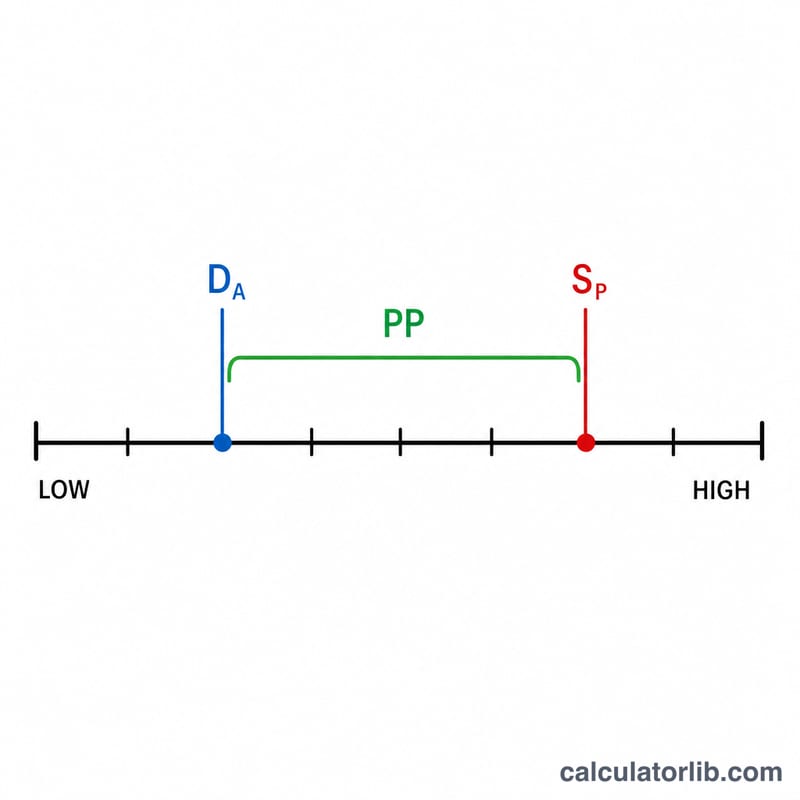
Pulse pressure is the difference between your systolic blood pressure (the top number, measured when the heart beats) and your diastolic blood pressure (the bottom number, measured when the heart rests between beats). It is reported in millimetres of mercury (mmHg) and reflects the force your heart generates with each contraction. A healthy resting pulse pressure for most adults falls between roughly 40 and 60 mmHg.
How to Use This Calculator
Enter your systolic reading and your diastolic reading from a blood pressure measurement, then read off your pulse pressure. The tool also estimates your mean arterial pressure (MAP) and labels whether your pulse pressure is low, normal, or high. This is an educational tool and is not a substitute for professional medical advice.
The Formula Explained
The calculation is simply Pulse Pressure = Systolic − Diastolic.
$$\text{PP} = \text{Systolic (mmHg)} - \text{Diastolic (mmHg)}$$For example, a reading of 120/80 mmHg gives a pulse pressure of \(120 - 80 = 40\) mmHg. The estimated mean arterial pressure uses MAP ≈ Diastolic + ⅓ × (Systolic − Diastolic), weighting the longer diastolic phase of the heartbeat.
$$\text{MAP} = \text{Diastolic (mmHg)} + \frac{\text{Systolic (mmHg)} - \text{Diastolic (mmHg)}}{3}$$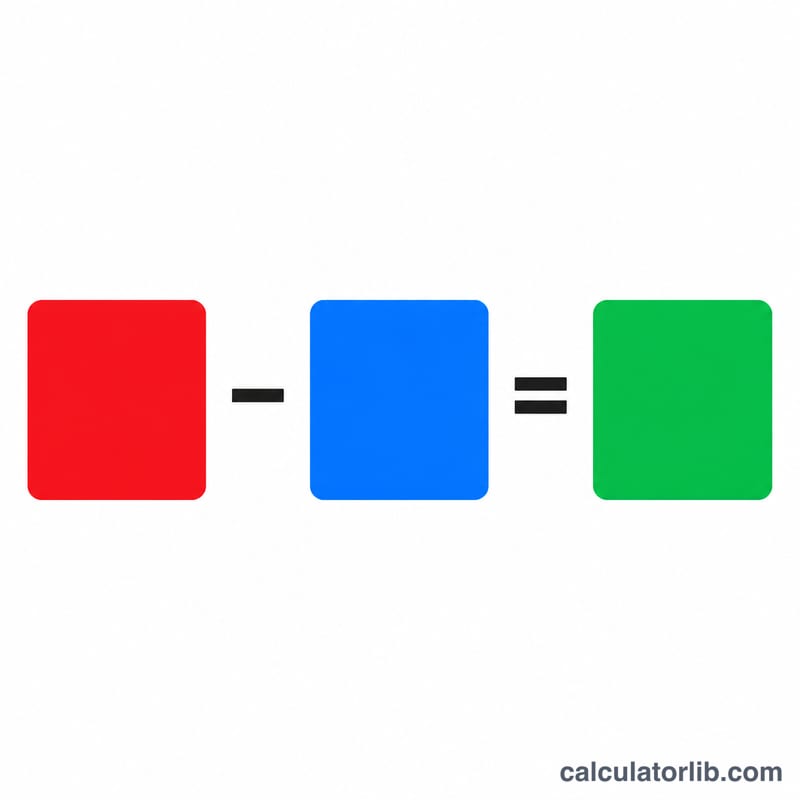
Worked Example
Suppose your blood pressure is 140/85 mmHg. Pulse pressure = \(140 - 85 = 55\) mmHg, which is within the normal range. The estimated MAP = \(85 + (55 \div 3) \approx 103.3\) mmHg.
FAQ
What does a high pulse pressure mean? A pulse pressure above about 60 mmHg ("wide" pulse pressure) can indicate stiffening of the large arteries and may be associated with increased cardiovascular risk.
What does a low pulse pressure mean? A pulse pressure below about 40 mmHg ("narrow") may occur with conditions that reduce stroke volume, such as heart failure or significant blood loss.
Is pulse pressure the same as heart rate? No. Heart rate counts beats per minute, while pulse pressure measures the pressure difference within each beat.