What Is the HbA1c to Average Glucose Calculator?
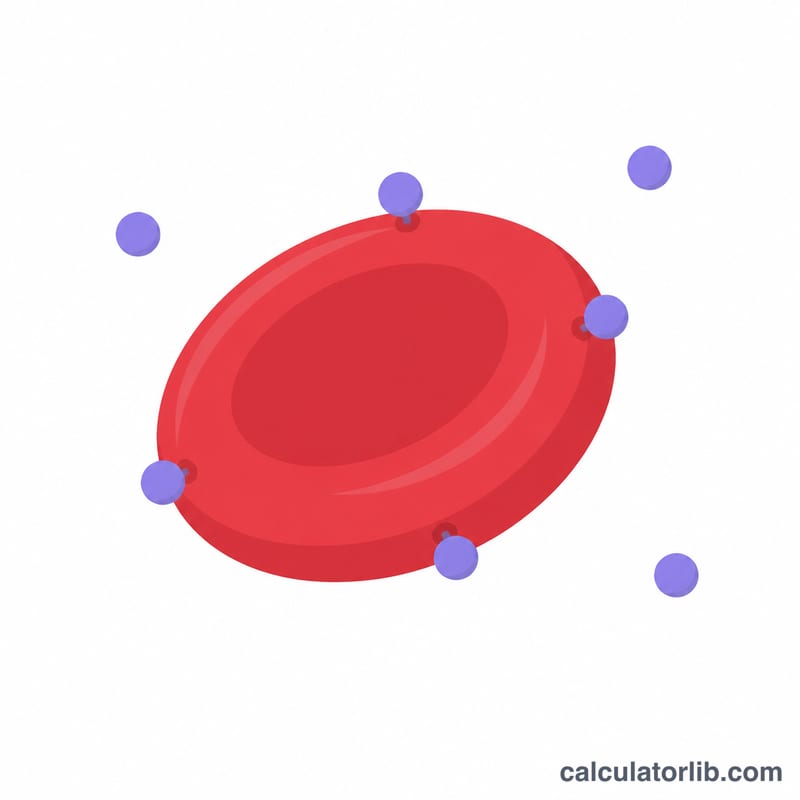
This tool converts a glycated hemoglobin (HbA1c) percentage into an estimated average glucose (eAG) level, expressed in both mg/dL and mmol/L. HbA1c reflects your average blood sugar over the previous 2–3 months, while eAG translates that percentage into the more familiar daily glucose meter units. This is a universal medical conversion based on the international ADAG (A1c-Derived Average Glucose) study and is not specific to any country.
How to Use It
Enter your HbA1c value as a percentage (for example, 7 for 7%). The calculator instantly returns your estimated average glucose in mg/dL and the equivalent in mmol/L. Typical HbA1c values range from about 4% (normal) up to 14% or higher in poorly controlled diabetes.
The Formula Explained
The conversion uses the linear regression derived from the ADAG study:
$$\text{eAG}_{\text{mg/dL}} = 28.7 \times \text{HbA1c (\%)} - 46.7$$To express the result in mmol/L, divide the mg/dL value by 18, since \(1\ \text{mmol/L} \approx 18\ \text{mg/dL}\) of glucose.
$$\text{eAG}_{\text{mmol/L}} = \frac{28.7 \times \text{HbA1c (\%)} - 46.7}{18}$$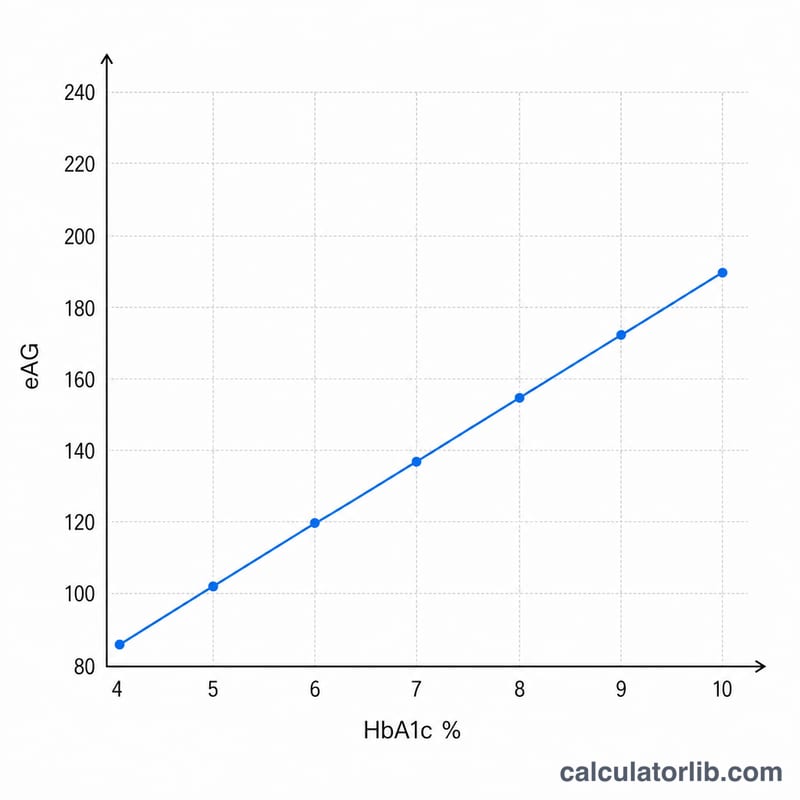
Worked Example
Suppose your HbA1c is 7%. Then \(\text{eAG} = 28.7 \times 7 - 46.7 = 200.9 - 46.7 = 154.2\ \text{mg/dL}\). Dividing by 18 gives about \(8.57\ \text{mmol/L}\). So an HbA1c of 7% corresponds to an average glucose of roughly 154 mg/dL (8.6 mmol/L).
HbA1c to eAG Conversion Chart
This chart uses the ADAG (A1c-Derived Average Glucose) formula: \(\text{eAG}_{\text{mg/dL}} = 28.7 \times \text{HbA1c} - 46.7\). The mmol/L value is the mg/dL value divided by 18. Values are rounded to one decimal place.
| HbA1c (%) | eAG (mg/dL) | eAG (mmol/L) |
|---|---|---|
| 5.0 | 96.8 | 5.4 |
| 5.5 | 111.2 | 6.2 |
| 6.0 | 125.5 | 7.0 |
| 6.5 | 139.9 | 7.8 |
| 7.0 | 154.2 | 8.6 |
| 7.5 | 168.6 | 9.4 |
| 8.0 | 182.9 | 10.2 |
| 9.0 | 211.6 | 11.8 |
| 10.0 | 240.3 | 13.3 |
| 11.0 | 269.0 | 14.9 |
| 12.0 | 297.7 | 16.5 |
Example: for an HbA1c of 7%, \(28.7 \times 7 - 46.7 = 200.9 - 46.7 = 154.2\) mg/dL, and \(154.2 \div 18 \approx 8.6\) mmol/L.
Interpreting Your HbA1c and eAG Result
The American Diabetes Association (ADA) diagnostic categories for HbA1c in adults are shown below, with the corresponding eAG from the ADAG formula. These categories are used in the United States and in many other countries, but local guidelines and units can differ.
| Category | HbA1c | Approximate eAG |
|---|---|---|
| Normal | Below 5.7% | Below about 117 mg/dL (6.5 mmol/L) |
| Prediabetes | 5.7% to 6.4% | About 117 to 137 mg/dL (6.5 to 7.6 mmol/L) |
| Diabetes | 6.5% or higher | About 140 mg/dL (7.8 mmol/L) or higher |
- Time frame: HbA1c reflects average blood glucose over roughly the past 2 to 3 months, weighted toward the most recent weeks. It does not show day-to-day swings, highs, or lows.
- It is an estimate: The ADAG formula comes from a regression of data from a study population. Your actual average glucose, for example from continuous glucose monitoring, can differ from the eAG.
- Factors that affect accuracy: Anemia, hemoglobin variants (hemoglobinopathies such as sickle cell trait), recent blood loss or transfusion, and chronic kidney disease can make HbA1c read falsely high or low. Pregnancy and some medications can also affect it.
- Diagnosis: A diagnosis of diabetes normally requires confirmatory testing, such as a repeat test or a different test (fasting glucose or an oral glucose tolerance test), unless symptoms and clearly elevated glucose are present.
This is general educational information, not medical advice. Targets and the meaning of any result depend on individual circumstances, so discuss your results with a qualified healthcare professional.
FAQ
Is eAG the same as a single glucose reading? No. eAG is an estimate of your average glucose over months, not your current reading at any moment.
Why does my meter average differ from eAG? Meter averages depend on when you test. eAG estimates a true 24-hour average across all times of day, so the two can differ.
Can I rely on this for diagnosis? This calculator is for educational purposes only. Always consult a healthcare professional for diagnosis and treatment decisions.