
What is the eAG Calculator?
The Estimated Average Glucose (eAG) calculator translates a lab HbA1c result, normally reported as a percentage, into an average blood glucose value expressed in the same units you see on a home glucose meter — mg/dL or mmol/L. This makes the long-term marker easier to relate to your day-to-day readings.
How to use it
Enter your most recent HbA1c percentage (for example 7) and the calculator instantly returns your estimated average glucose. Most lab reports list HbA1c between roughly 4% (non-diabetic) and 14% or higher (poorly controlled diabetes).
The formula explained
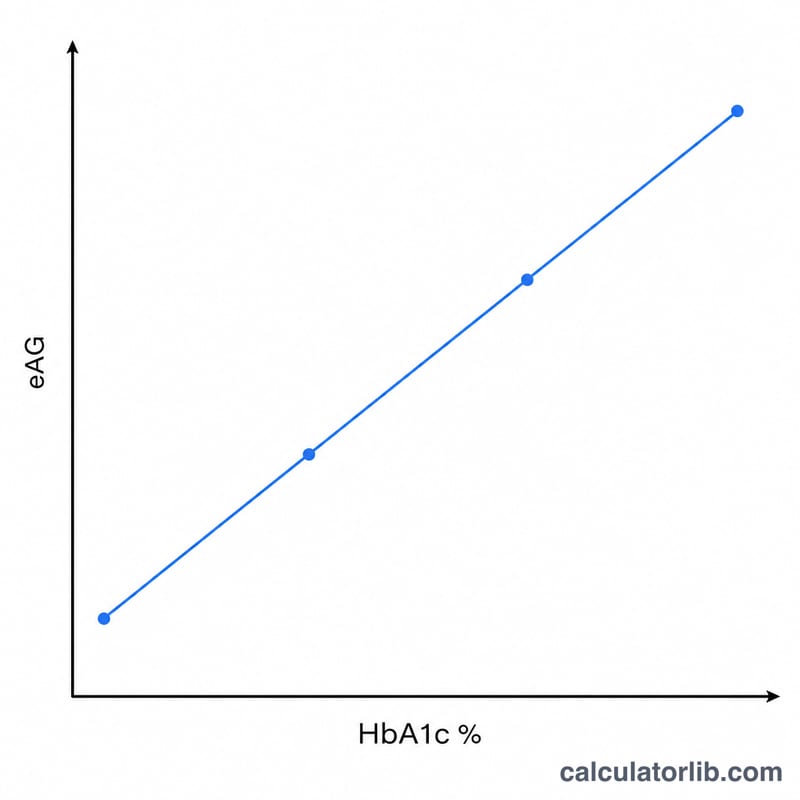
The calculator uses the linear regression equations from the international A1c-Derived Average Glucose (ADAG) study:
$$\text{eAG}_{\text{mg/dL}} = 28.7 \times \text{HbA1c (\%)} - 46.7$$$$\text{eAG}_{\text{mmol/L}} = 1.59 \times \text{HbA1c (\%)} - 2.59$$These relationships hold across the clinically relevant HbA1c range and are endorsed by the American Diabetes Association.
Worked example
Suppose your HbA1c is 7.0%. Then $$\text{eAG} = 28.7 \times 7 - 46.7 = 200.9 - 46.7 = 154.2 \text{ mg/dL},$$ or $$1.59 \times 7 - 2.59 = 11.13 - 2.59 = 8.54 \text{ mmol/L}.$$ An HbA1c of 7% therefore corresponds to an average glucose of about 154 mg/dL (8.5 mmol/L).
FAQ
Is eAG the same as a single glucose reading? No. eAG represents an estimated average over roughly 2–3 months, not a momentary value.
Why does my meter average differ from eAG? Meter averages depend on when you test; eAG reflects 24-hour glucose exposure including overnight periods.
Should I change treatment based on this? No. Use this as an educational guide and discuss any changes with your healthcare provider.