
What Is the VLDL Cholesterol Calculator?
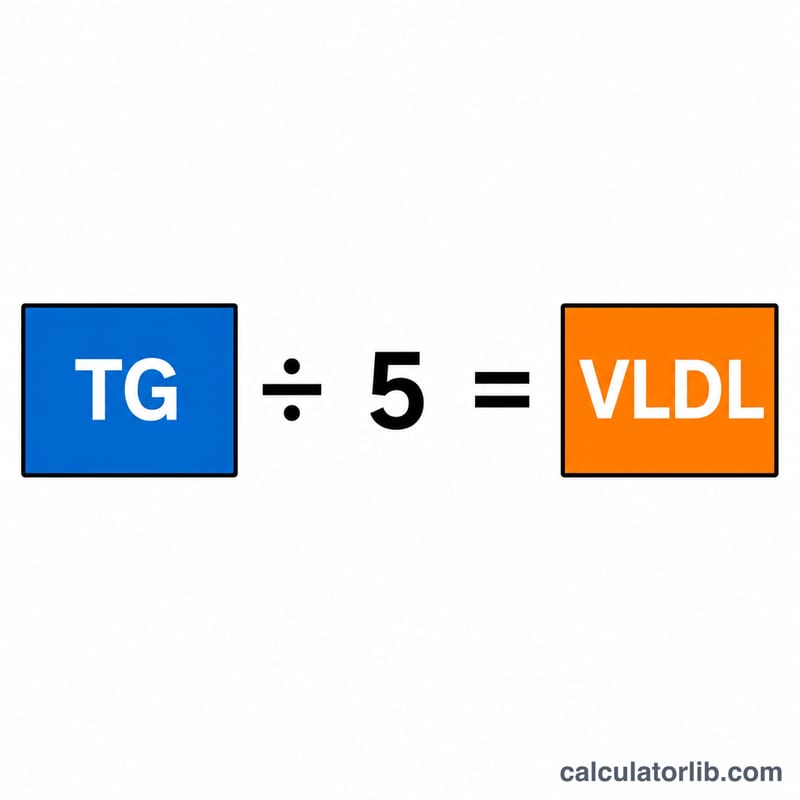
Very-low-density lipoprotein (VLDL) is a type of cholesterol-carrying particle that transports triglycerides through the bloodstream. Because measuring VLDL directly is expensive, most lipid panels estimate it from triglycerides. This calculator applies the widely used rule from the Friedewald equation: VLDL equals your triglyceride level divided by 5 (in mg/dL).
How to Use It
Enter your fasting triglyceride value in mg/dL — the number reported on a standard lipid panel — and the calculator instantly returns your estimated VLDL cholesterol. The estimate is most reliable when triglycerides are below 400 mg/dL; above that level the divide-by-5 method becomes inaccurate and a direct measurement is recommended.
The Formula Explained
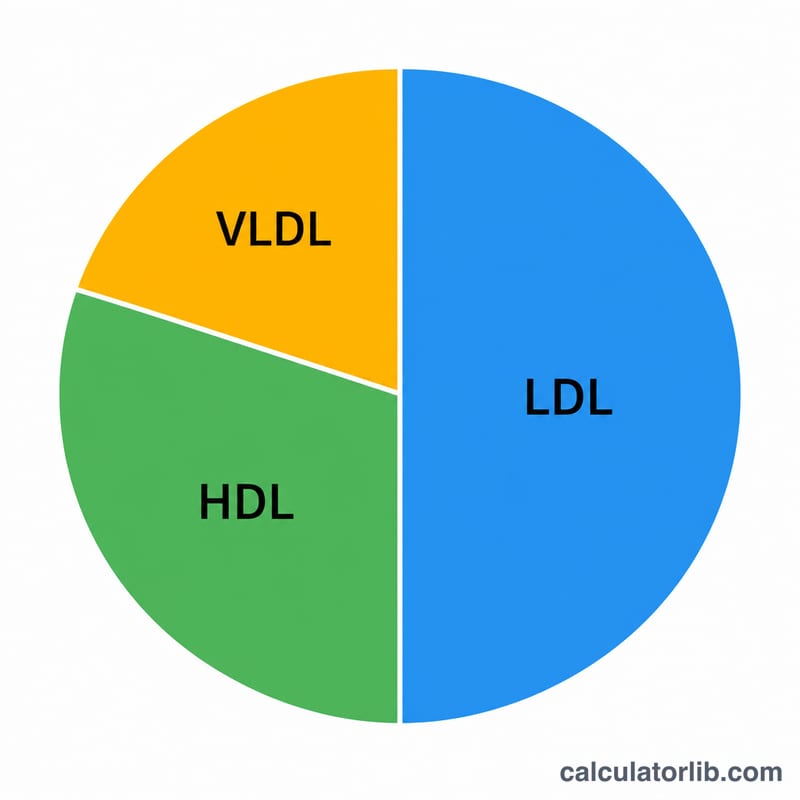
The relationship is simple: $$\text{VLDL} = \frac{\text{Triglycerides (mg/dL)}}{5}$$ This works because, on average, VLDL particles carry triglycerides and cholesterol in roughly a 5:1 ratio. Dividing triglycerides by 5 therefore gives a good approximation of the cholesterol carried in VLDL particles. The same VLDL value feeds into LDL estimates, where \(\text{LDL} = \text{Total Cholesterol} - \text{HDL} - \text{VLDL}\).
Worked Example
Suppose your fasting triglycerides measure 150 mg/dL. Then $$\text{VLDL} = \frac{150}{5} = 30 \text{ mg/dL}.$$ A triglyceride reading of 200 mg/dL would give \(\text{VLDL} = 40\) mg/dL.
FAQ
What is a normal VLDL level? A normal VLDL range is roughly 2–30 mg/dL. Higher values are associated with increased cardiovascular risk.
Does this work above 400 mg/dL triglycerides? No. The divide-by-5 estimate loses accuracy above 400 mg/dL; ask for a direct VLDL measurement instead.
Should I fast before the test? Yes. Triglycerides — and therefore VLDL — are best measured after a 9–12 hour fast for accuracy.