
What Is the Aortic Valve Area Calculator?
This tool estimates the aortic valve area (AVA) using the echocardiographic continuity equation, a cornerstone method for grading aortic stenosis severity. By conserving stroke volume across the left ventricular outflow tract (LVOT) and the aortic valve, it derives the effective orifice area without requiring invasive catheterization. This calculator is intended for clinicians, sonographers, and students; it is an educational aid and does not replace clinical judgment.
How to Use It
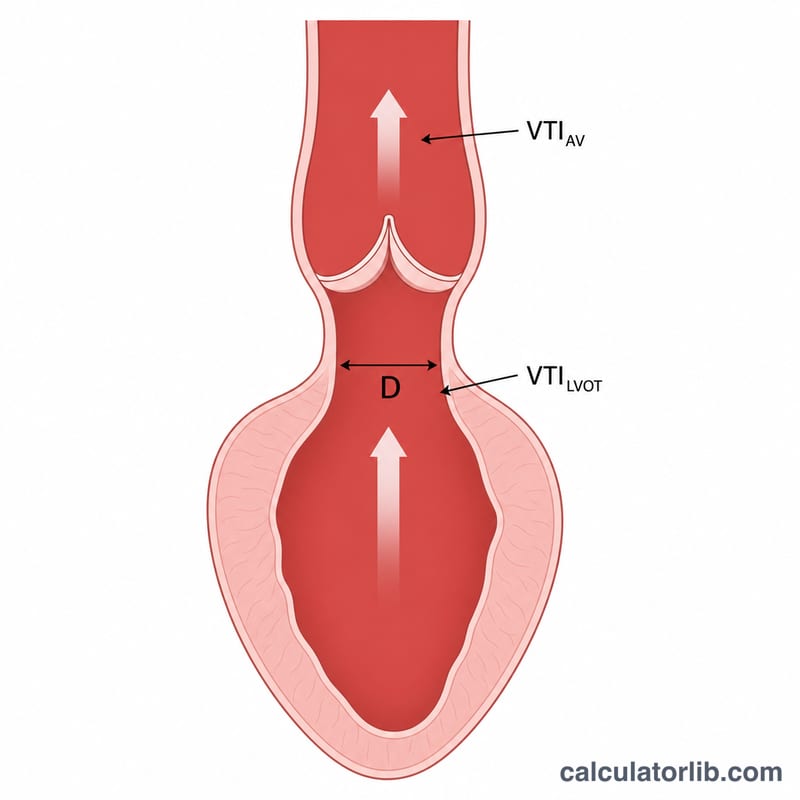
Enter three Doppler echocardiography measurements: the LVOT diameter (cm, measured in the parasternal long-axis view), the LVOT velocity-time integral (VTI) (cm, from pulsed-wave Doppler), and the aortic valve VTI (cm, from continuous-wave Doppler). The calculator returns the aortic valve area in cm², along with the intermediate LVOT area and stroke volume.
The Formula Explained
The continuity equation assumes the volume of blood passing through the LVOT equals the volume crossing the aortic valve. Stroke volume = cross-sectional area × VTI. The LVOT is modeled as a circle, so its area is \(0.785 \times \text{diameter}^2\) (where \(0.785 \approx \pi/4\)). Rearranging gives
$$\text{AVA} = \frac{\dfrac{\pi}{4}\,\text{LVOT Diam}^{2} \times \text{LVOT VTI}}{\text{AV VTI}}$$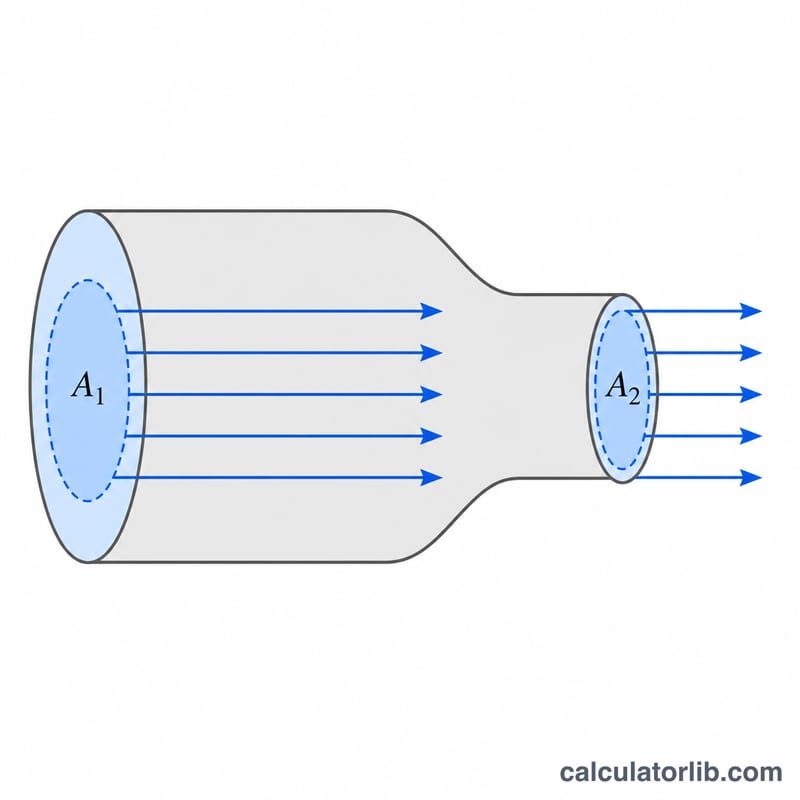
Worked Example
For an LVOT diameter of 2.0 cm, LVOT VTI of 20 cm, and aortic valve VTI of 80 cm: LVOT area = \(0.785 \times 2.0^{2} = 3.14\) cm²; stroke volume = \(3.14 \times 20 = 62.8\) cm³; AVA = \(62.8 \div 80 = 0.785\) cm². An area below 1.0 cm² typically indicates severe aortic stenosis.
Aortic Stenosis Severity Grading
The continuity-equation aortic valve area (AVA) is interpreted alongside Doppler-derived velocity and gradient measurements. The cutoffs below follow the ACC/AHA and American Society of Echocardiography (ASE) recommendations for grading native aortic stenosis severity.
| Parameter | Mild | Moderate | Severe |
|---|---|---|---|
| Aortic valve area (AVA) | > 1.5 cm² | 1.0 – 1.5 cm² | < 1.0 cm² |
| Indexed AVA | > 0.85 cm²/m² | 0.60 – 0.85 cm²/m² | < 0.6 cm²/m² |
| Mean transvalvular gradient | < 20 mmHg | 20 – 40 mmHg | > 40 mmHg |
| Peak aortic jet velocity | 2.6 – 2.9 m/s | 3.0 – 4.0 m/s | > 4.0 m/s |
| Velocity ratio (DVI) | > 0.50 | 0.25 – 0.50 | < 0.25 |
An aortic sclerosis (thickened but non-obstructive valve) typically shows a peak velocity < 2.6 m/s. Severe AS is generally defined by an AVA < 1.0 cm², a mean gradient > 40 mmHg, and a peak velocity > 4.0 m/s; very severe AS is sometimes cited at a peak velocity > 5.0 m/s or mean gradient > 60 mmHg.
Key Terms & Variables
- LVOT (left ventricular outflow tract)
- The region of the left ventricle just below the aortic valve through which blood passes during ejection.
- LVOT diameter
- The internal diameter of the outflow tract, measured in centimeters from the parasternal long-axis view in mid-systole. It is used to compute the LVOT cross-sectional area, \(\frac{\pi}{4}\,d^2\).
- VTI (velocity–time integral)
- The area under the Doppler velocity envelope over one cardiac cycle, expressed in centimeters. It represents the distance (stroke distance) a column of blood travels per beat at that location.
- Pulsed-wave (PW) Doppler
- A Doppler mode that samples blood velocity at a specific, user-selected depth — used to record the LVOT VTI proximal to the valve. It has limited maximum measurable velocity.
- Continuous-wave (CW) Doppler
- A Doppler mode that measures the highest velocity along the entire beam — used to record the high-velocity aortic valve VTI across the stenotic valve without aliasing.
- Stroke volume (SV)
- The volume of blood ejected per beat; at the LVOT it equals cross-sectional area × LVOT VTI. The continuity equation assumes this same stroke volume passes through the valve.
- AVA (aortic valve area)
- The effective orifice area of the aortic valve, in cm². Smaller areas indicate more severe stenosis.
- Continuity equation
- Conservation of flow stating that LVOT area × LVOT VTI = AVA × AV VTI, rearranged to solve for AVA = (LVOT area × LVOT VTI) ÷ AV VTI.
- Indexed AVA
- AVA divided by body surface area (cm²/m²), which adjusts for body size; < 0.6 cm²/m² supports severe stenosis. The BSA used for indexing can be computed from height and weight with a body surface area calculator.
FAQ
What is a normal aortic valve area? A normal AVA is roughly 3–4 cm². Severe aortic stenosis is generally defined as an area below 1.0 cm².
Why square the LVOT diameter? Because the outflow tract is treated as a circular cross-section, area scales with the square of the diameter — small measurement errors are therefore amplified.
Why divide by aortic valve VTI? The narrower stenotic valve speeds up blood flow, so a higher AV VTI relative to the LVOT VTI yields a smaller calculated valve area.