
What is the ECG Boxes to Seconds Calculator?
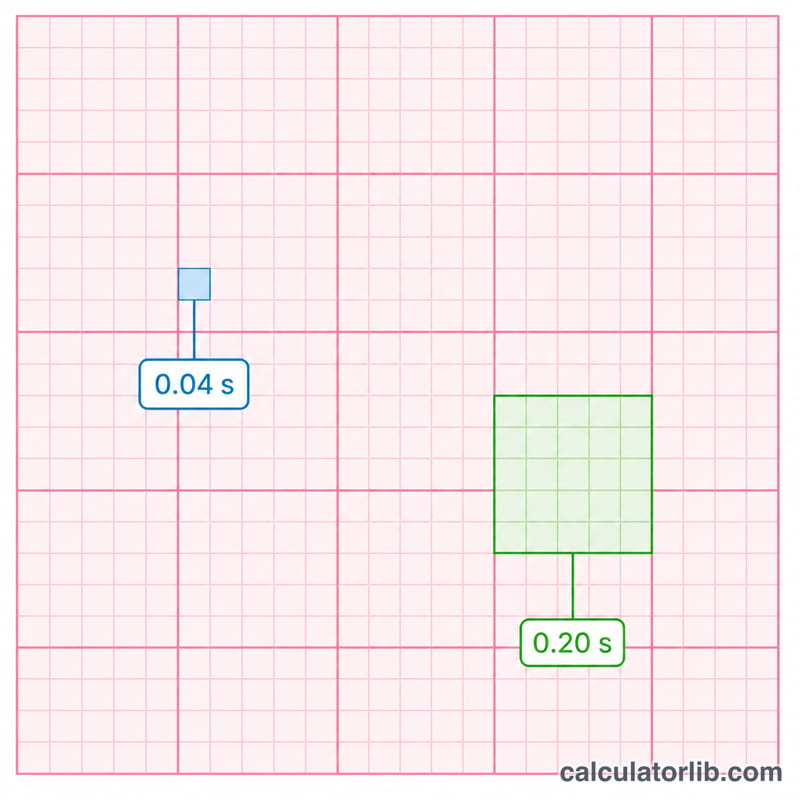
On standard ECG (electrocardiogram) paper running at 25 mm/s, each small box (1 mm) represents 0.04 seconds and each large box (5 mm) represents 0.20 seconds. This calculator converts a measured number of small or large boxes into a precise time duration in seconds and milliseconds, and gives the equivalent heart rate when the interval represents one R-R cycle.
How to use it
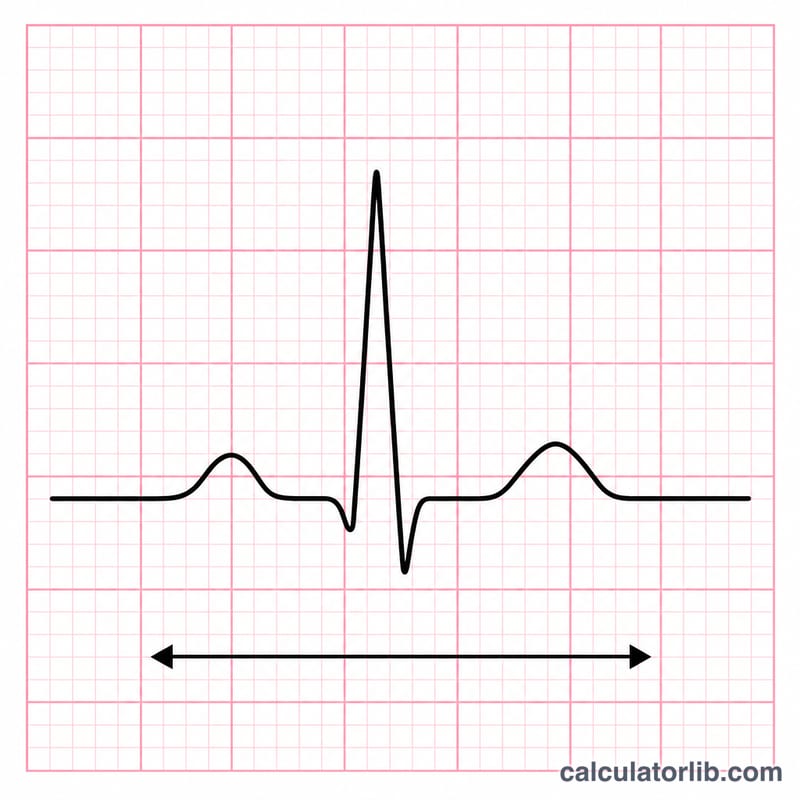
Count the boxes spanning the interval you want to measure (for example a QRS complex, QT interval, or one R-R interval). Enter the number of small boxes or the number of large boxes — if you only know large boxes, leave small boxes blank. Choose the paper speed (25 mm/s is standard worldwide; 50 mm/s doubles the resolution). The tool returns the duration and the corresponding rate.
The formula
$$\text{Time (s)} = \text{small\_boxes} \times \left( \frac{1}{\text{paper\_speed}} \right)$$ Since one large box equals five small boxes, large_boxes are first converted: \(\text{small\_total} = \text{large\_boxes} \times 5\). At 25 mm/s this gives 0.04 s per small box and 0.20 s per large box. $$\text{Heart rate (bpm)} = \frac{60}{\text{time in seconds}}$$
Worked example
Suppose an R-R interval spans 4 large boxes at 25 mm/s. Convert: \(4 \times 5 = 20\) small boxes. Duration $$= 20 \times 0.04 = 0.80 \text{ s} \ (800 \text{ ms})$$ Heart rate $$= \frac{60}{0.80} = 75 \text{ bpm}$$ — a normal resting rate.
FAQ
How many seconds is one small box? 0.04 s at 25 mm/s, or 0.02 s at 50 mm/s.
How many seconds is one large box? 0.20 s at 25 mm/s, or 0.10 s at 50 mm/s.
Why does paper speed matter? Faster paper spreads the same event over more boxes, so each box represents less time. At 50 mm/s every duration per box is halved.