
What this calculator does
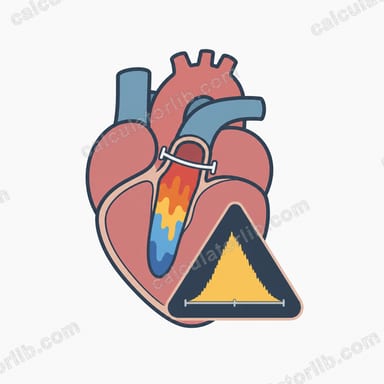
This tool estimates stroke volume (SV) and cardiac output (CO) from standard transthoracic echocardiography (TTE) measurements: the left ventricular outflow tract (LVOT) diameter, the LVOT velocity-time integral (VTI) from pulsed-wave Doppler, and the patient's heart rate. It is widely used in echo labs and critical-care settings to quantify forward flow.
How to use it
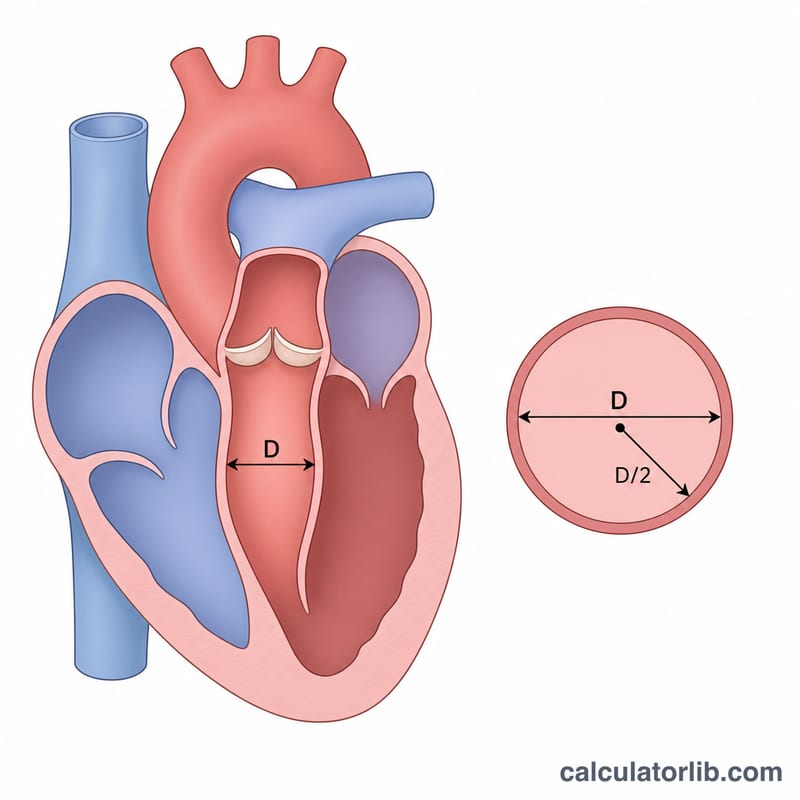
Measure the LVOT diameter in centimetres in the parasternal long-axis view during mid-systole. Obtain the LVOT VTI in centimetres by tracing the pulsed-wave Doppler envelope in the apical 5-chamber view. Enter the heart rate in beats per minute. The calculator returns the LVOT cross-sectional area, stroke volume in millilitres, and cardiac output in litres per minute.
The formula explained
The LVOT is modelled as a circle, so its cross-sectional area is \(\pi/4 \times D^{2} \approx 0.785 \times D^{2}\). Multiplying area by the VTI (the distance blood travels per beat) gives stroke volume: $$SV = 0.785 \times D^{2} \times VTI$$ Cardiac output is then SV × heart rate, divided by 1000 to convert mL/min into L/min.
$$CO = \frac{0.785 \cdot d^{2} \cdot VTI \cdot HR}{1000}$$ $$\text{where}\quad \left\{ \begin{aligned} d &= \text{LVOT Diameter (cm)} \\ VTI &= \text{LVOT VTI (cm)} \\ HR &= \text{Heart Rate (bpm)} \end{aligned} \right.$$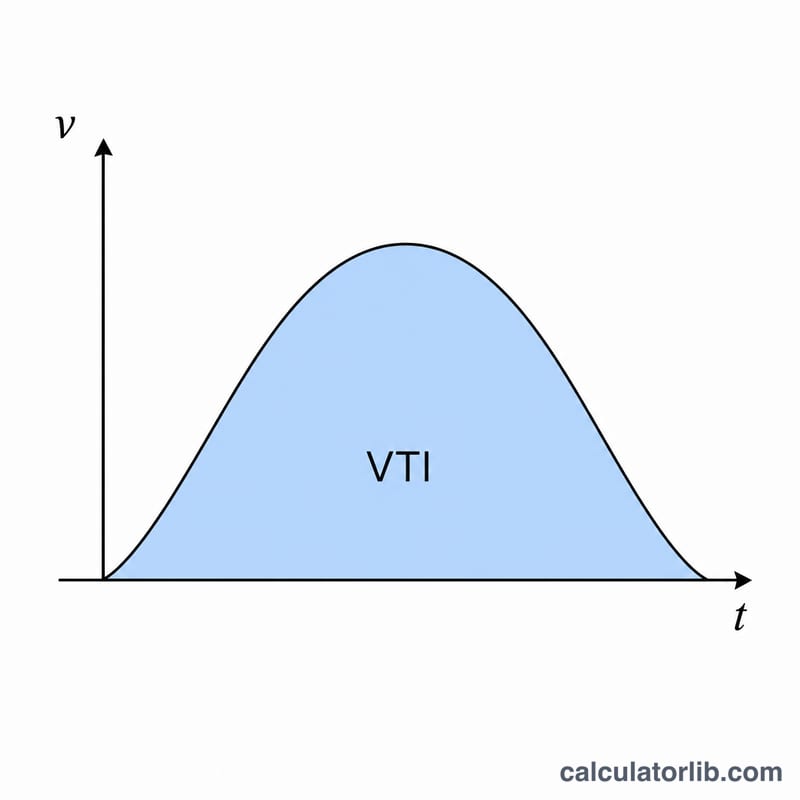
Worked example
For an LVOT diameter of 2.0 cm, VTI of 20 cm, and heart rate of 70 bpm: $$\text{area} = 0.785 \times 2.0^{2} = 3.14 \text{ cm}^{2}$$ $$SV = 3.14 \times 20 = 62.8 \text{ mL}$$ $$CO = 62.8 \times 70 / 1000 = 4.4 \text{ L/min}$$
FAQ
Why is the diameter squared so important? Because area scales with the square of diameter, a small measurement error in LVOT diameter is the largest source of error in the result.
What is a normal cardiac output? Roughly 4–8 L/min for a resting adult, though this varies with body size.
Is this a substitute for clinical judgement? No. This is an educational estimate; clinical decisions require a qualified clinician.