
What Is the Cardiac Index?
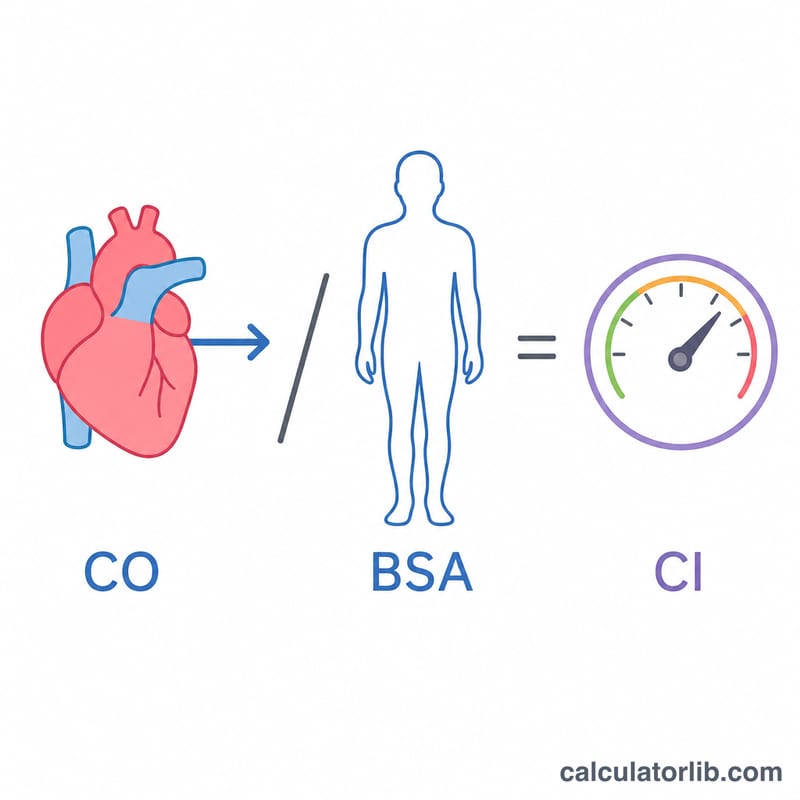
The cardiac index (CI) is a hemodynamic measurement that relates a person's cardiac output to their body size. By dividing cardiac output (the volume of blood the heart pumps per minute) by body surface area (BSA), clinicians obtain a value normalized for body size, allowing meaningful comparison between patients of different statures. Cardiac index is expressed in liters per minute per square meter (L/min/m²).
How to Use This Calculator
Enter the cardiac output in liters per minute (typically measured by thermodilution, Fick method, or echocardiography) and the body surface area in square meters (commonly derived from the Du Bois or Mosteller formula). The calculator instantly divides cardiac output by BSA to return the cardiac index.
The Formula Explained
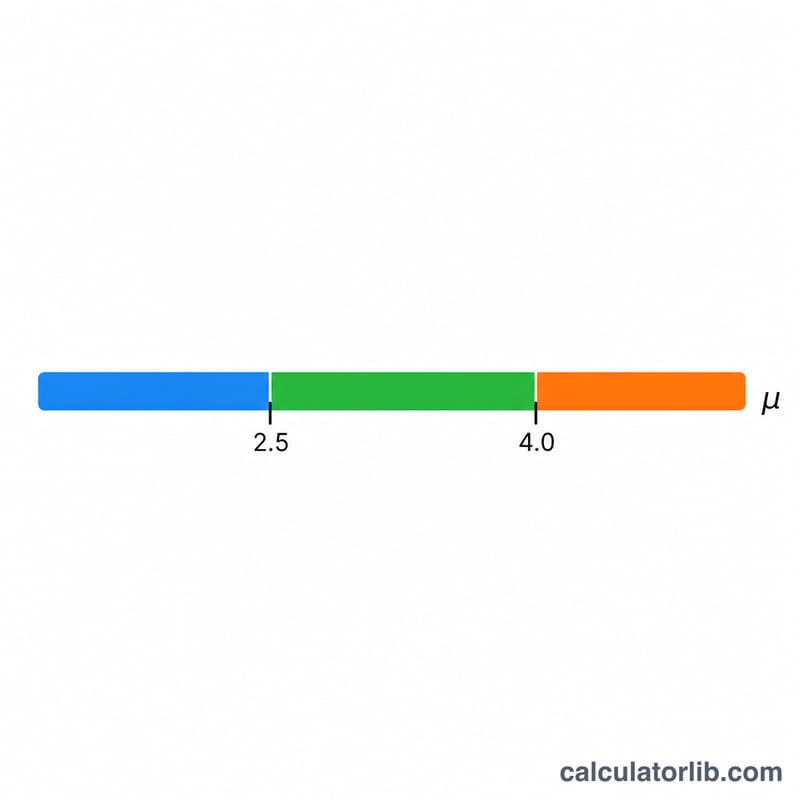
$$\text{CI} = \frac{\text{Cardiac Output (L/min)}}{\text{BSA (m}^2\text{)}}$$ For example, a cardiac output of 5 L/min in a patient with a BSA of 1.9 m² gives \(\text{CI} = 5 \div 1.9 \approx 2.63\) L/min/m². A normal resting cardiac index typically ranges from about 2.5 to 4.0 L/min/m². Values below this range may indicate reduced cardiac performance.
Worked Example
Suppose a patient has a cardiac output of 6 L/min and a BSA of 2.0 m². $$\text{CI} = 6 \div 2.0 = 3.0 \text{ L/min/m}^2$$ which falls within the normal range.
FAQ
What is a normal cardiac index? A typical resting value is between 2.5 and 4.0 L/min/m², though reference ranges vary by source and clinical context.
How is body surface area calculated? BSA is usually estimated from height and weight using the Mosteller or Du Bois formula.
Is this a substitute for medical advice? No. This tool is for educational and informational purposes; clinical decisions should be made by qualified healthcare professionals.