
What is the Ponderal Index?
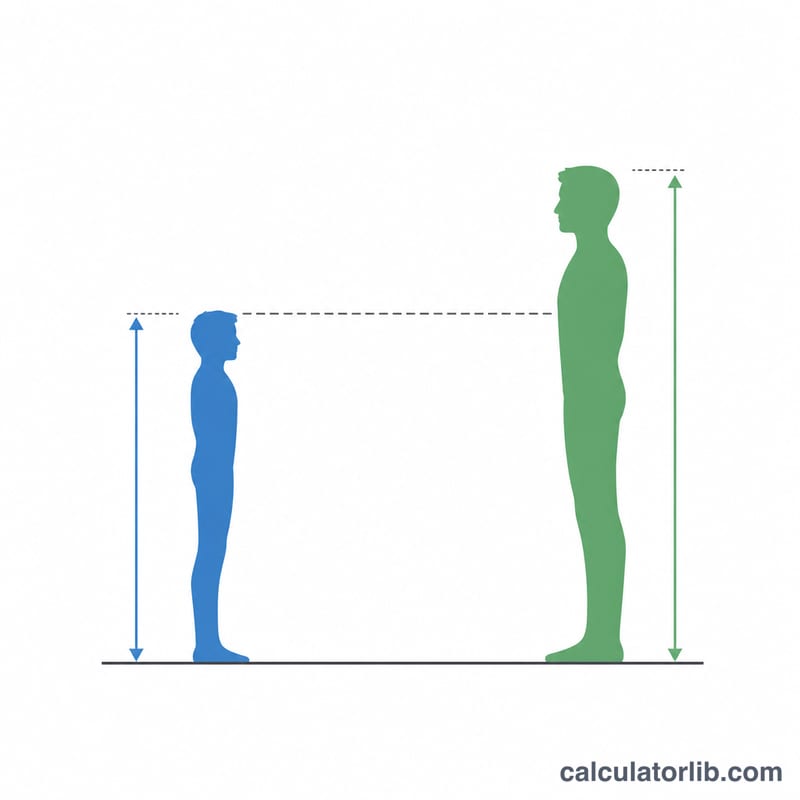
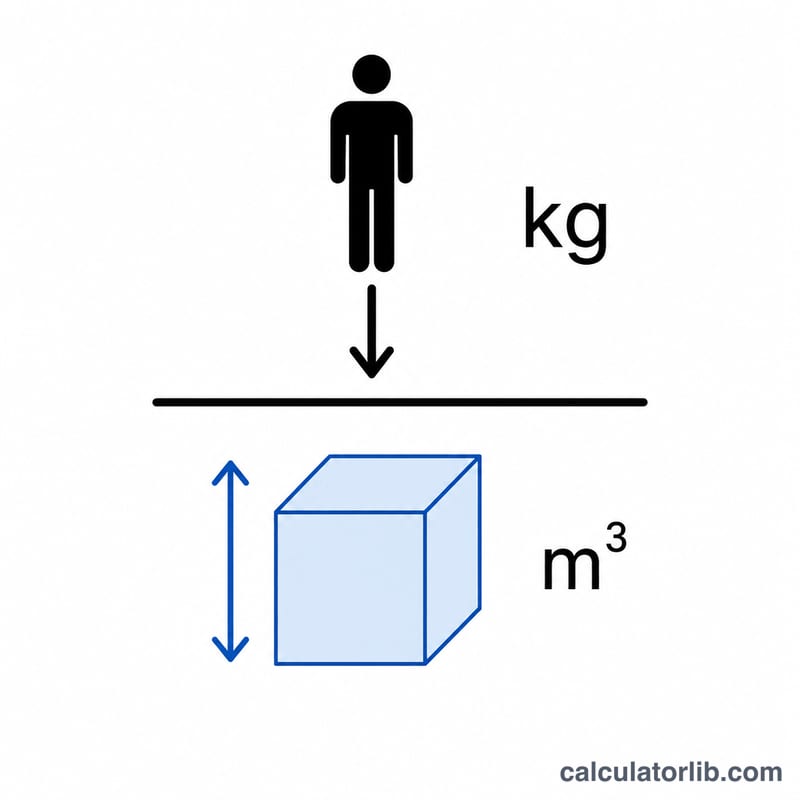
The Ponderal Index (PI), sometimes called the Rohrer Index, is a measure of leanness or corpulence that relates a person's mass to their height. Unlike the Body Mass Index (BMI), which divides mass by height squared, the Ponderal Index divides mass by height cubed. This cubic relationship makes it more reliable across people of very different heights, since BMI tends to overstate fatness in tall people and understate it in short people.
How to use this calculator
Enter your body mass in kilograms and your height in centimetres. The calculator converts your height to metres, cubes it, and divides your mass by the result. The output is expressed in kilograms per cubic metre (kg/m³). For most adults, a typical Ponderal Index falls roughly between 11 and 14 kg/m³.
The formula explained
The equation is simply $$\text{PI} = \frac{\text{mass}}{\text{height}^{3}}$$ where mass is in kilograms and height is in metres. Because height is cubed, small changes in height have a strong effect on the result, which is exactly what makes the index height-independent in principle.
Worked example
Suppose a person weighs 70 kg and is 175 cm tall. First convert height: \(175\,\text{cm} = 1.75\,\text{m}\). Cube it: \(1.75^{3} = 5.359375\,\text{m}^{3}\). Then divide: $$70 \div 5.359375 \approx 13.06\,\text{kg/m}^{3}.$$ So this person's Ponderal Index is about 13.1.
FAQ
Is the Ponderal Index better than BMI? For people who are unusually tall or short, the Ponderal Index is often considered more accurate because the cubic term better reflects how mass scales with body size.
What is a healthy Ponderal Index? There is no single official cutoff, but values around 11–14 kg/m³ are common for healthy adults. Always interpret it alongside other clinical measures.
Can I use pounds and inches? This calculator uses metric units (kg and cm). Convert imperial measurements first: \(1\,\text{lb} \approx 0.4536\,\text{kg}\) and \(1\,\text{inch} = 2.54\,\text{cm}\).