
What Is the Barthel Index?
The Barthel Index is a widely used ordinal scale that measures a person's performance in activities of daily living (ADL). It rates how independently someone can carry out ten everyday tasks, producing a total score from 0 (completely dependent) to 100 (fully independent). It is commonly used in rehabilitation, stroke care, geriatrics and disability assessment to track functional recovery over time.
The Ten Items
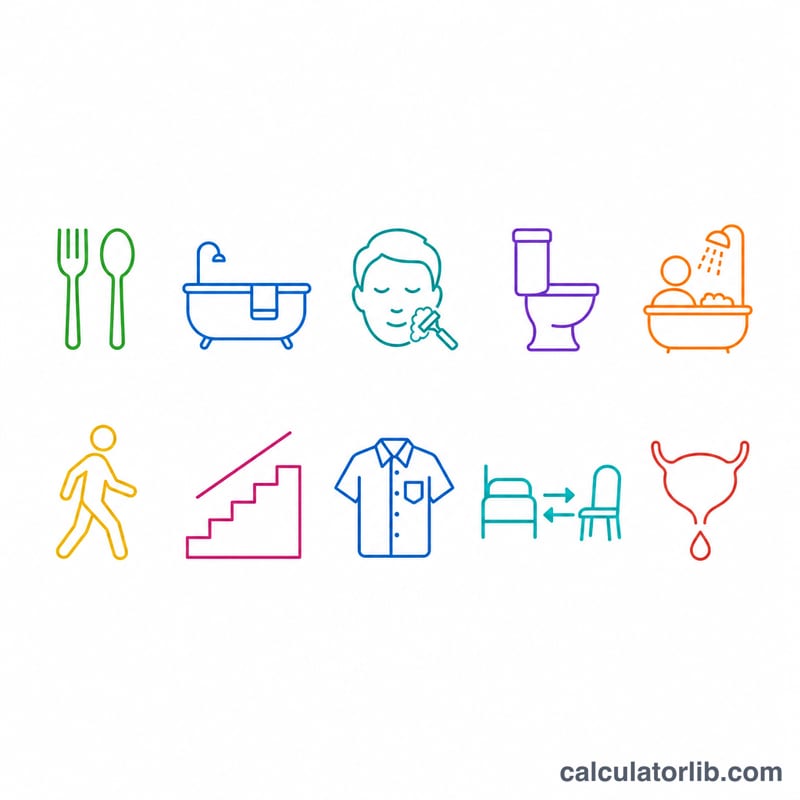
The index scores ten ADLs: feeding (0–10), bathing (0–5), grooming (0–5), dressing (0–10), bowel control (0–10), bladder control (0–10), toilet use (0–10), transfers bed to chair (0–15), mobility on level surfaces (0–15), and stairs (0–10). The maximum possible total is 100.
How to Use This Calculator
For each of the ten items, select the option that best describes the person's current ability. The calculator adds the chosen values and reports the total along with a general dependency category. Higher scores indicate greater independence.
Formula Explained
The score is a simple sum: $$\text{Barthel} = \text{feeding} + \text{bathing} + \text{grooming} + \text{dressing} + \text{bowels} + \text{bladder} + \text{toilet} + \text{transfers} + \text{mobility} + \text{stairs}$$ Each item uses fixed point values, so the result is always between 0 and 100 in increments of 5.
Worked Example
A patient is independent in feeding (10), bathing (5), grooming (5), dressing (10), bowels (10), bladder (10) and toilet use (10), needs minor help with transfers (10), walks with help (10) and needs help on stairs (5). Total = $$10+5+5+10+10+10+10+10+10+5 = \mathbf{85}$$ indicating minimal dependency.
Interpreting Your Barthel Score
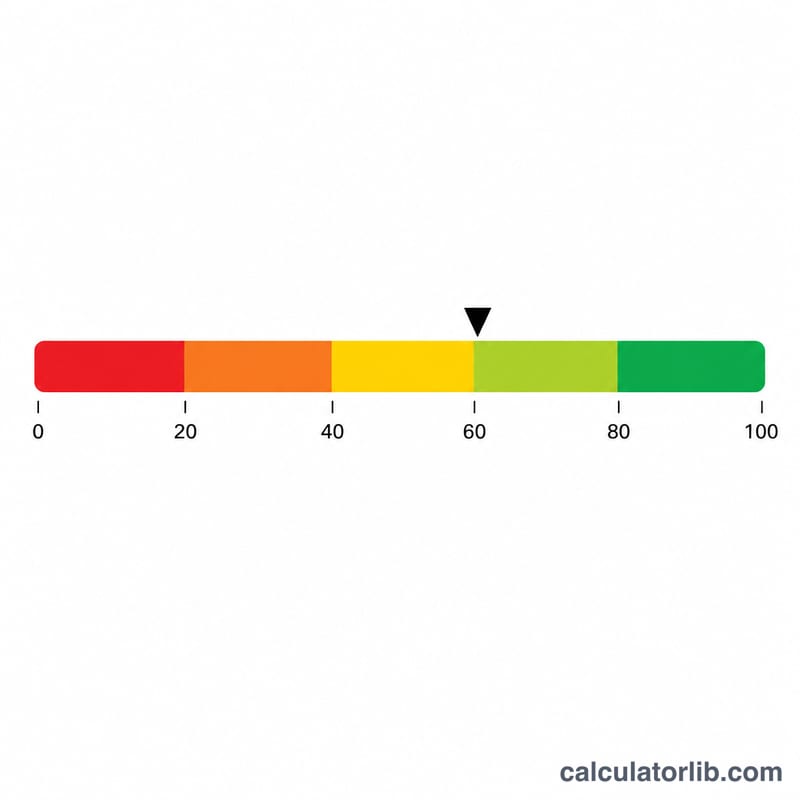
The Barthel Index sums ten activities of daily living into a single score from 0 to 100 (in 5-point increments), where higher totals indicate greater functional independence and lower totals indicate greater dependence on others for everyday self-care. The total is most commonly grouped into five dependency bands:
| Score range | Dependency band | What it reflects functionally |
|---|---|---|
| 0–20 | Total dependency | The person requires assistance for essentially all activities of daily living, including feeding, transfers, and personal hygiene. |
| 21–60 | Severe dependency | Substantial help is needed across most ADL tasks, though some limited self-care may be possible. |
| 61–90 | Moderate dependency | The person manages a number of activities independently but still needs assistance with several tasks, such as bathing, stairs, or transfers. |
| 91–99 | Slight dependency | Largely independent, with help required for only one or two specific tasks. |
| 100 | Independent | The person completes all ten assessed activities without physical assistance (this does not by itself mean a person can live entirely alone). |
For example, a person scoring Feeding 10, Bathing 0, Grooming 5, Dressing 10, Bowels 10, Bladder 5, Toilet 10, Transfers 15, Mobility 10, and Stairs 0 totals 75, placing them in the moderate dependency band.
The Barthel score is a screening and tracking tool, not a diagnosis. Cut-off bands are guides, and the same total can arise from very different combinations of abilities, so the individual item pattern matters as much as the sum. This is general information, not professional medical advice. Interpretation, care planning, and decisions about support belong with qualified clinicians who can assess the whole clinical picture.
FAQ
What does a low score mean? Scores below 20 indicate total dependency, while scores of 80 or above suggest the person is largely independent in daily tasks.
Is the Barthel Index a diagnosis? No. It is a functional assessment tool. It does not diagnose disease but helps quantify and monitor functional ability.
Can it replace clinical judgment? No. It supports care planning and should be interpreted by qualified professionals alongside other clinical information.