
What is the FIB-4 Index?
The Fibrosis-4 (FIB-4) index is a simple, non-invasive scoring tool used to estimate the amount of scarring (fibrosis) in the liver. It combines four routinely available values — patient age, two liver enzymes (AST and ALT), and platelet count — into a single number. Originally developed for patients with viral hepatitis, it is now widely applied to screen for advanced fibrosis in conditions such as non-alcoholic fatty liver disease (NAFLD/MASLD). This tool is for educational use and does not replace clinical judgement.
How to use this calculator
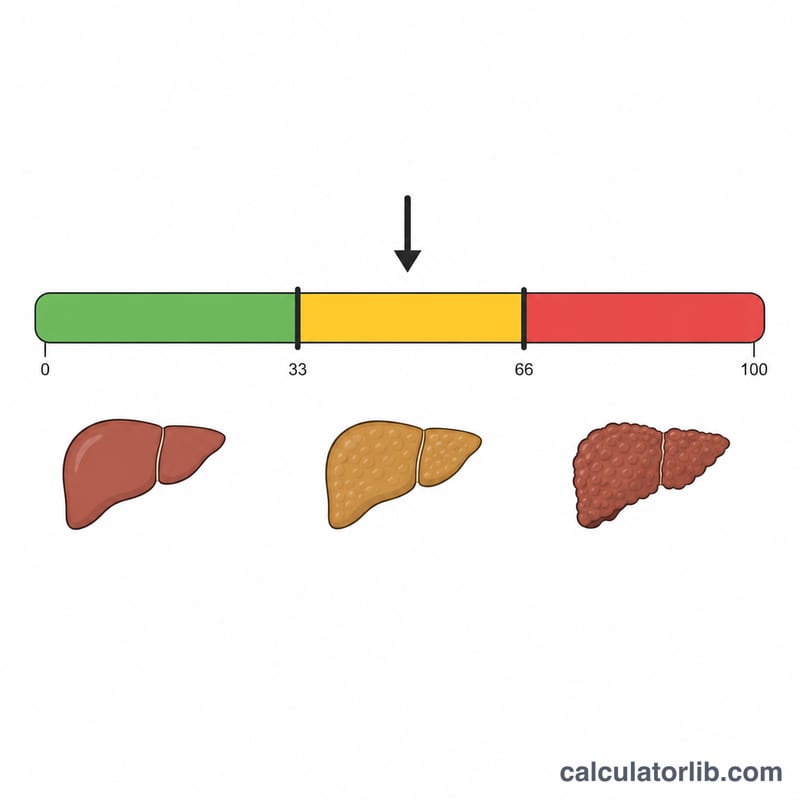
Enter the patient's age in years, the AST and ALT enzyme levels in U/L, and the platelet count in 109/L (the same as ×10³/µL). Press calculate to get the FIB-4 score along with its risk category. Make sure lab values come from the same blood draw for the most meaningful result.
The formula explained
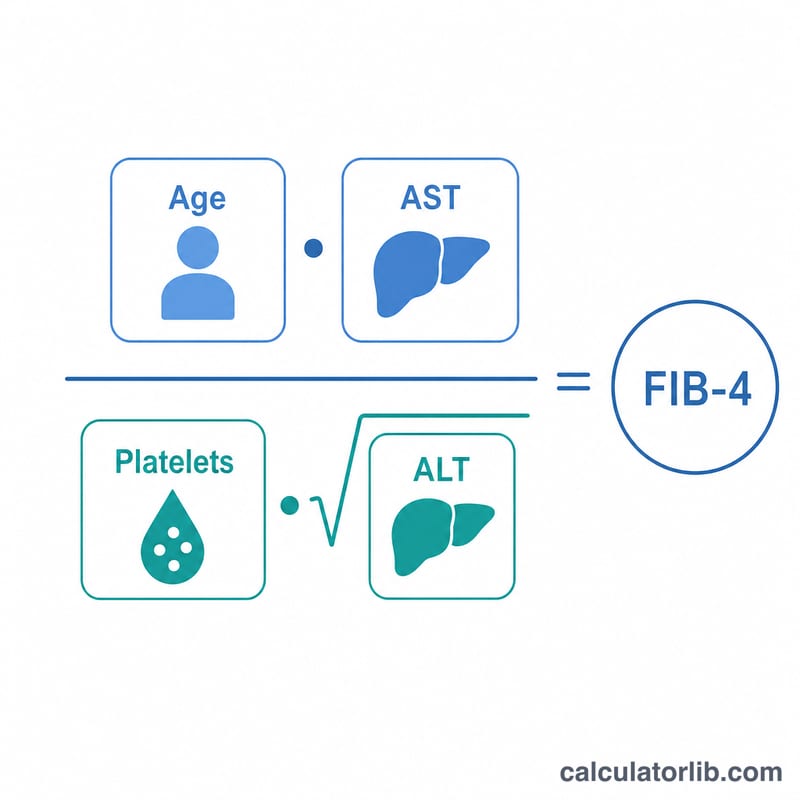
$$\text{FIB-4} = \frac{\text{Age} \times \text{AST}}{\text{Platelets} \times \sqrt{\text{ALT}}}$$ Age and AST raise the score, while higher platelets and ALT lower it. The logic reflects that liver damage tends to raise AST relative to ALT and reduces platelet production, so a higher score signals more likely fibrosis.
Worked example
For a 55-year-old with AST = 40, ALT = 30 and platelets = 150: numerator = \(55 \times 40 = 2200\); denominator = \(150 \times \sqrt{30} = 150 \times 5.4772 = 821.58\); $$\text{FIB-4} = \frac{2200}{821.58} \approx 2.68$$ This falls in the indeterminate range (1.45–3.25), suggesting further evaluation may be warranted.
FAQ
What do the cut-offs mean? A score below 1.45 indicates low risk of advanced fibrosis; above 3.25 indicates high risk; between the two is indeterminate and may need additional testing such as elastography.
Which units should I use? AST and ALT in U/L, platelets in 109/L (×10³/µL), and age in years.
Is FIB-4 a diagnosis? No. It is a screening estimate. Only a clinician can diagnose liver fibrosis, often confirmed with imaging or biopsy.