
What Is the Mentzer Index?
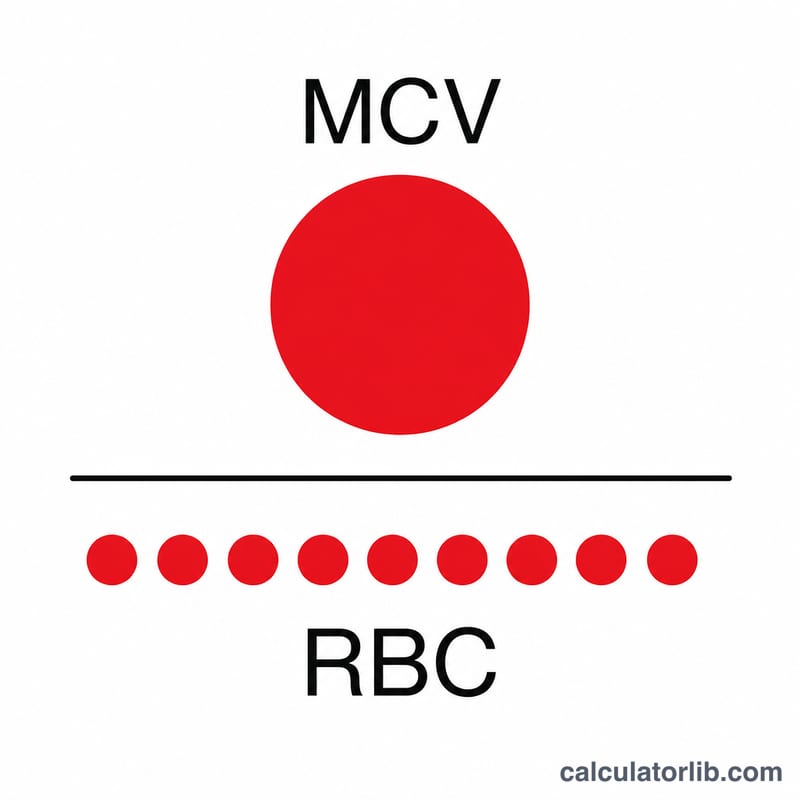
The Mentzer Index is a simple screening ratio used in hematology to help differentiate between beta thalassemia trait and iron deficiency anemia in patients with microcytic anemia. It is calculated by dividing the mean corpuscular volume (MCV) by the red blood cell (RBC) count. Both values come directly from a routine complete blood count (CBC). This tool is a clinical-decision aid, not a diagnosis—always confirm with further testing.
How to Use This Calculator
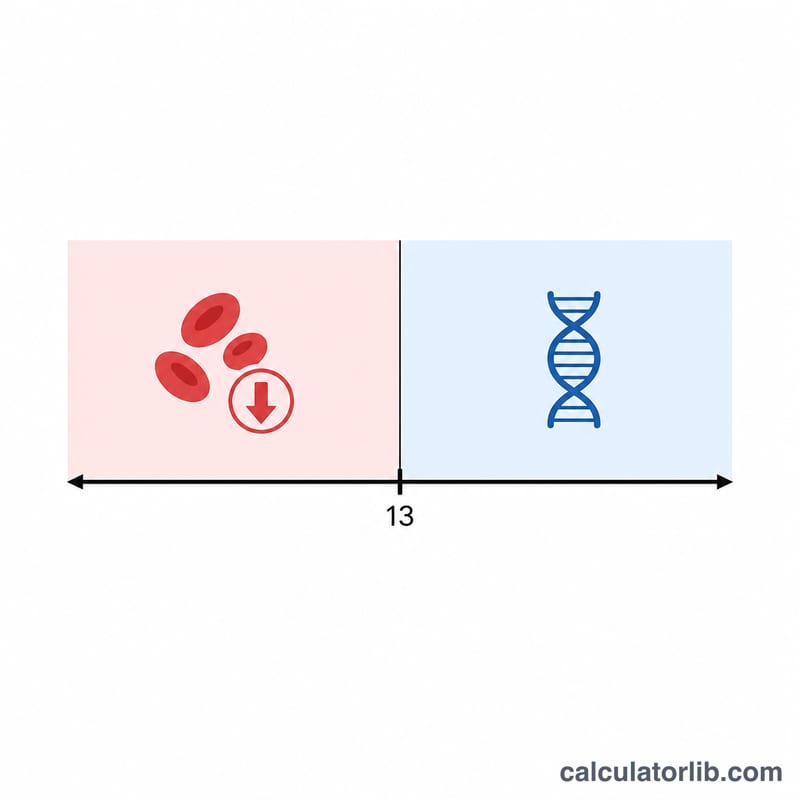
Enter your MCV in femtoliters (fL) and your RBC count in millions per microliter (millions/µL), both taken from your CBC report. The calculator instantly returns the Mentzer Index and a quick interpretation based on the standard cutoff of 13.
The Formula Explained
The equation is simply $$\text{Mentzer Index} = \frac{\text{MCV (fL)}}{\text{RBC (millions/}\mu\text{L)}}$$ The reasoning: in thalassemia trait, the body produces many small red cells, so the RBC count stays relatively high while MCV is low—giving a small ratio. In iron deficiency, the marrow makes fewer cells, lowering the RBC count, so the ratio is larger. The widely used interpretation is: an index below 13 suggests thalassemia trait, while an index above 13 suggests iron deficiency anemia.
Worked Example
Suppose a patient has an MCV of 65 fL and an RBC count of 5.5 million/µL. The Mentzer Index = $$65 \div 5.5 = 11.82$$ Because \(11.82\) is below 13, the result is suggestive of thalassemia trait, warranting hemoglobin electrophoresis for confirmation.
FAQ
Is the Mentzer Index definitive? No. It is a screening guide with imperfect sensitivity and specificity. Borderline values near 13 are especially uncertain and require further workup.
What units should I use? MCV in fL and RBC count in millions/µL (10⁶/µL), as reported on a standard CBC.
Why MCV over RBC and not the reverse? The ratio was defined this way so that the value falls below 13 for thalassemia and above 13 for iron deficiency, giving a single memorable cutoff.