
What Is the Neutrophil-to-Lymphocyte Ratio (NLR)?
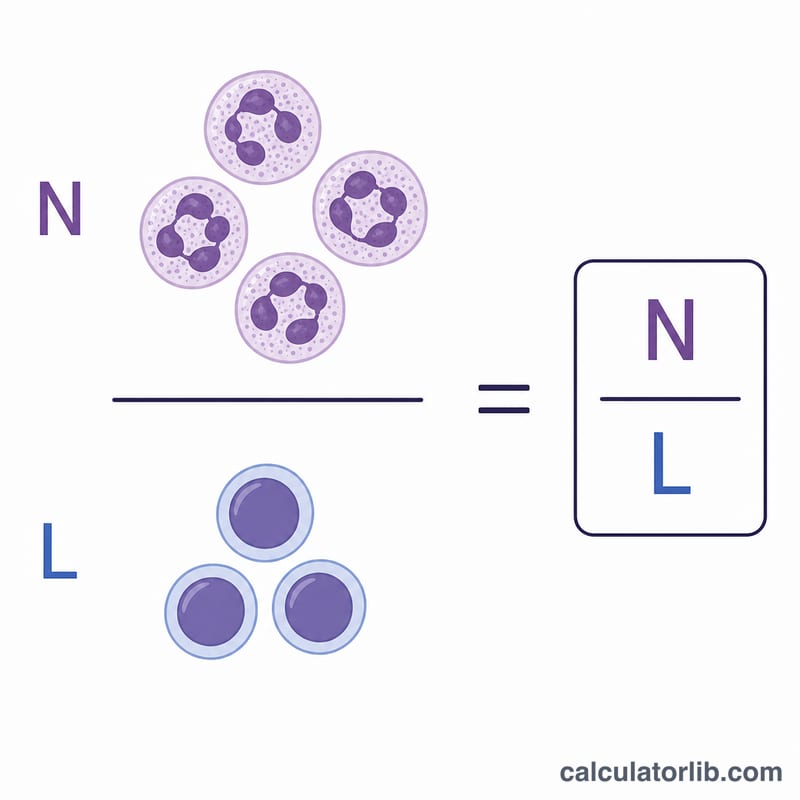
The Neutrophil-to-Lymphocyte Ratio (NLR) is a simple, widely studied marker of systemic inflammation derived from a standard complete blood count (CBC) with differential. It compares two populations of white blood cells: neutrophils, which respond to acute stress and inflammation, and lymphocytes, which reflect the body's immune regulation. A higher NLR generally indicates greater physiological stress or inflammation.
How to Use This Calculator
Enter your Absolute Neutrophil Count (ANC) and Absolute Lymphocyte Count (ALC). These values appear on most CBC lab reports, typically expressed in cells/µL or ×10⁹/L. As long as both counts use the same unit, the resulting ratio is identical because the units cancel out. Press calculate to instantly get your NLR.
The Formula Explained
The math is intentionally simple:
$$\text{NLR} = \frac{\text{Absolute Neutrophil Count}}{\text{Absolute Lymphocyte Count}}$$
For example, if your ANC is 5,000 cells/µL and your ALC is 2,000 cells/µL, then \(\text{NLR} = 5{,}000 \div 2{,}000 = 2.5\). Many clinical studies treat NLR values around 1–3 as typical for healthy adults, with higher values warranting further interpretation in context.
Worked Example
Suppose a lab report shows an absolute neutrophil count of 7,500 cells/µL and an absolute lymphocyte count of 1,500 cells/µL. The NLR is $$\text{NLR} = 7{,}500 \div 1{,}500 = 5.0,$$ a notably elevated ratio that a clinician would interpret alongside symptoms and other tests.
FAQ
What units should I use? Use whatever your lab reports, as long as both counts share the same unit. Because NLR is a ratio, cells/µL and ×10⁹/L produce the same number.
What is a normal NLR? Reference ranges vary, but many sources cite roughly 1–3 for healthy adults. Always interpret results with a healthcare professional.
Can I calculate NLR from percentages? Not directly — you need absolute counts. If you only have percentages, multiply each by the total white blood cell count first to get the absolute values.