
What is the Riemann Zeta Function?
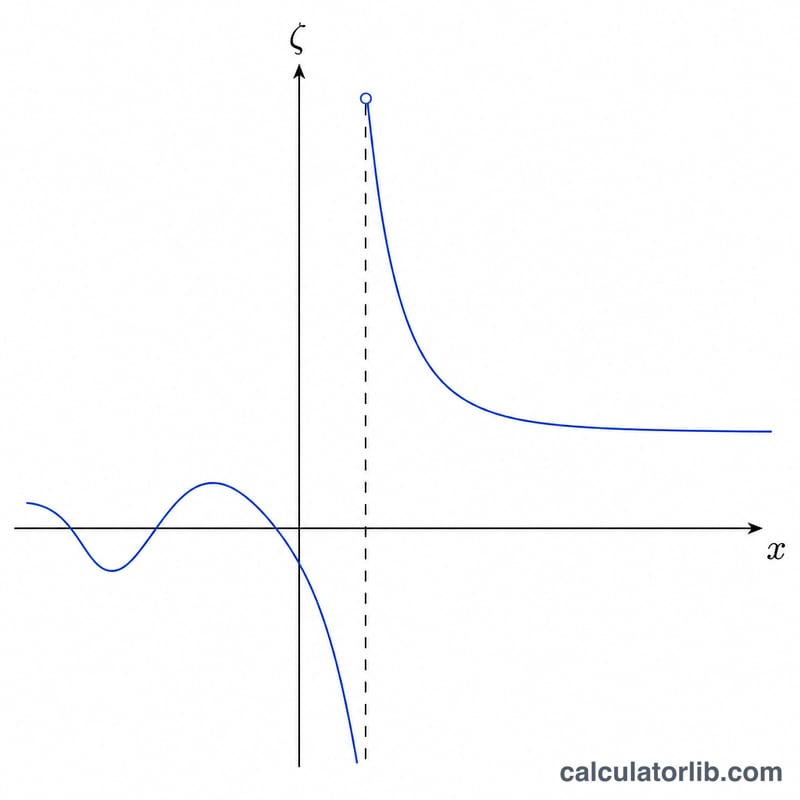
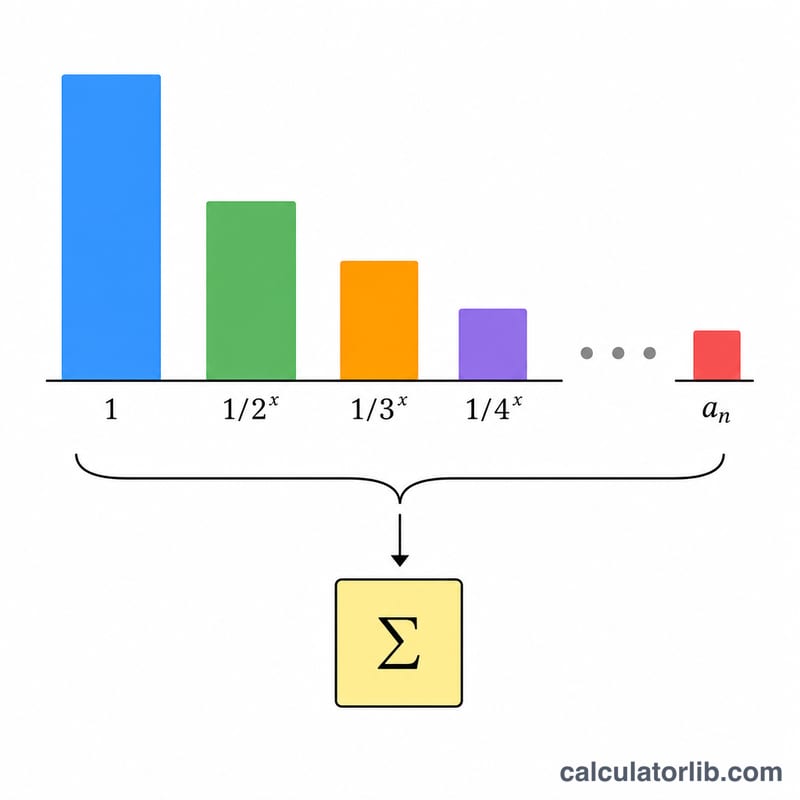
The Riemann zeta function is one of the most important objects in number theory and analysis. For a real argument x greater than 1 it is defined by the convergent series \(\zeta(x) = 1 + \frac{1}{2^x} + \frac{1}{3^x} + \frac{1}{4^x} + \ldots\), the sum of the reciprocals of every positive integer raised to the power x. Through analytic continuation it is extended to almost every real (and complex) value, the single exception being \(x = 1\), where it has a simple pole and diverges to infinity. This tool evaluates \(\zeta(x)\) for any REAL x; it does not accept complex arguments.
How to Use This Calculator
Enter the real number x and pick how many display digits you want. The calculator returns \(\zeta(x)\) and, separately, \(\zeta(x)-1\). The second value is the tail of the series, \(\zeta(x)-1 = \frac{1}{2^x} + \frac{1}{3^x} + \ldots\), which is useful for large x where \(\zeta(x)\) is so close to 1 that the rounded value simply reads "1" and all the real information hides in the remainder.
The Formula Explained
For \(x > 1\) we sum the series with Euler-Maclaurin acceleration: a handful of explicit terms plus a smooth correction reproduces many correct digits quickly. For \(x < 1\) we apply the functional equation $$\zeta(x) = 2^x\,\pi^{x-1}\,\sin\!\left(\frac{\pi x}{2}\right)\,\Gamma(1-x)\,\zeta(1-x),$$ where \(1-x > 1\) so the right-hand zeta is computed by the same series. The sine factor automatically produces the trivial zeros \(\zeta(-2) = \zeta(-4) = \ldots = 0\).
Worked Example
For \(x = 2\) (the famous Basel problem) the series equals $$\frac{\pi^2}{6} = 1.6449340668\ldots,$$ so \(\zeta(2)-1 = 0.6449340668\ldots\). For the default \(x = 7\), \(\zeta(7) = 1.0083492773\ldots\), meaning the entire tail from \(n = 2\) onward only adds about \(0.00835\). For \(x = -1\) the functional equation gives the celebrated value \(\zeta(-1) = -\frac{1}{12}\).
FAQ
Why is \(\zeta(1)\) undefined? The series becomes the harmonic series, which diverges; \(x = 1\) is a simple pole, so the calculator returns infinity.
Can I enter complex numbers? No. This tool handles only real x. The deeper theory (and the Riemann Hypothesis) lives on the complex plane.
Why show \(\zeta(x)-1\) too? For large x, \(\zeta(x)\) rounds to 1 in ordinary precision, but \(\zeta(x)-1\) keeps the meaningful small remainder visible.