
What it is
The Maintenance Fluids Calculator estimates the volume of intravenous (or oral) fluids a patient needs over 24 hours to replace ongoing normal losses (urine, stool, sweat, respiration). It uses the widely taught Holliday-Segar method, also known as the "4-2-1 rule," which is commonly applied to pediatric patients but works for any body weight. This tool is for educational reference only and does not replace clinical judgment.
How to use it
Enter the patient's body weight in kilograms and submit. The calculator returns the maintenance rate in millilitres per hour (mL/h) and the total daily volume in millilitres per day (mL/day). Always reassess fluid needs against the clinical picture, electrolytes, and ongoing or abnormal losses.
The formula explained
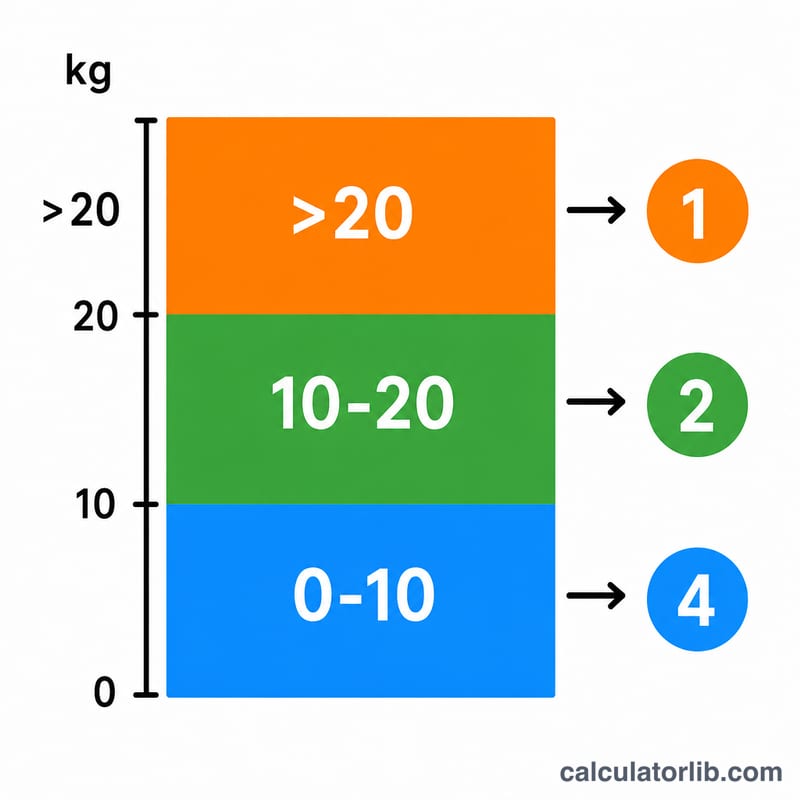
The 4-2-1 rule splits weight into tiers: 4 mL/kg/h for the first 10 kg, 2 mL/kg/h for the next 10 kg (11–20 kg), and 1 mL/kg/h for every kilogram above 20 kg. A patient ≤10 kg gets \(\text{weight} \times 4\); an 11–20 kg patient gets \(40 + 2 \times (\text{weight} - 10)\); a patient over 20 kg gets \(60 + 1 \times (\text{weight} - 20)\). Multiplying the hourly rate by 24 gives the daily volume. The "100-50-20" daily rule is the same method expressed per day.
Worked example
For a 25 kg child: first 10 kg → \(10 \times 4 = 40\) mL/h; next 10 kg → \(10 \times 2 = 20\) mL/h; remaining 5 kg → \(5 \times 1 = 5\) mL/h. Total $$40 + 20 + 5 = 65 \text{ mL/h},$$ or \(65 \times 24 = 1{,}560\) mL/day.

FAQ
Is this only for children? The 4-2-1 rule was derived for pediatric maintenance but the tiered formula can be computed for any weight; adult maintenance is often capped or estimated differently in practice.
Does it account for dehydration? No. This gives baseline maintenance only. Deficits and ongoing abnormal losses must be added separately.
What about very large adults? Many clinicians cap maintenance fluids (e.g., around 100–120 mL/h) regardless of weight; use clinical guidelines.