
What this calculator does
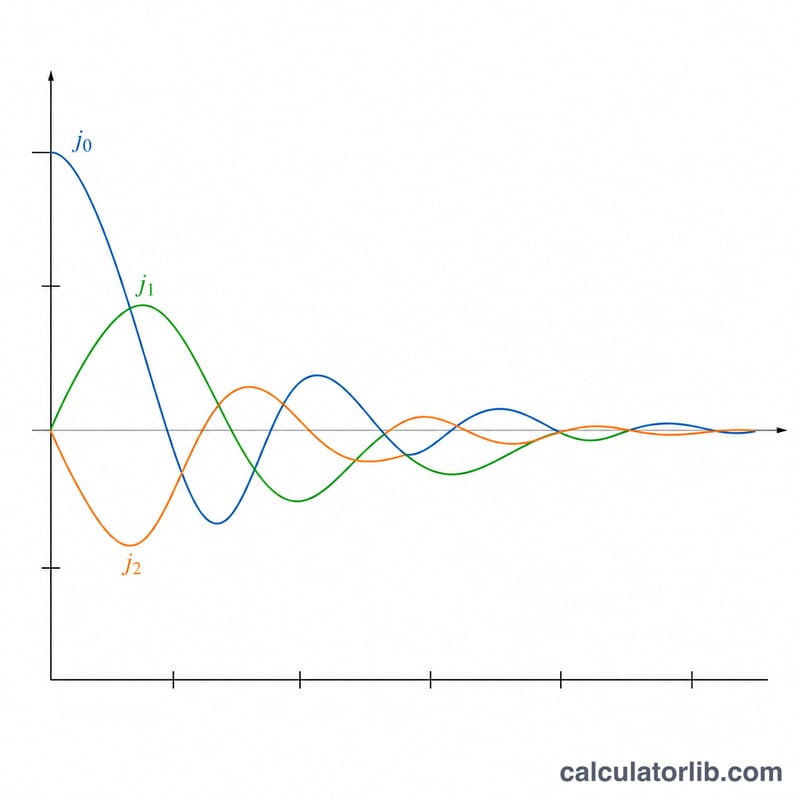
This tool tabulates the spherical Bessel function of the first kind, \(j_\nu(x)\), at a sequence of x values. You choose the order \(\nu\), a starting x, a step size, and how many rows to generate. The calculator returns a two-column table of \((x, j_\nu(x))\) pairs. It is pure mathematics and applies identically everywhere — no country or unit assumptions are involved.
How to use it
Enter the order \(\nu\) (it may be any real number, e.g. 0, 1, 2 or 1.5), the initial value of x, the increment added to x on each row, and the number of rows. Each row k uses \(x_k = \text{initialX} + k\cdot\text{stepX}\). The first hero number shows \(j_\nu\) at the very first x; the table lists every generated value.
The formula explained
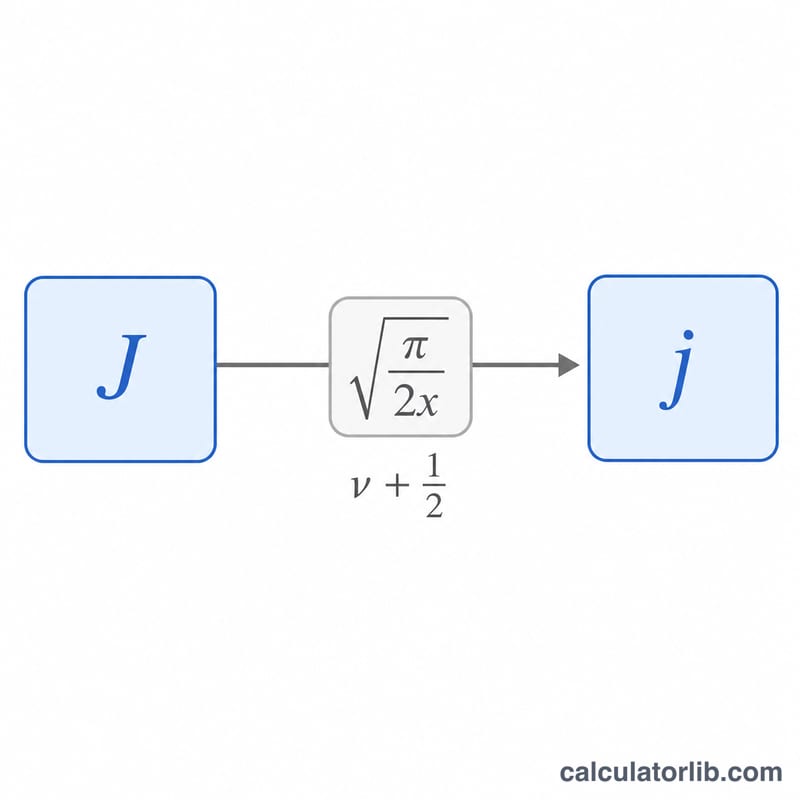
For general real order, $$j_\nu(x) = \sqrt{\frac{\pi}{2x}}\cdot J_{\nu+\frac{1}{2}}(x),$$ where J is the ordinary Bessel function of the first kind, evaluated through its power series with a Lanczos gamma function. For integer order the calculator uses the numerically stable closed forms \(j_0(x) = \sin(x)/x\) and \(j_1(x) = \sin(x)/x^2 - \cos(x)/x\), then climbs with the upward recurrence $$j_{n+1}(x) = \frac{2n+1}{x}\cdot j_n(x) - j_{n-1}(x).$$ At \(x = 0\) the limit is applied: \(j_0(0) = 1\) and \(j_n(0) = 0\) for \(\nu > 0\), avoiding division by zero.
Worked example
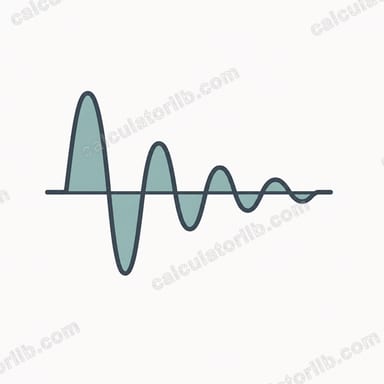
Order \(\nu = 0\), initialX = 0, stepX = 0.2, 6 rows gives \(x = 0, 0.2, 0.4, 0.6, 0.8, 1.0\). Using \(j_0(x) = \sin(x)/x\): $$j_0(0)=1,\quad j_0(0.2)=0.993347,\quad j_0(0.4)=0.973546,$$ $$j_0(0.6)=0.941071,\quad j_0(0.8)=0.896695,\quad j_0(1.0)=0.841471$$ — the familiar damped sinc shape.
FAQ
Can the order be a fraction? Yes. Non-integer \(\nu\) uses the \(\sqrt{\pi/2x}\cdot J\) series form.
Why is the first value exactly 1 when x starts at 0? Because \(j_0(0) = 1\) by limit; for \(\nu > 0\) the limit is 0.
Is upward recurrence always safe? For modest orders and x typical of a table viewer, yes. For very large order relative to x, downward recurrence is more stable, but that is rarely needed here.