
What this calculator does
The Amoxicillin Pediatric Dosage Calculator estimates how much amoxicillin a child should receive based on body weight, the prescribed milligrams per kilogram per day, and how many times per day the medicine is given. It also converts the milligram dose into a practical liquid volume (mL) for common oral suspension strengths. This is an educational tool and not a substitute for a prescriber's instructions.
How to use it
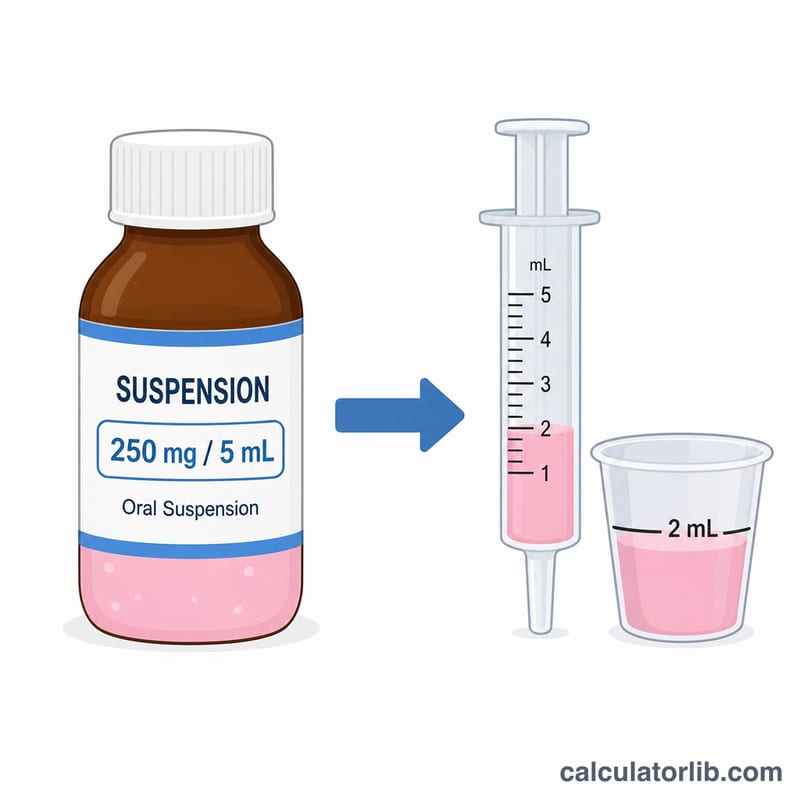
Enter the child's weight in kilograms, the target dose in mg/kg/day (commonly 25–45 mg/kg/day, or higher for certain infections), select how many doses are given per day (2, 3, or 4), and choose the suspension concentration on the bottle (e.g., 250 mg per 5 mL). The calculator returns the total daily dose, the dose per administration, and the matching volume to measure.
The formula explained
First the total daily dose is found by multiplying weight by the mg/kg/day target: $$\text{Daily dose} = \text{weight} \times \text{mg/kg/day}$$ That total is divided by the number of doses per day to get the amount per dose. To get a measurable volume, the mg per dose is divided by the suspension strength and multiplied by 5, since strength is expressed per 5 mL.
$$\text{Per dose (mg)} = \dfrac{\text{weight} \times \text{mg/kg/day}}{\text{doses per day}}$$ $$\text{mL/dose} = \dfrac{\text{mg/dose}}{\text{conc}} \times 5$$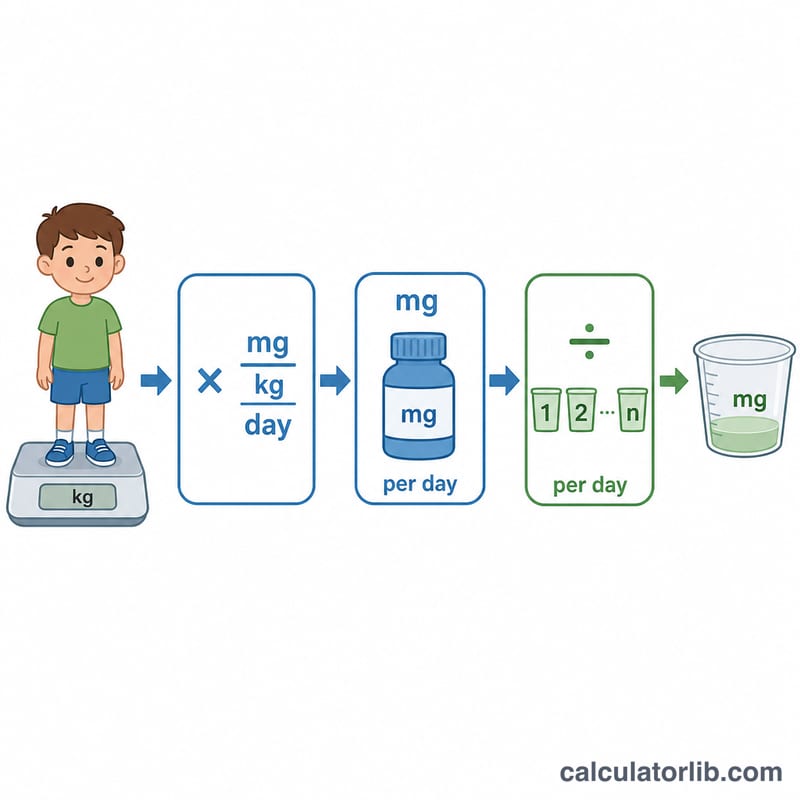
Worked example
A 20 kg child prescribed 45 mg/kg/day in 3 divided doses, using a 250 mg/5 mL suspension: daily dose = \(20 \times 45 = 900\) mg/day. Per dose = \(900 \div 3 = 300\) mg. Volume per dose = \((300 \div 250) \times 5 = 6\) mL three times daily.
Common Amoxicillin Dosing Regimens by Indication
The table below summarizes commonly cited pediatric amoxicillin dosing ranges based on guidance from the American Academy of Pediatrics (AAP) and the Infectious Diseases Society of America (IDSA). These are educational reference values only — actual dosing depends on the child's weight, renal function, local resistance patterns, and clinical judgment. Always verify dosing with a clinician or pharmacist before administering.
| Indication | Typical dose (mg/kg/day) | Divided doses/day | Source / notes |
|---|---|---|---|
| Acute otitis media (high-dose) | 80–90 | 2 | AAP 2013 AOM guideline |
| Group A strep pharyngitis | 50 (max 1000 mg/day) | 1–2 | IDSA 2012; once-daily option |
| Acute bacterial sinusitis | 45 (standard) or 80–90 (high-dose) | 2 | AAP 2013 sinusitis guideline |
| Community-acquired pneumonia | 90 | 2–3 | IDSA/PIDS 2011 |
| General mild infection (standard) | 40–45 | 2–3 | Common label dosing |
For a 16 kg child treated for acute otitis media at 90 mg/kg/day, the total daily dose is \(16 \times 90 = \) 1440 mg/day, split into 2 doses.
Suspension Strengths and mg-per-mL Reference
Amoxicillin oral suspension is supplied in several concentrations, each expressed as milligrams per 5 mL. Dividing by 5 gives the mg-per-mL strength used to calculate the volume of each dose.
| Concentration (mg/5 mL) | mg per mL |
|---|---|
| 125 mg/5 mL | 25 mg/mL |
| 200 mg/5 mL | 40 mg/mL |
| 250 mg/5 mL | 50 mg/mL |
| 400 mg/5 mL | 80 mg/mL |
To find the volume per dose: \(V_{dose} = \dfrac{D_{dose}}{\text{mg per mL}}\). A higher concentration means a smaller volume for the same milligram dose, which can make administration easier for higher-weight children.
FAQ
What mg/kg/day should I use? Typical amoxicillin ranges are 25–45 mg/kg/day, with up to 80–90 mg/kg/day for high-dose regimens. Always follow the prescriber's order.
Is there a maximum dose? Yes — pediatric doses should not exceed adult dosing; this tool does not cap automatically, so verify against guidelines.
Can I use pounds? No, enter weight in kilograms. Divide pounds by 2.2046 to convert first.