
What Is the Pediatric GFR Calculator?
This tool estimates the glomerular filtration rate (GFR) in children and adolescents using the bedside Schwartz equation. GFR reflects how well the kidneys filter blood and is a key marker of kidney function. The bedside Schwartz formula was developed for use with serum creatinine measured by IDMS-traceable (enzymatic) methods and applies to patients roughly 1 to 18 years old. It is intended for clinical and educational reference only and does not replace professional medical judgment.
How to Use It
Enter the child's height in centimeters and their serum creatinine in mg/dL. The calculator returns the estimated GFR in mL/min/1.73 m² along with the corresponding chronic kidney disease (CKD) category.
The Formula Explained
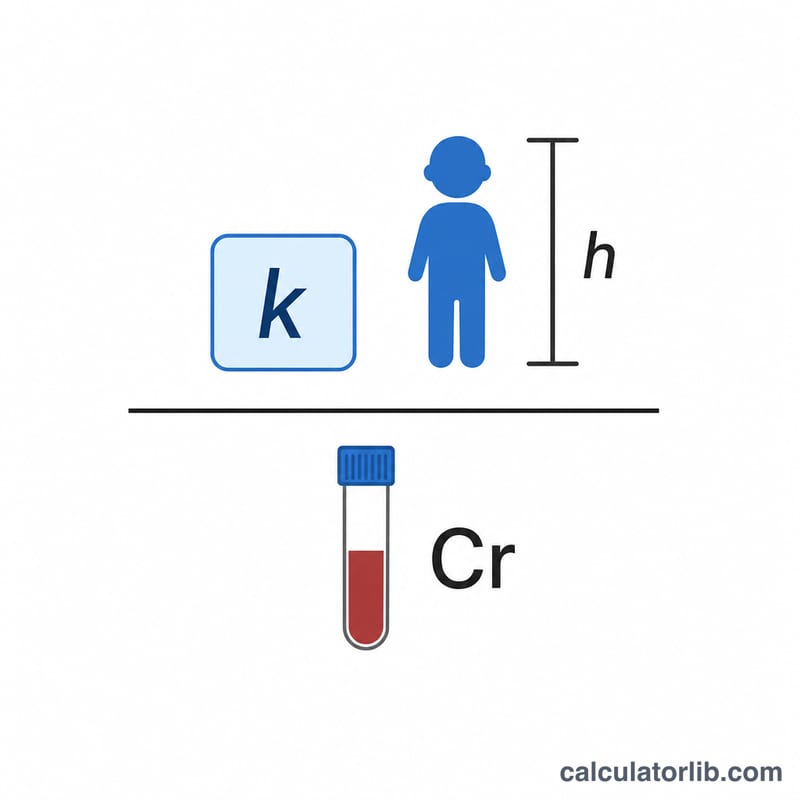
The bedside Schwartz equation is:
$$\text{eGFR} = \frac{0.413 \times \text{Height}}{\text{SCr}}$$where \(\text{Height}\) is in centimeters and \(\text{SCr}\) is serum creatinine in mg/dL. The constant \(0.413\) replaces the older height-dependent k-values once creatinine assays were standardized.
Worked Example
For a child who is \(100\,\text{cm}\) tall with a serum creatinine of \(0.5\,\text{mg/dL}\):
$$\text{eGFR} = \frac{0.413 \times 100}{0.5} = \frac{41.3}{0.5} = 82.6$$So the estimated GFR is about \(82.6\) mL/min/1.73 m², which falls in the mildly decreased (G2) category.
CKD Stages and GFR Thresholds
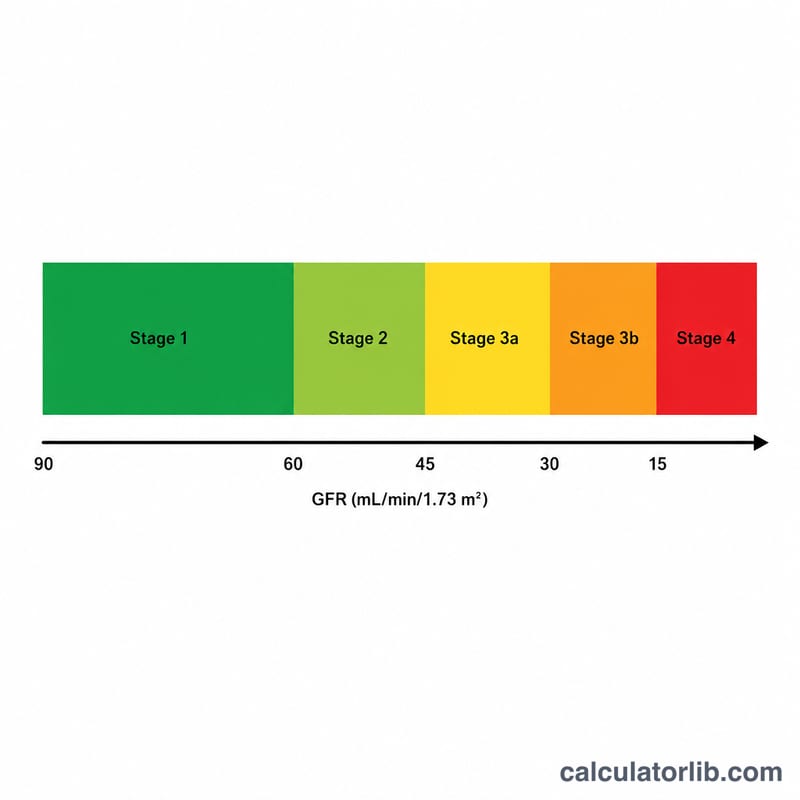
The Kidney Disease: Improving Global Outcomes (KDIGO) guidelines classify chronic kidney disease (CKD) into six GFR categories. The bedside Schwartz equation reports eGFR already normalized to a standard body surface area of 1.73 m², so its result is directly comparable to these thresholds.
| GFR Category | eGFR (mL/min/1.73 m²) | Description |
|---|---|---|
| G1 | \(\geq 90\) | Normal or high |
| G2 | 60–89 | Mildly decreased |
| G3a | 45–59 | Mildly to moderately decreased |
| G3b | 30–44 | Moderately to severely decreased |
| G4 | 15–29 | Severely decreased |
| G5 | \(< 15\) | Kidney failure |
A worked example: for a child 120 cm tall with a serum creatinine of 0.6 mg/dL, the bedside Schwartz estimate is \(\frac{0.413 \times 120}{0.6} = \) 82.6 mL/min/1.73 m², which falls in category G2. Note that a value below 90 in a young child does not by itself indicate CKD, because normal GFR is physiologically lower at younger ages (see interpretation below).
Interpreting Your Pediatric eGFR Result
The bedside Schwartz equation, \(\text{eGFR} = \frac{0.413 \times \text{Height (cm)}}{\text{Serum Creatinine (mg/dL)}}\), gives an estimate of how well the kidneys filter waste, expressed per 1.73 m² of body surface area. Higher numbers generally mean better filtering function.
- \(\geq 90\): Within the expected range for older children and adolescents. A single high-normal value is reassuring but should be read alongside the rest of the clinical picture.
- 60–89: Mildly decreased relative to the adult reference. In healthy younger children this can be entirely normal, since GFR matures with age.
- 45–59 (G3a) and 30–44 (G3b): Moderately reduced filtration that typically warrants further evaluation, including repeat testing and assessment for protein in the urine.
- 15–29 (G4): Severely reduced function requiring specialist nephrology care.
- \(< 15\) (G5): Kidney failure; usually managed with preparation for dialysis or transplant.
Trends matter more than a single reading. A one-time eGFR can be affected by hydration status, recent illness, muscle mass, diet, and laboratory variation in the creatinine measurement. Tracking several values over weeks or months gives a far more reliable picture of kidney function than any isolated result.
Normal values are lower in younger children. GFR at birth is low and rises over the first one to two years of life, approaching adult-normalized values by roughly age 2. The KDIGO categories above are derived from adult data; a clinician interprets a child's value against age-appropriate norms rather than the adult cutoff of 90.
The bedside Schwartz equation is validated mainly in children and adolescents (roughly 1–18 years) with relatively stable kidney function and is not appropriate for adults, neonates, or rapidly changing (acute) kidney injury. This is general educational information and not a substitute for professional medical advice—discuss any result with your child's physician or a pediatric nephrologist.
Key Terms & Definitions
- GFR (Glomerular Filtration Rate)
- The volume of blood plasma the kidneys filter per minute, the standard measure of overall kidney function, reported in mL/min/1.73 m².
- Serum Creatinine (SCr)
- A waste product of muscle metabolism cleared by the kidneys. Because it rises as filtration falls, its blood concentration (in mg/dL) is the key input to estimating GFR.
- eGFR (estimated GFR)
- A calculated approximation of true GFR derived from a formula using serum creatinine and other variables—here, height—rather than from a direct clearance measurement.
- IDMS-traceable / enzymatic assay
- Modern, standardized creatinine measurement methods calibrated to isotope-dilution mass spectrometry (IDMS). The bedside Schwartz constant of 0.413 was derived for IDMS-traceable (typically enzymatic) creatinine values; older non-standardized assays require different constants.
- CKD (Chronic Kidney Disease)
- A persistent (≥3 months) reduction in kidney function or evidence of kidney damage, staged by GFR category (G1–G5) and by albuminuria.
- 1.73 m² Body Surface Area normalization
- GFR is scaled to a reference adult body surface area of 1.73 m² so results can be compared across people of different body sizes. The bedside Schwartz equation already produces a value normalized to this standard.
FAQ
Who is this calculator for? Children and adolescents (approximately ages 1–18). For adults, use a CKD-EPI or MDRD calculator instead.
Why height instead of weight? Muscle mass — and therefore creatinine production — correlates with height in children, making height a better predictor of GFR.
Is a single value diagnostic? No. GFR estimates can vary with hydration, diet, and assay method. Trends over time interpreted by a clinician are more meaningful than one reading.