
What This Calculator Does
The Dog Age in Human Years Calculator estimates how old your dog is in equivalent human years. The old "multiply by 7" rule is a myth — dogs mature very quickly in their early life and then age more slowly. This tool uses a more accurate, research-based logarithmic relationship for dogs aged one year and older, and a linear approximation for puppies under one year.
The Formula
For a dog aged one year or older, the equivalent human age \(H\) is given by:
$$H = 16 \ln(d) + 31$$where \(d\) = dog age in years and \(\ln\) is the natural logarithm. This formula comes from a 2019 study comparing DNA methylation (the "epigenetic clock") between dogs and humans. For puppies under one year old, a simple linear approximation is used:
$$H = 15 \, d$$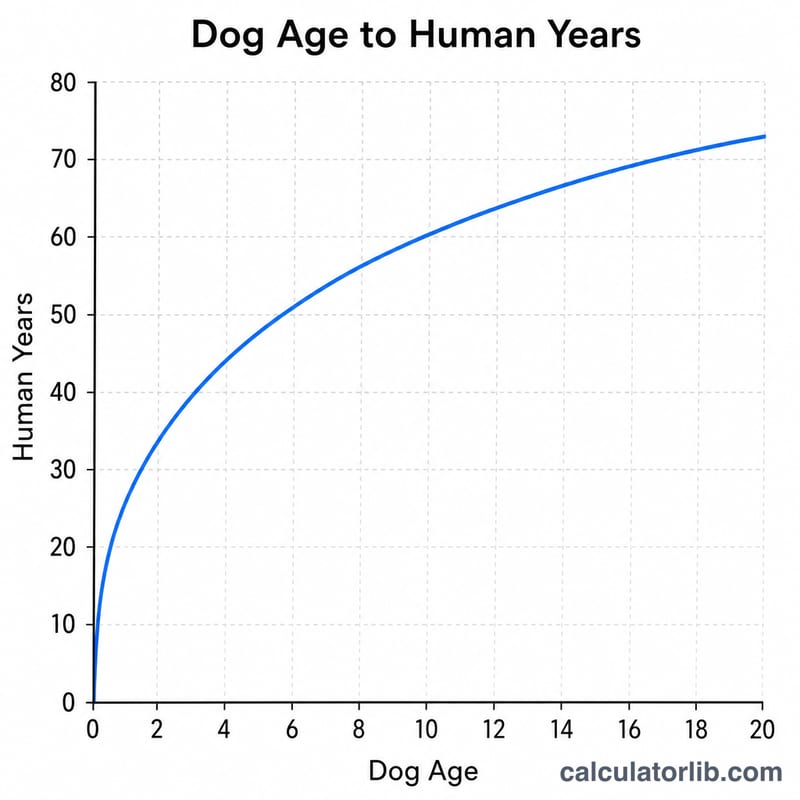
How to Use It
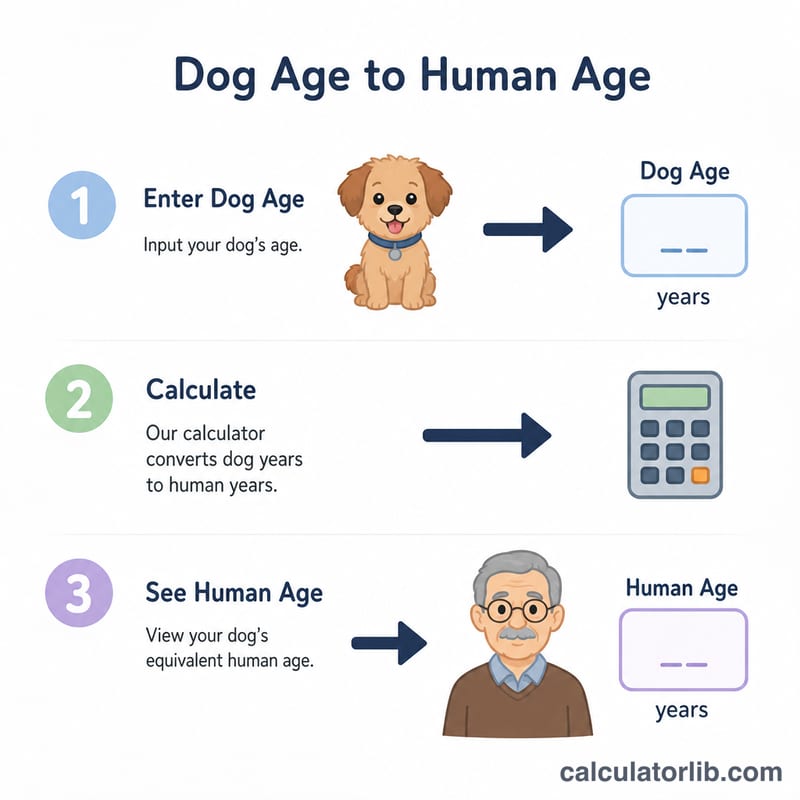
Enter your dog's age in years (you can use decimals, e.g. 0.5 for six months) and read off the equivalent human age. The calculator automatically picks the logarithmic formula for ages of one year and above, or the linear puppy formula below one year.
Worked Example
Suppose your dog is 5 years old. Since \(5 \ge 1\), we use the logarithmic formula:
$$H = 16 \ln(5) + 31 = 16 \times 1.6094 + 31 = 25.75 + 31 = 56.75$$So a 5-year-old dog is roughly 57 in human years.
FAQ
Is the "multiply by 7" rule accurate? No. It overestimates young dogs and underestimates the rapid early aging. The logarithmic formula matches biological aging far better.
Does breed or size matter? Yes, larger breeds tend to age faster, but this formula gives a solid general estimate that works well for medium-sized dogs.
Why a different formula for puppies? The logarithm of an age below 1 produces unrealistic (even negative) values, so a simple linear estimate is used for the first year of life.