
What This Calculator Does
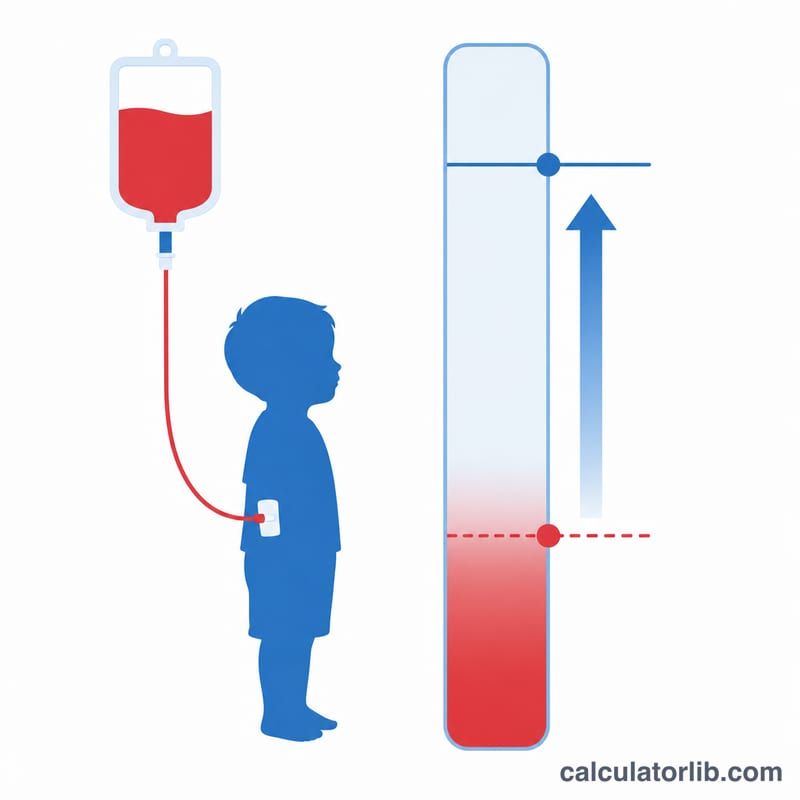
The Pediatric Blood Transfusion Volume Calculator estimates the volume of packed red blood cells (PRBC) required to raise a child's hemoglobin (Hb) from its current value to a desired target. It uses the widely taught rule that about 4 mL/kg of PRBC raises hemoglobin by roughly 1 g/dL. This tool is intended for educational and clinical reference only and does not replace institutional protocols or physician judgment.
How to Use It
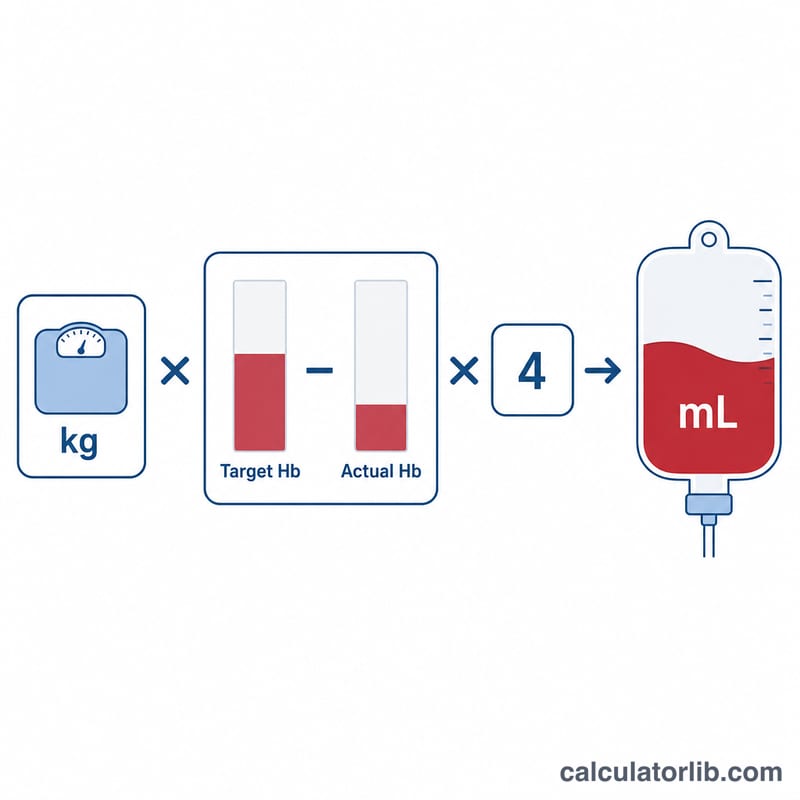
Enter the patient's weight in kilograms, the current (actual) hemoglobin in g/dL, and the desired hemoglobin in g/dL. The calculator multiplies the weight by the hemoglobin increase and by a factor of 4 to estimate the transfusion volume in milliliters. Always cross-check the result against your local transfusion guidelines and consider the hematocrit of the specific blood product.
The Formula Explained
The equation is: $$V = \text{Weight (kg)} \times \left( \text{Hb}_{\text{desired}} - \text{Hb}_{\text{actual}} \right) \times 4$$ The factor 4 reflects that approximately 4 mL/kg of standard PRBC (with a hematocrit around 55–65%) increases hemoglobin by 1 g/dL. The hemoglobin difference represents how much you wish to increase the Hb.
Worked Example
A child weighs 10 kg with a current hemoglobin of 7 g/dL, and the target is 12 g/dL. The hemoglobin increase is \(12 - 7 = 5\) g/dL. $$V = 10 \times 5 \times 4 = 200 \text{ mL}$$ of packed red blood cells.
FAQ
Why the factor of 4? It is a clinical approximation: roughly 4 mL/kg of PRBC raises Hb by 1 g/dL. Some centers use 3 mL/kg for higher-hematocrit units.
Does this apply to whole blood? No. This formula assumes packed red blood cells. Whole blood has a lower hematocrit and requires a larger volume.
Is the result a maximum dose? Not necessarily. Use clinical judgment, monitor for volume overload, and follow your institution's maximum single-transfusion limits.