
What is the Pediatric Blood Volume Calculator?
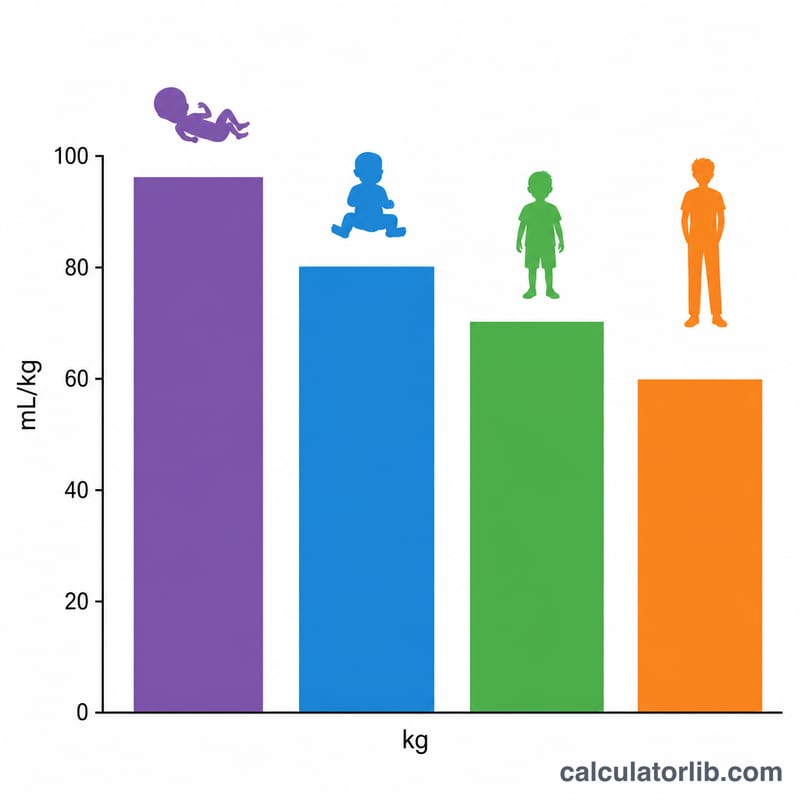
This tool estimates a child's total blood volume (often called estimated blood volume, or EBV) from body weight using standard age-based factors expressed in milliliters per kilogram (mL/kg). Blood volume per kilogram is higher in newborns and decreases with age, so the calculator lets you choose a patient category that matches the appropriate factor. This is a general educational estimate and not a substitute for clinical judgment.
How to use it
Enter the child's weight in kilograms and select the patient category. The calculator multiplies weight by the corresponding mL/kg factor and reports the result in both milliliters and liters. Typical factors used here are: premature neonate 90 mL/kg, term neonate 85 mL/kg, infant (1–12 months) 80 mL/kg, child (1–12 years) 75 mL/kg, and adolescent/adult 70 mL/kg.
The formula explained
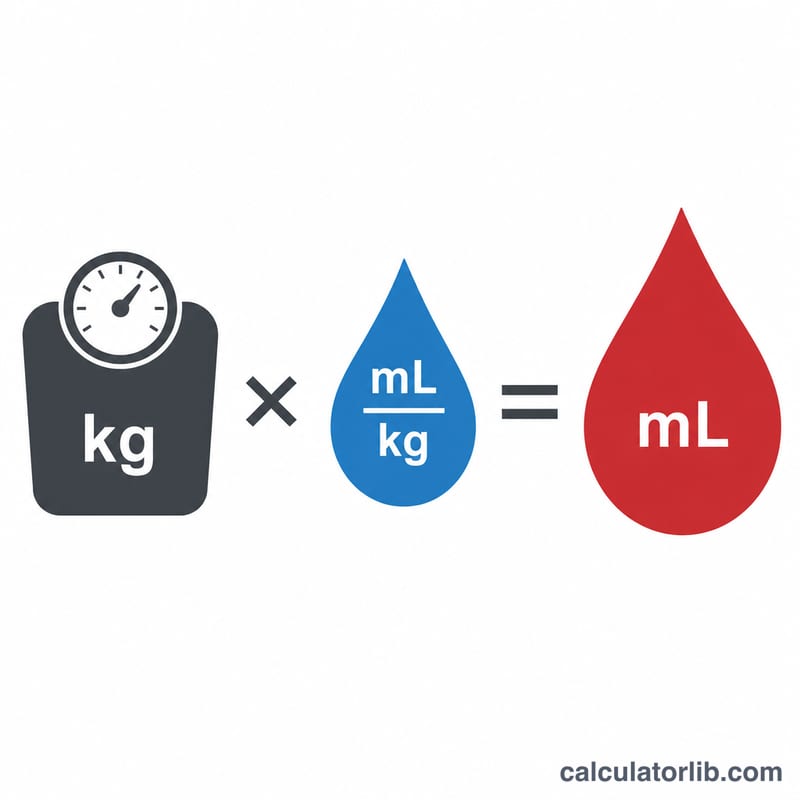
The calculation is simply $$\text{EBV} = \text{Weight (kg)} \times \text{mL/kg}$$ Because younger patients carry proportionally more blood for their size, the multiplier shrinks as the patient matures. Dividing the milliliter result by 1000 converts it to liters.
Worked example
Consider a 10 kg infant (1–12 months, 80 mL/kg). $$\text{EBV} = 10 \times 80 = 800 \text{ mL}$$ equal to 0.8 L. A 4 kg term neonate at 85 mL/kg would have an estimated blood volume of \(4 \times 85 = 340\) mL.
FAQ
Why do neonates have a higher mL/kg value? Newborns have a larger blood volume relative to body weight; this proportion declines through infancy and childhood.
Is this the same as maximum allowable blood loss? No. EBV is the starting point; maximum allowable blood loss is a further calculation that also uses the starting and target hematocrit.
Which factor should I choose? Pick the category that matches the patient's age and maturity. When in doubt, follow local clinical protocols and consult a clinician.