
What Is the Bladder Volume Calculator?
The Bladder Volume Calculator estimates the volume of urine held in the bladder using three perpendicular dimensions — length, width and height — typically obtained from a transabdominal ultrasound scan. It applies the widely used ellipsoid approximation, which models the bladder as a flattened sphere and gives a quick, non-invasive volume estimate in milliliters.
How to Use It
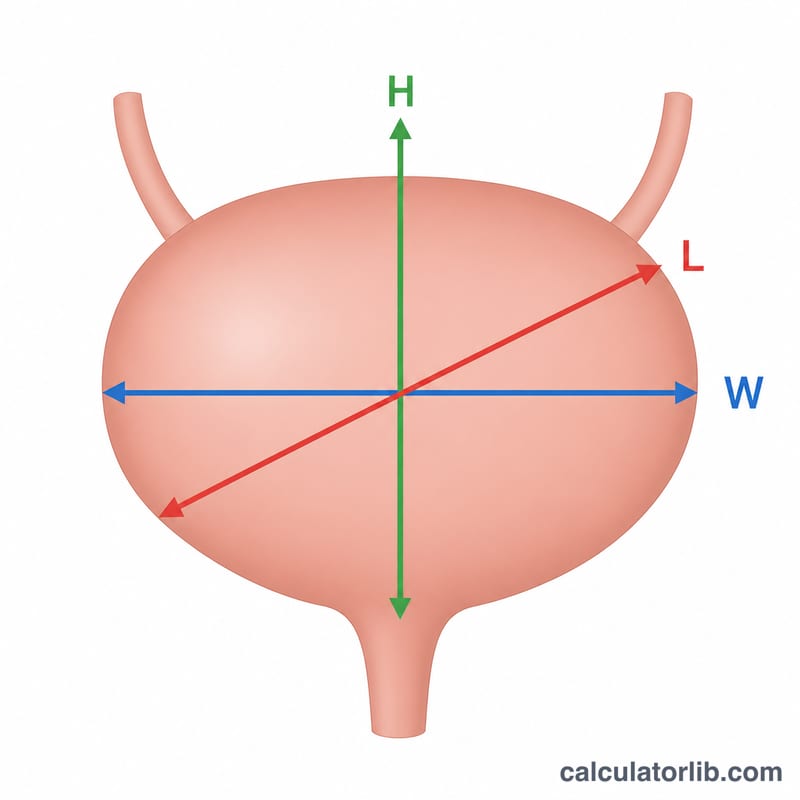
Measure the bladder in three planes (in centimeters): the longitudinal length, the transverse width and the anteroposterior height. Enter all three values and the calculator returns the estimated volume in milliliters and liters. This is an estimation tool intended to support, not replace, clinical judgment.
The Formula Explained
The ellipsoid formula is $$V = 0.52 \times L \times W \times H.$$ The constant \(0.52\) approximates \(\pi/6\) (\(\approx 0.5236\)), the coefficient that converts the bounding box of an ellipsoid into its true volume. Because all dimensions are in centimeters, one cubic centimeter equals one milliliter, so the result is directly in mL.
Worked Example
Suppose the ultrasound measures length 8 cm, width 6 cm and height 5 cm. Then $$V = 0.52 \times 8 \times 6 \times 5 = 0.52 \times 240 = 124.8 \text{ mL}.$$ The bladder therefore holds about 125 mL of urine, or roughly 0.125 L.
Interpreting Your Bladder Volume Result
The ellipsoid formula gives an estimate of bladder volume in milliliters from three ultrasound dimensions: \(V = 0.52 \times L \times W \times H\). The result describes how much urine the bladder currently holds at the moment the images were captured, not the bladder's maximum capacity.
Full versus near-empty: A larger computed volume (for many adults, roughly 300–500 mL or more) suggests a comfortably full or distended bladder, while a small value (under about 50 mL) indicates a near-empty bladder. As an illustration, a scan measuring 8 cm \(\times\) 7 cm \(\times\) 6 cm gives \(V = 0.52 \times 8 \times 7 \times 6 = \) 174.7 mL, a partially filled bladder.
Post-void residual (PVR): When the scan is performed immediately after the person urinates, the estimate represents the post-void residual — the urine left behind after voiding. PVR is the most common clinical use of this calculation, because an elevated residual can point to incomplete emptying. The volume number itself is what gets compared against whatever threshold the clinician is using.
Estimate versus true (catheterized) volume: The ellipsoid value is a geometric approximation that assumes the bladder is shaped like a smooth ellipsoid. Direct measurement by catheterization drains and measures the actual fluid, and is generally treated as the reference standard. Ultrasound estimates can differ from catheterized volumes by a meaningful margin in either direction.
Accuracy limitations: The ellipsoid model is least reliable at the extremes. A very full bladder often deviates from a clean ellipsoid shape, and a nearly empty or irregularly shaped bladder produces dimensions that the formula handles poorly, so small-volume estimates carry proportionally larger error. Measurement technique, probe angle, patient position, and bladder wall thickening all affect the dimensions entered and therefore the result.
This is general educational information about how the calculation works and is not medical advice. Interpretation of any bladder volume or residual measurement should be done by a qualified healthcare professional in the context of the individual patient.
FAQ
Why 0.52 instead of π/6? \(0.52\) is a rounded clinical convention. Some protocols use \(0.52\), others use \(0.7\) or \(0.625\) depending on bladder shape assumptions; \(0.52\) is the most common ellipsoid coefficient.
Is the result exact? No. It is an estimate. Real bladders are not perfect ellipsoids, so actual volume may differ, especially at very full or nearly empty states.
What units should I use? Enter all three dimensions in centimeters. The output is in milliliters (cm³) and liters.