
What Is the BUN/Creatinine Ratio?
The blood urea nitrogen (BUN) to creatinine ratio is a simple, unitless number obtained by dividing the BUN value by the creatinine value, both expressed in mg/dL (the conventional units used in the United States). Clinicians use it alongside other lab results to help distinguish the possible causes of changes in kidney function. This calculator is an educational aid only and does not replace professional medical interpretation.
How to Use It
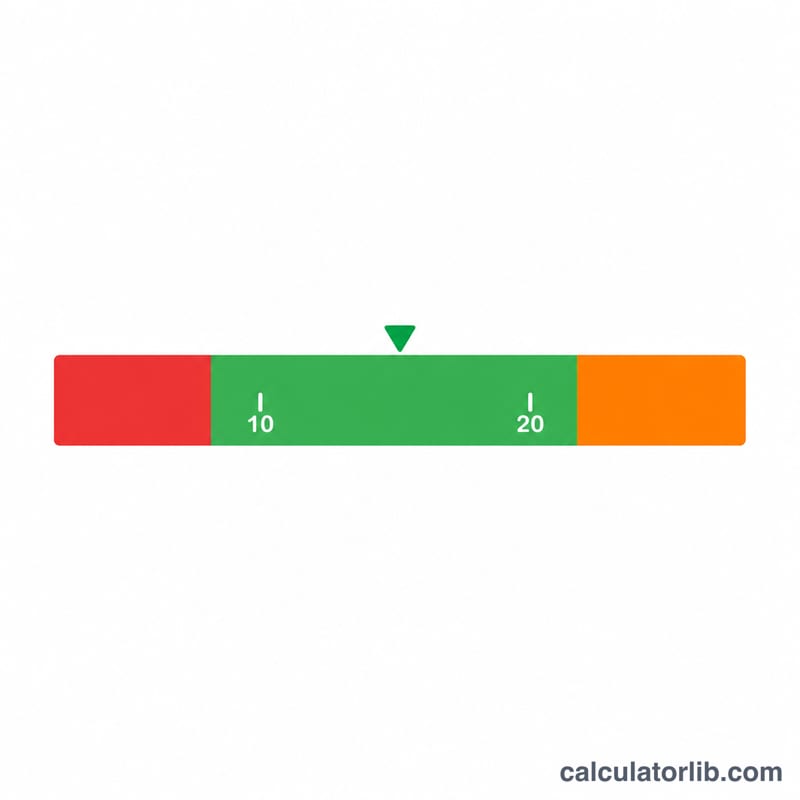
Enter your BUN result in mg/dL and your serum creatinine result in mg/dL, then read the calculated ratio. The tool also classifies the result into low, normal, or high bands using common reference cut-offs. Always confirm your lab's own reference ranges, since they can vary.
The Formula Explained
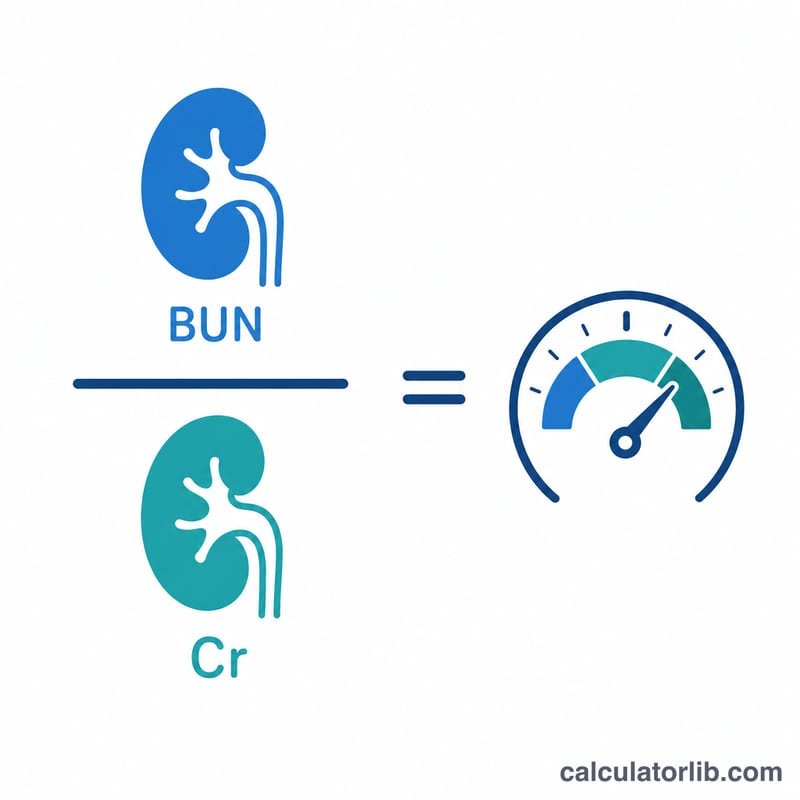
The math is a single division: $$\text{Ratio} = \frac{\text{BUN}}{\text{Creatinine}}$$ Because both inputs share the same unit (mg/dL), the result is dimensionless. A typical reference range is roughly 10:1 to 20:1. A high ratio may suggest prerenal causes such as dehydration or reduced blood flow to the kidneys, while a low ratio can be linked to low protein intake or liver issues — but interpretation always depends on the full clinical picture.
Worked Example
Suppose your BUN is 20 mg/dL and your creatinine is 1.0 mg/dL. The ratio is $$20 \div 1.0 = 20$$ written as 20:1, which sits at the upper edge of the normal range. If creatinine were 0.5 mg/dL instead, the ratio would be $$20 \div 0.5 = 40$$ a high value worth discussing with a clinician.
Interpreting Your Result
The BUN-to-creatinine ratio compares two waste products filtered by the kidneys. It is calculated by dividing serum BUN by serum creatinine, both expressed in mg/dL:
$$\text{BUN/Creatinine Ratio} = \frac{\text{BUN (mg/dL)}}{\text{Creatinine (mg/dL)}}$$
For example, a BUN of 15 mg/dL with a creatinine of 1.0 mg/dL gives a ratio of 15:1, which falls in the normal range.
Normal ratio (about 10:1 to 20:1)
A ratio in this band is generally consistent with balanced production and clearance of urea and creatinine and does not, by itself, point to a specific kidney problem.
High ratio (above 20:1)
An elevated ratio—especially when BUN rises proportionally more than creatinine—is often associated with prerenal conditions, in which blood flow to the kidneys is reduced or urea reabsorption is increased. Common contributors include dehydration, reduced renal perfusion (for example from heart failure or volume depletion), gastrointestinal bleeding (digested blood adds a protein/nitrogen load), and high dietary protein intake. Certain medications and catabolic states can also raise the ratio.
Low ratio (below 10:1)
A reduced ratio can accompany low protein intake, liver disease (where the liver produces less urea), intrinsic renal disease affecting the tubules, overhydration, or pregnancy. In some cases it reflects how the underlying problem affects BUN and creatinine differently rather than overall kidney function.
The ratio is only one piece of information and is always interpreted alongside the absolute BUN and creatinine values, estimated kidney function, symptoms, medications, and clinical history. This is general educational information and not a substitute for professional medical advice—do not use it for self-diagnosis. Discuss your results with a qualified clinician.
BUN and Creatinine Reference Ranges
The table below lists typical adult serum reference ranges in conventional units. These are approximate and commonly cited values; the exact range printed on your lab report may differ depending on the laboratory, assay method, and population served, so always interpret your numbers against your own report's stated range.
| Measurement | Typical adult range |
|---|---|
| BUN (blood urea nitrogen) | ~7–20 mg/dL |
| Creatinine, men | ~0.7–1.3 mg/dL |
| Creatinine, women | ~0.6–1.1 mg/dL |
| BUN/Creatinine ratio | ~10:1 to 20:1 |
As an illustration, a man with a BUN of 18 mg/dL and a creatinine of 1.2 mg/dL has a ratio of 15:1—within the normal band even though both inputs sit near the upper end of their reference ranges.
Reference ranges vary with age, sex, muscle mass, hydration, and diet. Values slightly outside a range are not automatically abnormal, and values inside it do not guarantee normal kidney function. A clinician evaluates these results together with other tests such as estimated GFR.
FAQ
What units does this use? Conventional US units (mg/dL) for both BUN and creatinine. If your lab reports in mmol/L, convert first.
What is a normal ratio? Commonly cited as about 10:1 to 20:1, though references vary.
Can I diagnose myself with this? No. This is informational only; discuss any abnormal results with a healthcare professional.