
What is a K/D Ratio?
Your K/D ratio (kill/death ratio) is one of the most common performance metrics in competitive video games, especially first-person shooters (FPS) like Call of Duty, Counter-Strike, and Valorant. It measures how many enemies you eliminate for each time you die. A K/D above 1.0 means you get more kills than deaths; below 1.0 means the opposite. The KDA ratio adds assists into the mix and is popular in MOBA and team-objective games like League of Legends and Overwatch.
How to Use This Calculator
Enter your total kills, total deaths, and (optionally) your total assists for a match, session, or your whole career. The calculator instantly returns your K/D ratio and your KDA ratio. Leave assists at 0 if your game does not track them or you only care about K/D.
The Formula Explained
The math is simple division:
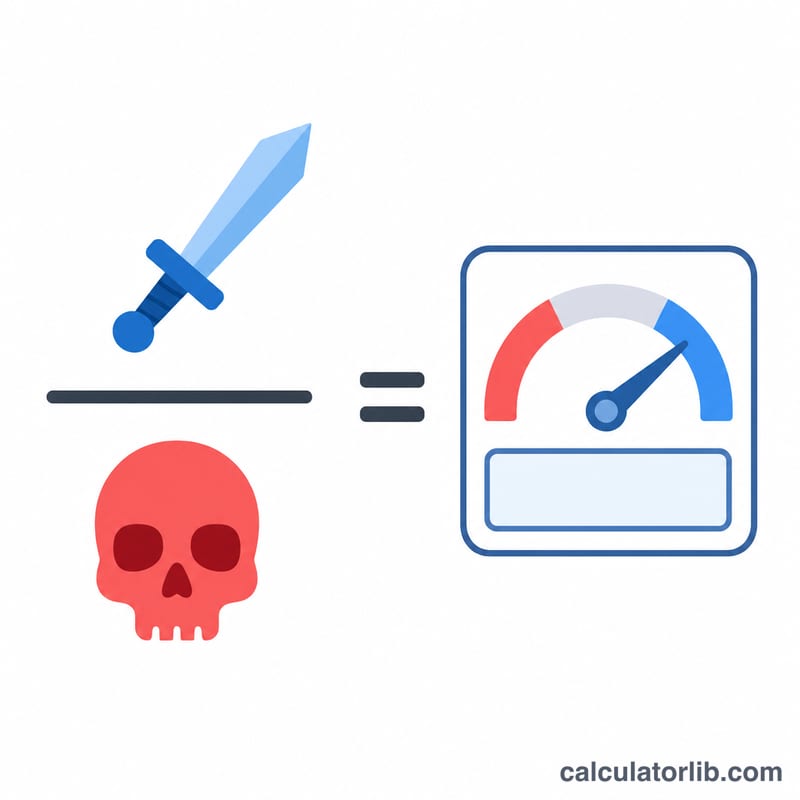
$$\text{K/D} = \frac{\text{Kills}}{\text{Deaths}}$$ and $$\text{KDA} = \frac{\text{Kills} + \text{Assists}}{\text{Deaths}}$$. To avoid dividing by zero, if you have zero deaths the calculator treats the result as your raw kill (or kills + assists) total, since you effectively have a "perfect" game.
Worked Example
Suppose you finished a match with 24 kills, 8 deaths, and 10 assists. Your K/D ratio is $$24 \div 8 = \mathbf{3.0}$$ Your KDA is $$(24 + 10) \div 8 = 34 \div 8 = \mathbf{4.25}$$ Both are strong numbers indicating a dominant performance.
FAQ
What is a good K/D ratio? Anything above 1.0 is positive. Competitive players often aim for 1.5–2.0, while top-tier players exceed 3.0.
What is the difference between K/D and KDA? K/D ignores assists; KDA rewards supportive play by counting assists alongside kills, making it fairer for support and team roles.
What happens with 0 deaths? Division by zero is undefined, so the calculator simply shows your kill total (or kills + assists) as the ratio for a flawless game.