
What is the PF Ratio?
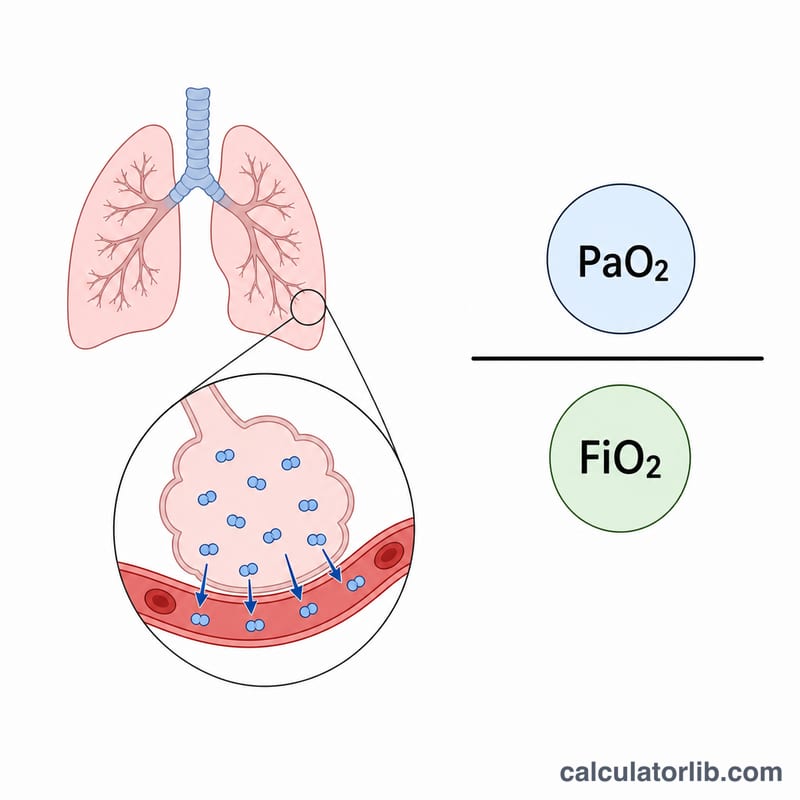
The PF ratio, also written as PaO2/FiO2 or P/F ratio, is a quick clinical index of how well the lungs are oxygenating blood. It divides the arterial partial pressure of oxygen (PaO2, in mmHg, obtained from an arterial blood gas) by the fraction of inspired oxygen (FiO2, expressed as a decimal between 0.21 and 1.0). A lower ratio means worse oxygenation. It is a cornerstone of the Berlin definition used to diagnose and grade Acute Respiratory Distress Syndrome (ARDS).
How to use this calculator
Enter the patient's PaO2 in mmHg and the FiO2 as a percentage (for example 21 for room air, 40 for 40% oxygen, 100 for pure oxygen). The calculator converts the percentage to a decimal fraction, divides PaO2 by it, and returns the P/F ratio along with a Berlin-definition severity interpretation.
The formula explained
The equation is simply P/F = PaO2 ÷ FiO2. Because FiO2 is entered here as a percentage, it is first divided by 100 to become a fraction. For ARDS, with PEEP ≥ 5 cmH2O, the cutoffs are: mild 200–300, moderate 100–200, and severe ≤ 100 mmHg.
$$\text{PF Ratio} = \frac{\text{PaO}_2\ (\text{mmHg})}{\dfrac{\text{FiO}_2\ (\%)}{100}}$$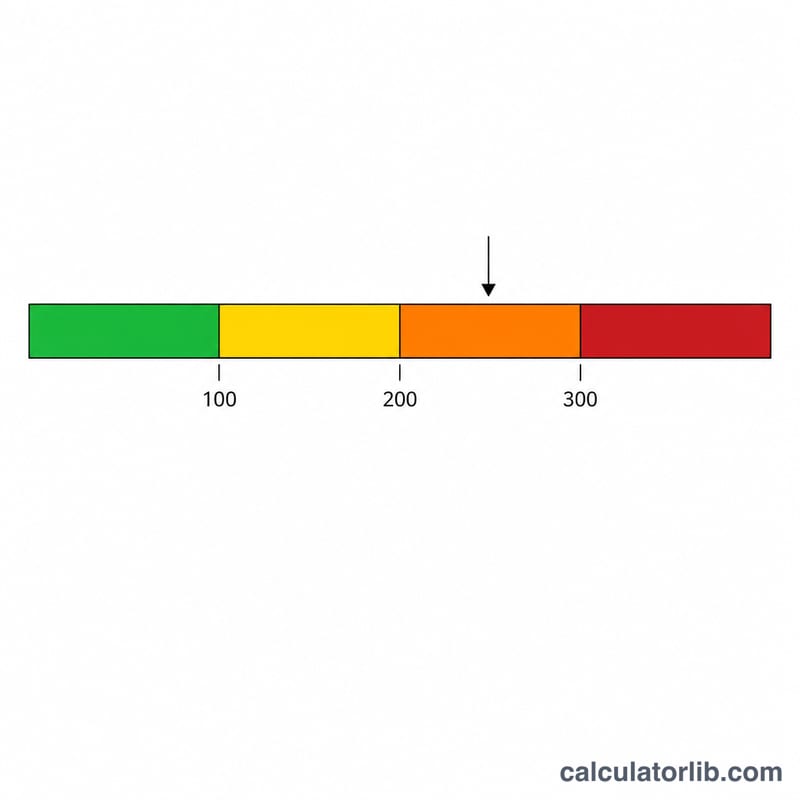
Worked example
Suppose PaO2 is 90 mmHg on FiO2 of 60% (0.60). Then \(\text{P/F} = 90 / 0.60 = 150\ \text{mmHg}\). A ratio of 150 falls in the 100–200 band, indicating moderate ARDS.
FAQ
What is a normal P/F ratio? A healthy person typically has a P/F ratio above 400 mmHg.
Why enter FiO2 as a percent? It is more intuitive at the bedside; the tool converts it to the decimal fraction the formula requires.
Does altitude affect it? Yes — PaO2 is lower at altitude, so the ratio should be interpreted in clinical context. This tool is for educational support, not a substitute for clinical judgment.