
What Is the Qp/Qs Ratio?
The Qp/Qs ratio compares pulmonary blood flow (Qp) to systemic blood flow (Qs). It is a cornerstone measurement in the evaluation of congenital and acquired intracardiac shunts. A ratio of 1.0 indicates balanced circulation with no significant shunt. A ratio greater than 1.0 suggests a net left-to-right shunt (extra blood recirculating through the lungs), while a ratio less than 1.0 suggests a net right-to-left shunt.
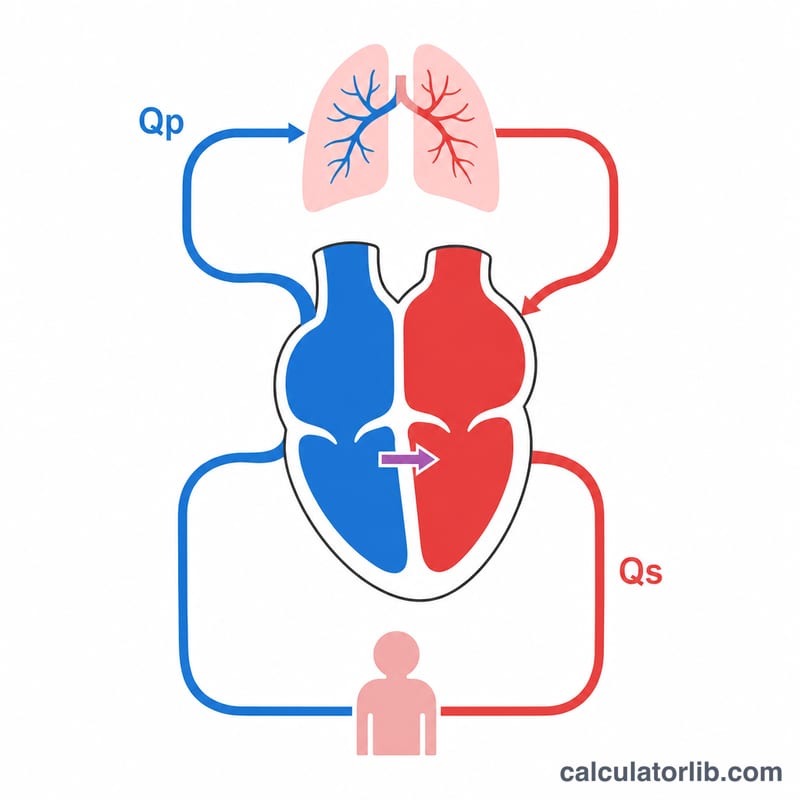
How to Use This Calculator
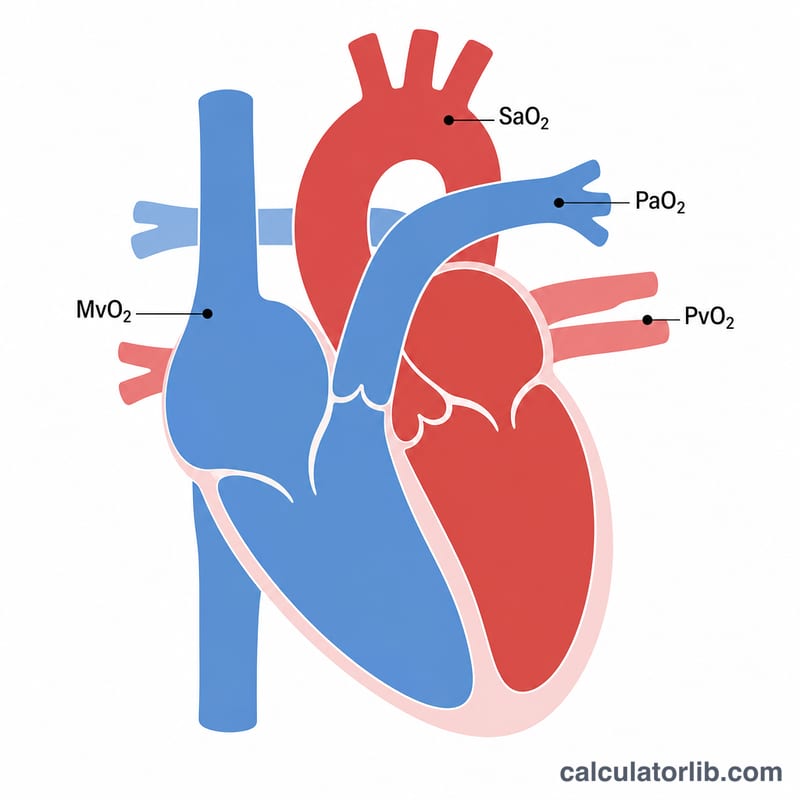
Enter four oxygen saturation values, all measured during cardiac catheterization or oximetry: the systemic arterial saturation (SaO₂, typically aortic), the mixed venous saturation (MvO₂, from the pulmonary artery or calculated), the pulmonary vein saturation (PvO₂), and the pulmonary artery saturation (PaO₂). The calculator instantly returns the Qp/Qs ratio along with the numerator and denominator so you can sanity-check the inputs.
The Formula Explained
The Fick principle expresses flow as oxygen uptake divided by an arteriovenous oxygen content difference. Because the oxygen consumption term cancels when forming the ratio, Qp/Qs simplifies to a ratio of saturation differences:
$$\frac{Q_p}{Q_s} = \frac{\text{SaO}_2 - \text{MvO}_2}{\text{PvO}_2 - \text{PaO}_2}$$
The systemic flow is driven by the difference between arterial and mixed venous saturation; the pulmonary flow is driven by the difference across the lungs (pulmonary vein minus pulmonary artery).
Worked Example
Suppose SaO₂ = 95%, MvO₂ = 75%, PvO₂ = 98%, and PaO₂ = 85%. The numerator is \(95 - 75 = 20\) and the denominator is \(98 - 85 = 13\).
$$\frac{Q_p}{Q_s} = \frac{20}{13} \approx 1.54$$
indicating a moderate left-to-right shunt.
FAQ
What is a normal Qp/Qs? A ratio near 1.0 is normal. Values above ~1.5–2.0 often prompt consideration of shunt closure depending on clinical context.
Where does PvO₂ come from? Pulmonary vein saturation is often assumed to be ~98% if not directly sampled, since fully oxygenated blood leaves the lungs.
Is this a diagnosis? No. This tool is an educational aid for clinicians; interpretation requires full hemodynamic and clinical assessment.