
What Is Vital Capacity?
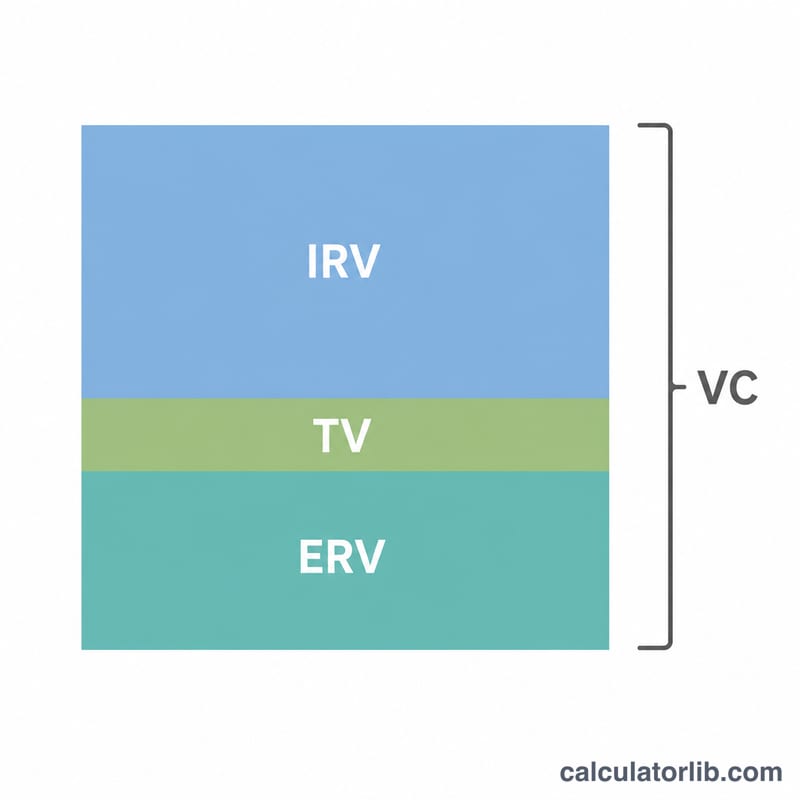
Vital capacity (VC) is the maximum amount of air a person can exhale after a maximal inhalation. It is one of the fundamental lung volume measurements used in respiratory physiology and pulmonary function testing. VC is the sum of three component volumes: tidal volume (TV), inspiratory reserve volume (IRV), and expiratory reserve volume (ERV). This calculator is universal — it is pure arithmetic and applies regardless of country.
How to Use This Calculator
Enter the three lung volume components in milliliters (mL): your tidal volume (the normal breath at rest), your inspiratory reserve volume (extra air you can breathe in beyond a normal breath), and your expiratory reserve volume (extra air you can force out after a normal exhale). The calculator adds them together to give your vital capacity in both mL and liters.
The Formula Explained
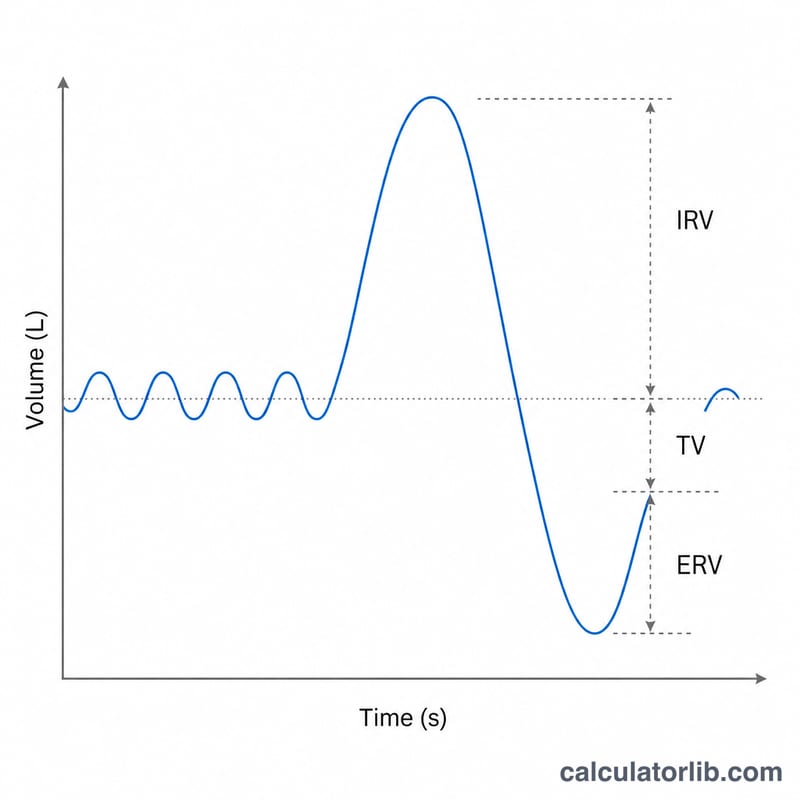
The equation is simply $$\text{VC} = \text{TV} + \text{IRV} + \text{ERV}$$ Tidal volume represents normal quiet breathing, the inspiratory reserve is the additional inhalation capacity, and the expiratory reserve is the additional exhalation capacity. Adding these gives the total usable breathing range. Note that vital capacity does not include residual volume — the air that always remains in the lungs and cannot be voluntarily expelled.
Worked Example
For a typical healthy adult: TV = 500 mL, IRV = 3000 mL, ERV = 1100 mL. The vital capacity is $$500 + 3000 + 1100 = 4600 \text{ mL}$$ or 4.6 L. This is a representative average value; actual values vary with age, sex, height, and fitness.
FAQ
What is a normal vital capacity? For healthy adults it commonly ranges from about 3 to 5 liters, with men typically higher than women.
Does VC include residual volume? No. Vital capacity is the maximum air that can be moved in and out of the lungs and excludes the residual volume that always remains.
How does VC relate to total lung capacity? Total lung capacity (TLC) equals vital capacity plus residual volume \(\text{TLC} = \text{VC} + \text{RV}\).