
What this calculator does
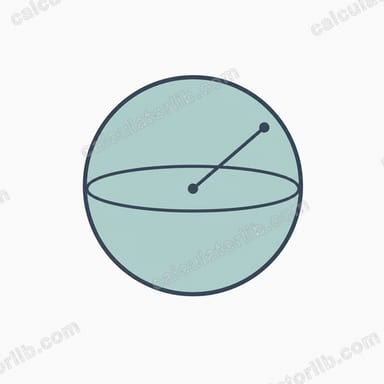
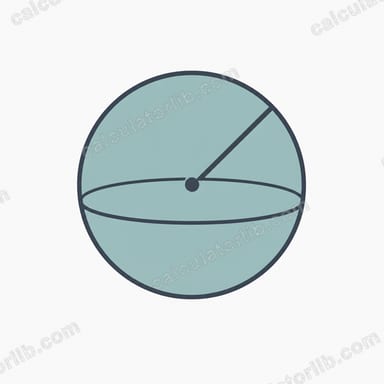
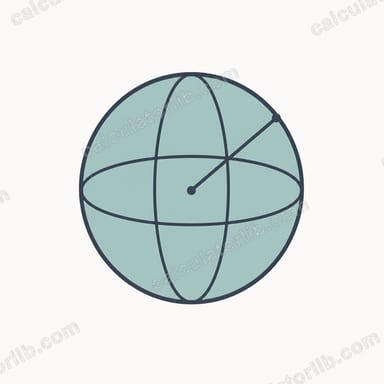
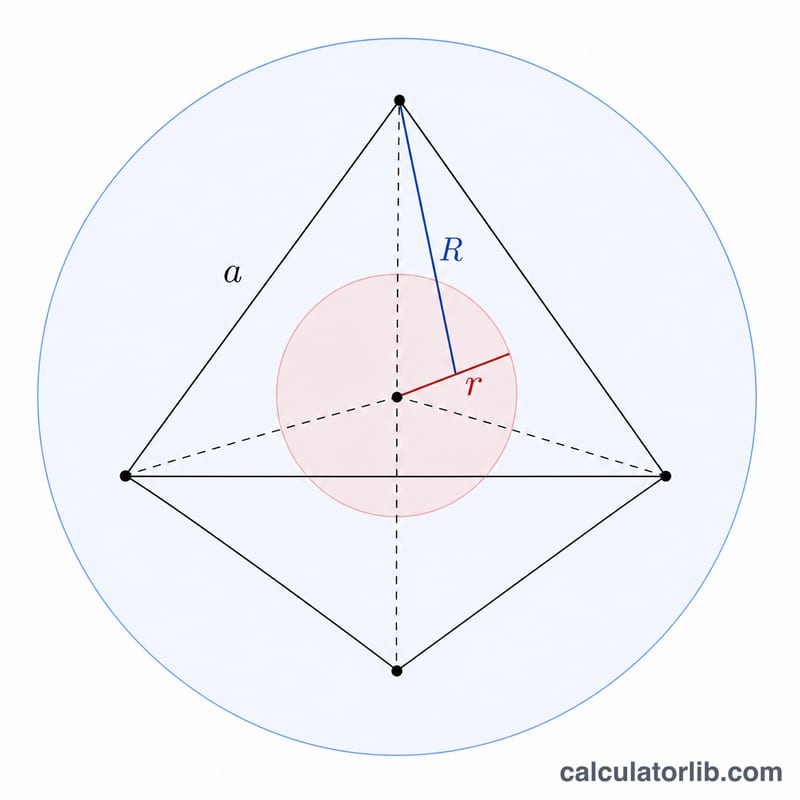
This tool takes the edge length of any one of the five regular (Platonic) polyhedra and returns four geometric quantities: the volume, the surface area, the radius of the inscribed sphere (the largest sphere that fits inside, touching every face) and the radius of the circumscribed sphere (the smallest sphere that contains it, passing through every vertex). The mathematics is universal — it applies identically in every country and uses ordinary decimal output.
The five Platonic solids
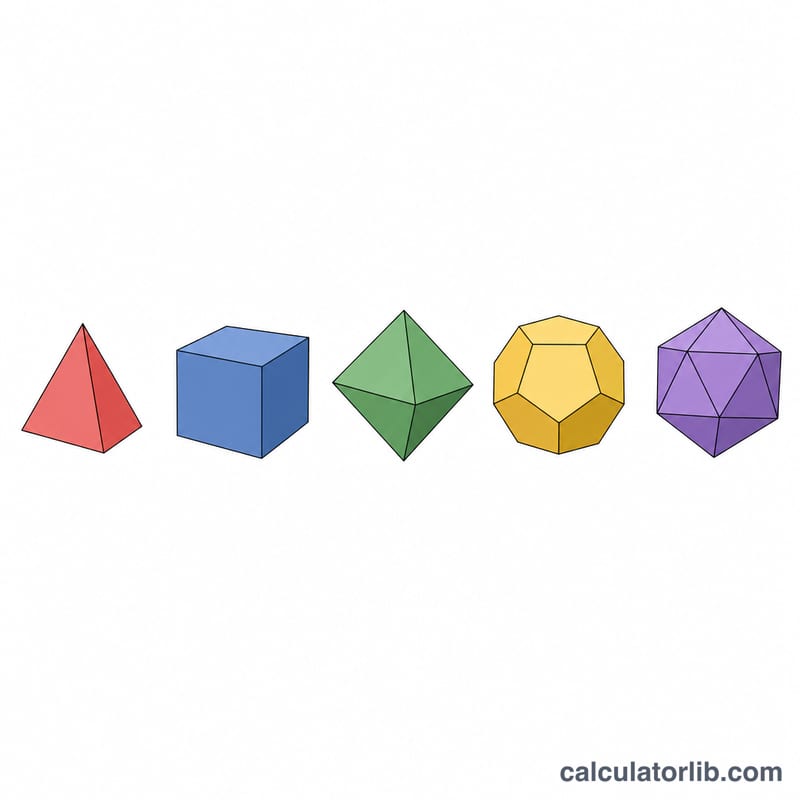
A Platonic solid has identical regular-polygon faces meeting the same way at every vertex. There are exactly five: the regular tetrahedron (4 triangles), the cube or regular hexahedron (6 squares), the regular octahedron (8 triangles), the regular dodecahedron (12 pentagons) and the regular icosahedron (20 triangles).
How to use it
Pick the polyhedron from the dropdown, type the edge length, and choose its unit (mm, cm, m, in or ft). The edge is converted to metres internally, so results are reported in SI: volume in m³, surface area in m² and both radii in m. Every output is a fixed coefficient multiplied by a power of the edge length: volume is proportional to \(a^{3}\), surface area to \(a^{2}\), and both radii to \(a\).
Formula explained
For the regular tetrahedron, $$V = \frac{\sqrt{2}}{12}\cdot a^{3} \approx 0.117851\cdot a^{3}$$ and $$S = \sqrt{3}\cdot a^{2} \approx 1.732051\cdot a^{2},$$ while \(r_{in} = \frac{\sqrt{6}}{12}\cdot a\) and \(r_{out} = \frac{\sqrt{6}}{4}\cdot a\). Each of the other four solids has its own closed-form coefficients (the cube is simplest: \(V = a^{3}\), \(S = 6a^{2}\), \(r_{in} = a/2\), \(r_{out} = \frac{\sqrt{3}}{2}a\)). For every solid the circumradius is strictly larger than the inradius.
Worked example
Take a cube with edge \(a = 2\) m. $$V = 2^{3} = 8 \text{ m}^{3}.$$ $$S = 6 \times 2^{2} = 24 \text{ m}^{2}.$$ $$r_{in} = 2/2 = 1 \text{ m}.$$ $$r_{out} = \frac{\sqrt{3}}{2} \times 2 = \sqrt{3} \approx 1.732051 \text{ m}.$$
FAQ
What is the difference between the two sphere radii? The inradius measures the in-sphere that just touches each face from inside; the circumradius measures the sphere through all the vertices.
Can I enter an edge in inches or feet? Yes — choose the unit and the value is converted to metres before computing, so all outputs are SI.
What if I enter zero or a negative edge? A solid must have a strictly positive edge, so the calculator flags non-positive input as invalid.