
What is the nPr Permutations Calculator?
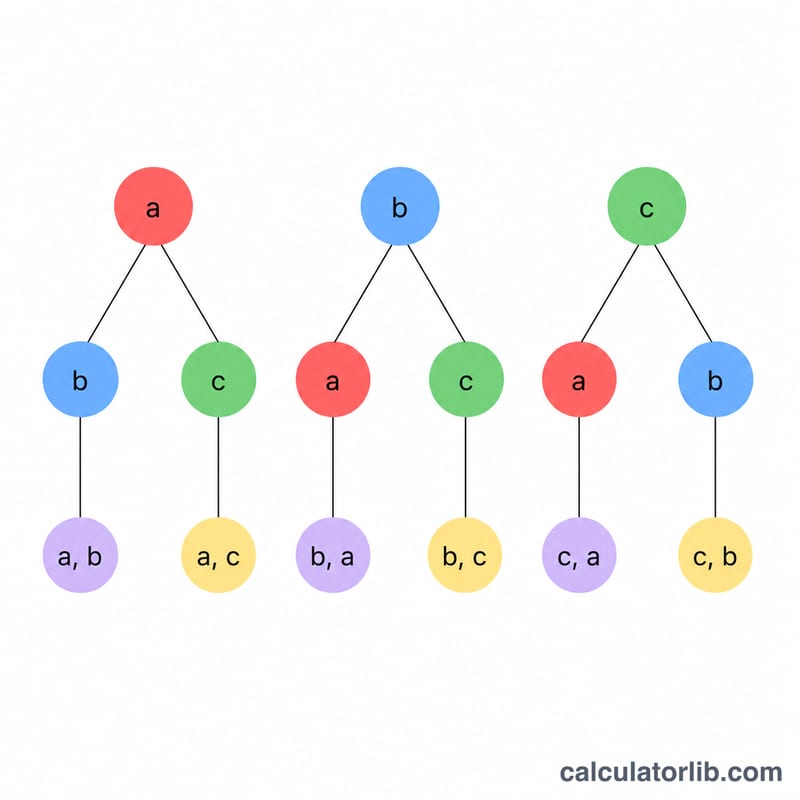
A permutation counts the number of distinct ordered arrangements you can make by selecting r items from a set of n distinct items. Order matters: choosing A then B is different from choosing B then A. This calculator computes nPr, written as nP r or P(n, r), for any non-negative integers n and r.
How to Use It
Enter n, the total number of distinct items available, and r, the number of items you select and arrange. The calculator returns the count of all possible ordered arrangements. Both values must be non-negative whole numbers; decimals are floored and negatives are rejected.
The Formula Explained
The standard formula is:
$$P(\text{n}, \text{r}) = \frac{\text{n}!}{\left(\text{n} - \text{r}\right)!}$$
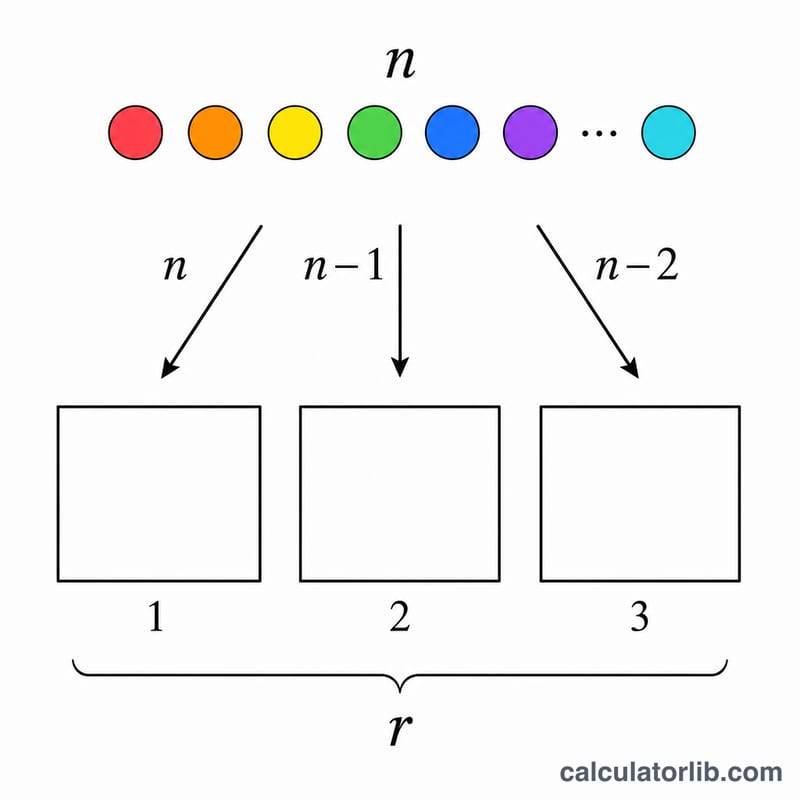
To avoid computing huge factorials, this tool uses the equivalent falling-factorial form: multiply r consecutive descending integers starting at n, that is \(\text{n} \times (\text{n}-1) \times \ldots \times (\text{n}-\text{r}+1)\). This keeps precision higher for moderate inputs. For very large n the exact integer can exceed the safe range of floating-point numbers, so extremely large results may lose exact integer precision.
Worked Example
Suppose you have 10 distinct items and want to select and arrange 3 of them. Then $$P(10, 3) = \frac{10!}{7!} = 10 \times 9 \times 8 = 720.$$ There are 720 distinct ordered arrangements.
FAQ
What is nPr when r = 0? It equals 1 — there is exactly one way to arrange nothing (the empty arrangement), consistent with \(0! = 1\).
What if r is greater than n? The result is 0. You cannot select more distinct items than are available.
How is nPr different from nCr (combinations)? Permutations count ordered arrangements, while combinations count unordered selections. They are related by \(P(\text{n}, \text{r}) = C(\text{n}, \text{r}) \times \text{r}!\).