
What is the Combinations (nCr) Calculator?
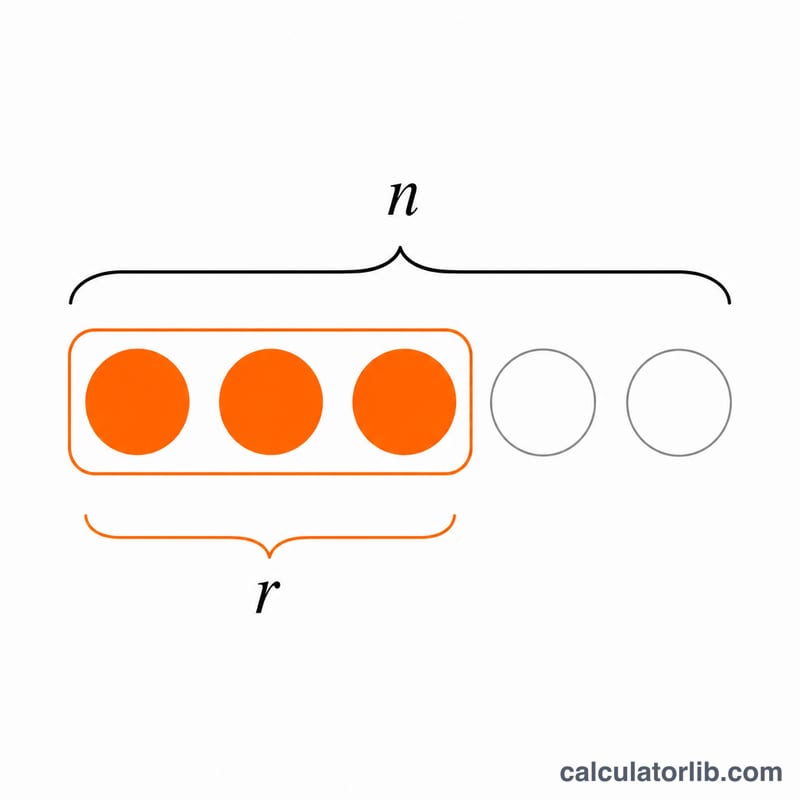
This calculator finds the number of combinations — written nCr, C(n, r), or "n choose r" — which is the number of ways to select r items from a set of n distinct items when the order of selection does not matter. Picking {A, B} is the same combination as picking {B, A}. This is the binomial coefficient, a cornerstone of combinatorics, probability, and statistics.
How to use it
Enter the total number of items n and the number you want to choose r, then read off the result. Both values must be non-negative integers, and r cannot exceed n (the page enforces n ≥ r ≥ 0). The calculator uses exact big-integer arithmetic, so even very large results stay precise without rounding.
The formula explained
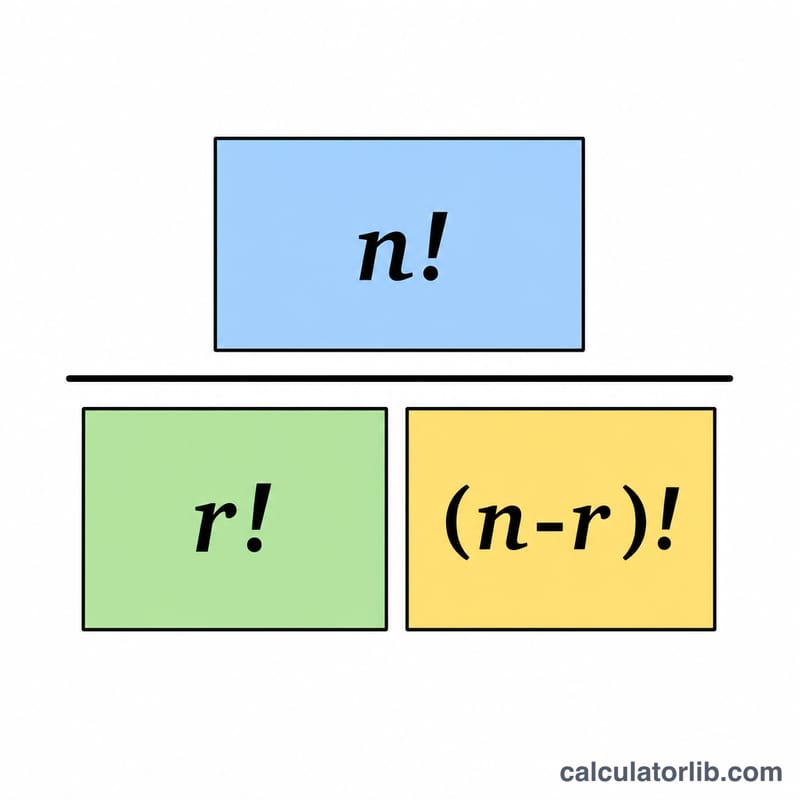
The classic definition is $$C(n, r) = \frac{n!}{r!\,(n - r)!}$$ To avoid computing huge factorials, this tool uses the stable multiplicative form with the symmetry rule \(C(n, r) = C(n, n - r)\): set \(k = \min(r, n - r)\), start with 1, and repeatedly multiply by \((n - k + i)\) and divide by \(i\) for \(i = 1..k\). Each division is exact, so the running value is always a whole number.
Worked example
How many 2-card hands can you draw from 4 cards? $$C(4, 2) = \frac{4!}{2!\cdot 2!} = \frac{24}{4} = 6$$ A lottery example: choosing 6 numbers from 49 gives \(C(49, 6) = 13{,}983{,}816\) distinct tickets — which is why the jackpot odds are so steep.
FAQ
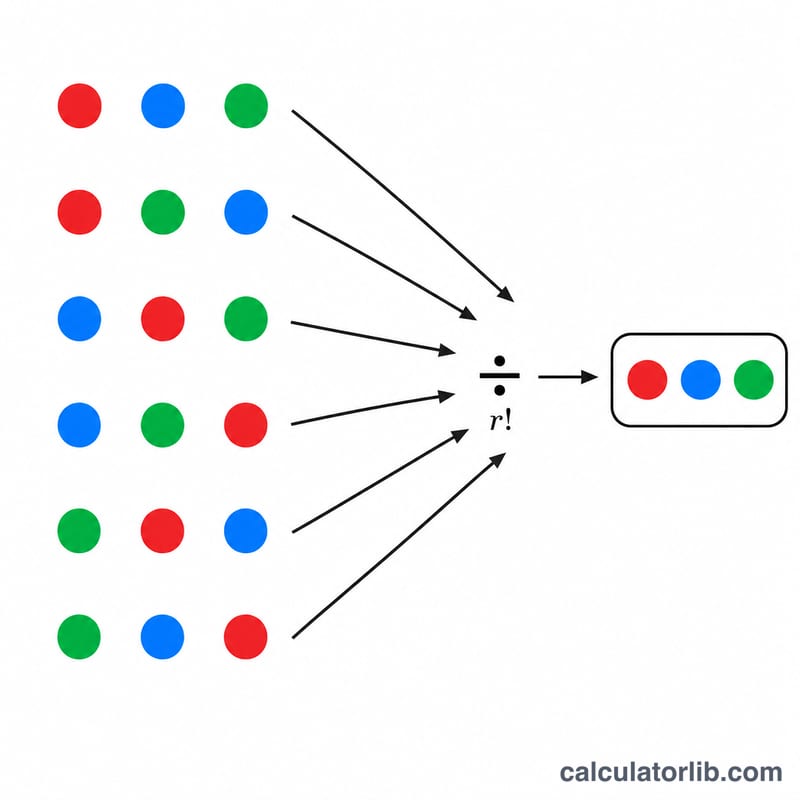
What is the difference between combinations and permutations? Combinations ignore order; permutations count it. \(nPr = nCr \cdot r!\), so permutations are always larger (or equal) for the same n and r.
What is \(C(n, 0)\) or \(C(n, n)\)? Both equal 1: there is exactly one way to choose nothing, and one way to choose everything.
Can r be larger than n? No. You cannot choose more items than exist, so \(C(n, r) = 0\) when \(r > n\); this calculator treats that case as invalid and returns 0.