
What is Maddrey's Discriminant Function?
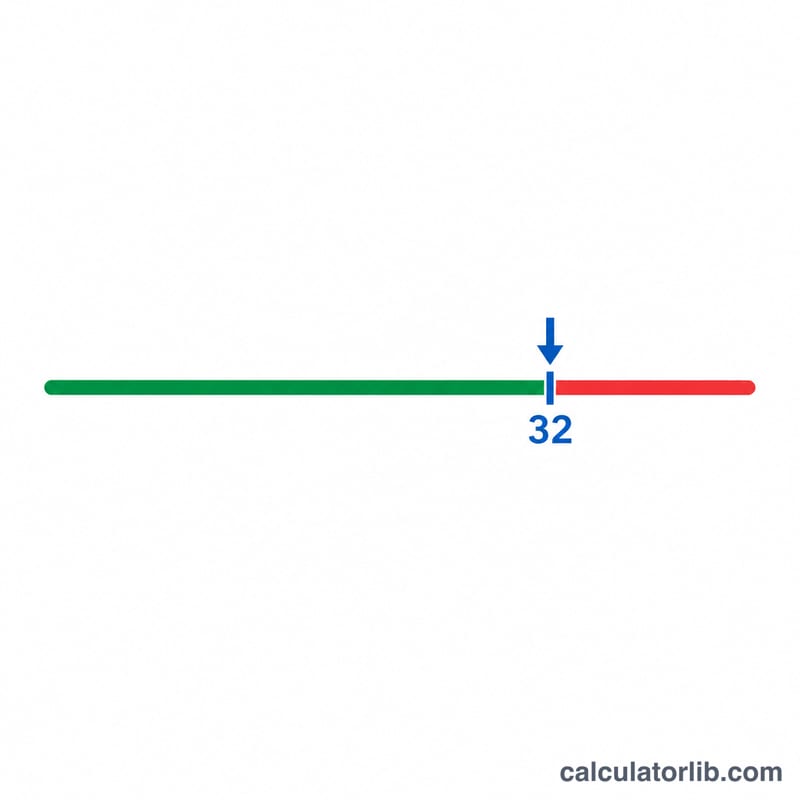
Maddrey's Discriminant Function (mDF), also called the discriminant function or DF, is a clinical scoring tool used to assess the severity and short-term prognosis of alcoholic hepatitis. First described by Maddrey and colleagues in 1978 and later modified, it combines a patient's prothrombin time (compared with a laboratory control value) and serum total bilirubin into a single number. A DF score of 32 or higher identifies patients with severe disease who have a high 30-day mortality risk and who may benefit from corticosteroid or pentoxifylline therapy.
How to use this calculator
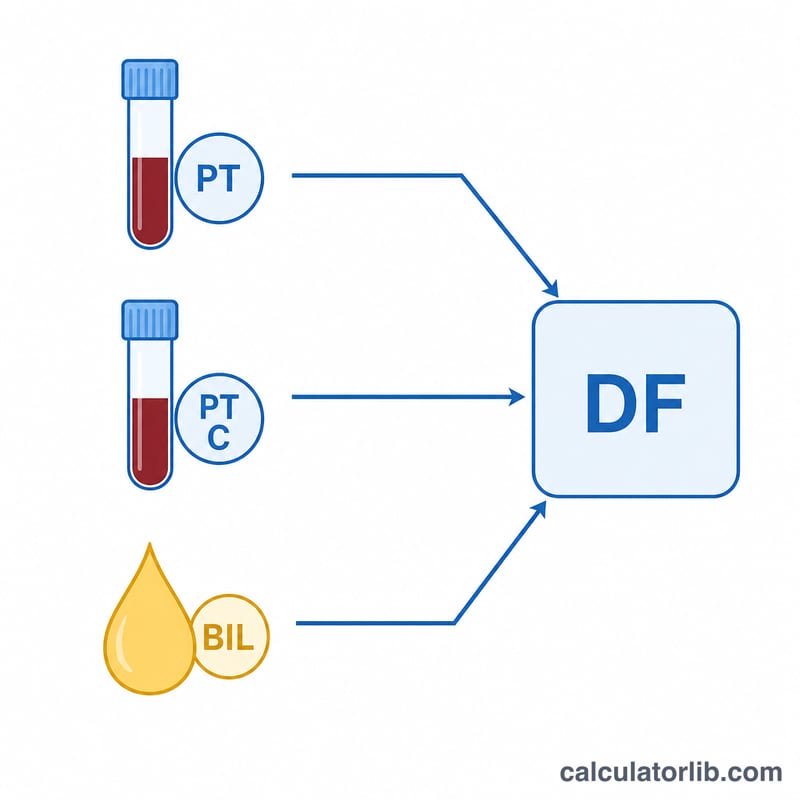
Enter the patient's prothrombin time (PT) in seconds, the laboratory's control PT in seconds, and the total bilirubin in mg/dL. The calculator instantly returns the DF score and flags whether the value meets the severe threshold. Make sure the PT and control PT come from the same assay so the difference is meaningful.
The formula explained
The equation is $$\text{DF} = 4.6 \times \left( \text{Patient PT} - \text{Control PT} \right) + \text{Total Bilirubin}$$ The prothrombin time difference reflects the liver's synthetic (clotting) function, while bilirubin reflects its excretory function. The constant 4.6 weights the coagulation component. Bilirubin is expressed in mg/dL; if your lab reports it in µmol/L, divide by 17.1 first.
Worked example
A patient has a PT of 20 seconds, a control PT of 12 seconds, and total bilirubin of 15 mg/dL. $$\text{DF} = 4.6 \times (20 - 12) + 15 = 4.6 \times 8 + 15 = 36.8 + 15 = \mathbf{51.8}$$ Because \(51.8 \geq 32\), this indicates severe alcoholic hepatitis.
FAQ
What DF value is considered severe? A score of 32 or greater indicates severe alcoholic hepatitis with poor prognosis.
Which bilirubin units should I use? Use mg/dL. Convert µmol/L to mg/dL by dividing by 17.1.
Is the DF still used? Yes, although newer scores like MELD and the Glasgow Alcoholic Hepatitis Score are also used; mDF remains a widely cited threshold for treatment decisions. This tool is for educational purposes and does not replace clinical judgment.