
What is the Discriminant?
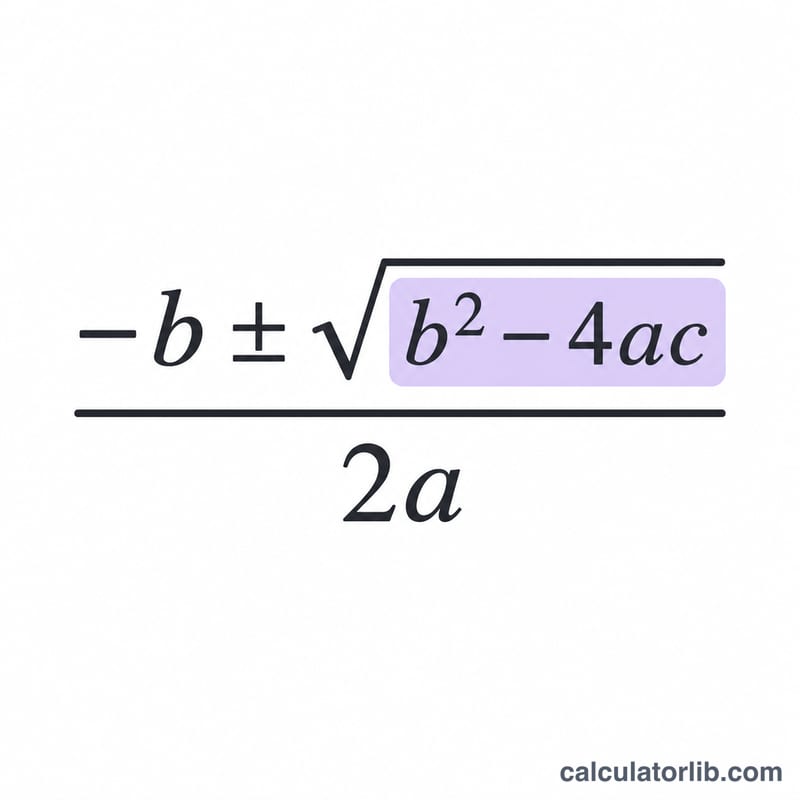
The discriminant is the part of the quadratic formula under the square root sign. For any quadratic equation written as ax² + bx + c = 0, the discriminant is defined as \(\Delta = b^{2} - 4ac\). Its value tells you, without solving the equation, how many real solutions (roots) the quadratic has and whether they are real or complex.
How to Use This Calculator
Enter the three coefficients of your quadratic equation: a (the coefficient of x²), b (the coefficient of x), and c (the constant term). Click calculate and the tool returns \(\Delta\) along with the number of real roots. Note that a should not be zero — otherwise the equation is linear, not quadratic.
The Formula Explained
$$\Delta = b^{2} - 4ac$$ The sign of \(\Delta\) classifies the roots:
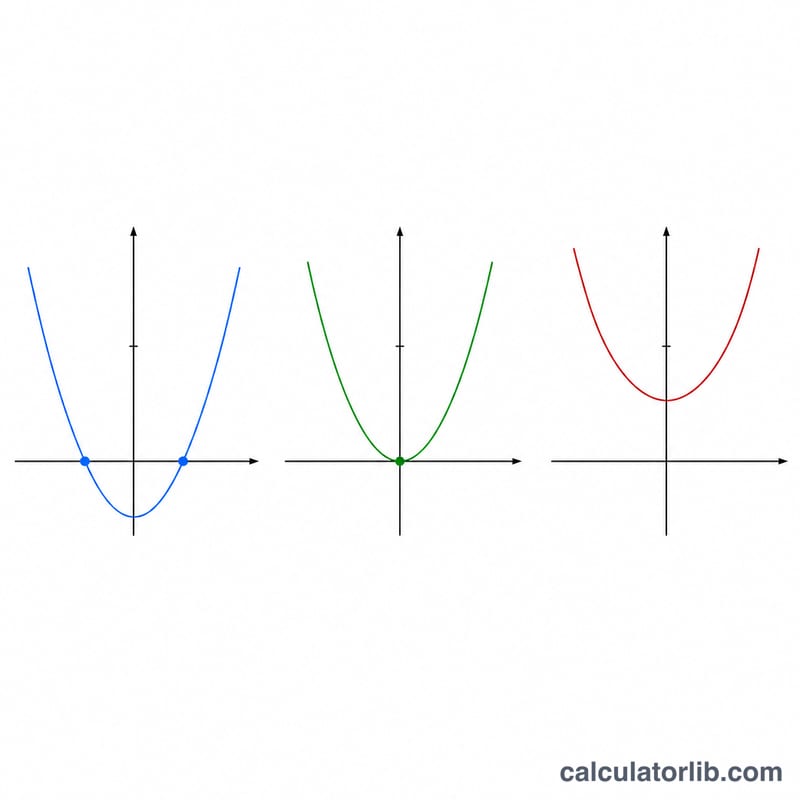
- \(\Delta > 0\) — two distinct real roots.
- \(\Delta = 0\) — exactly one repeated real root.
- \(\Delta < 0\) — no real roots; the two roots are complex conjugates.
Worked Example
Take the equation x² − 3x + 2 = 0, so a = 1, b = −3, c = 2. Then $$\Delta = (-3)^{2} - 4(1)(2) = 9 - 8 = 1.$$ Since \(\Delta = 1 > 0\), the equation has two distinct real roots (which happen to be x = 1 and x = 2).
FAQ
What if a = 0? The equation is no longer quadratic but linear, and the discriminant concept does not apply.
Can the discriminant be negative? Yes. A negative discriminant means there are no real roots — the solutions are complex numbers.
What does a discriminant of zero mean? It means the parabola touches the x-axis at exactly one point, giving a single repeated real root.