
What this calculator does
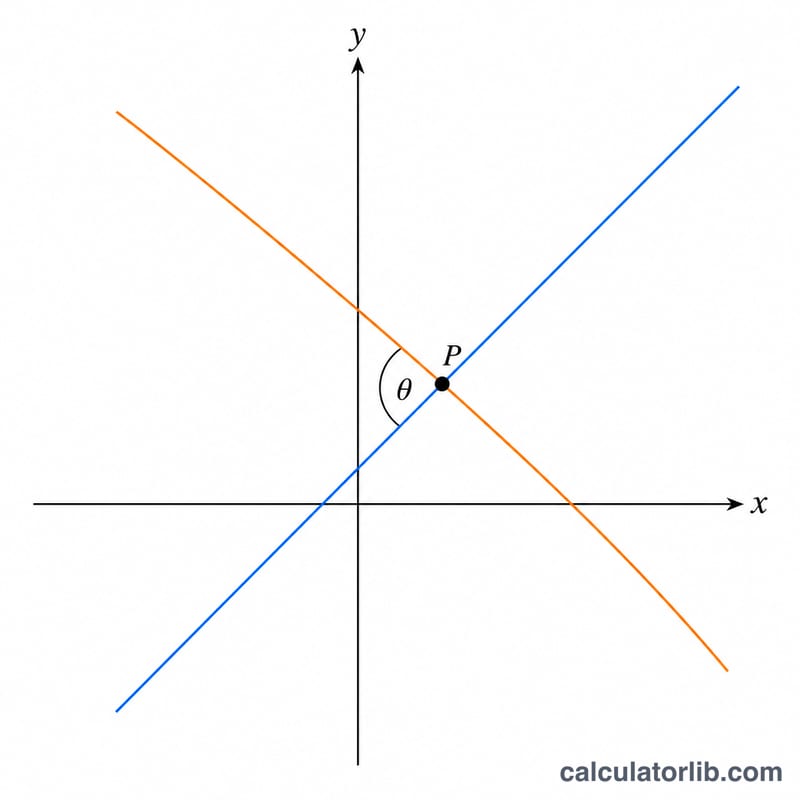
Given two straight lines written in slope-intercept form, \(y = a_1\cdot x + b_1\) and \(y = a_2\cdot x + b_2\), this tool finds their intersection point \(P(x_p, y_p)\) and the acute angle \(\theta\) at which the lines cross. It is a pure-math geometry tool that works in any coordinate plane, so no country or unit system applies.
How to use it
Enter the slope and y-intercept of each line. Choose whether you want the crossing angle reported in degrees (default) or radians, then read the intersection coordinates and angle from the results panel. If the lines are parallel the tool reports that no intersection exists; if they are the same line it reports that they are identical.
The formulas explained
Two lines meet where their y-values are equal: \(a_1\cdot x + b_1 = a_2\cdot x + b_2\). Solving for x gives \(x_p = (b_2 - b_1) / (a_1 - a_2)\), and substituting back gives \(y_p = a_1\cdot x_p + b_1\). The angle between the lines comes from the tangent-difference identity: \(\theta = \left| \arctan\left( \frac{a_2 - a_1}{1 + a_1\cdot a_2} \right) \right|\). The absolute value guarantees the acute angle (0° to 90°). When \(1 + a_1\cdot a_2 = 0\) the lines are perpendicular and \(\theta\) is exactly 90° (\(\pi/2\) radians).
$$\begin{gathered} x_p = \frac{b_2 - b_1}{a_1 - a_2}, \qquad y_p = a_1\,x_p + b_1 \\[1.5em] \theta = \left| \arctan\!\left( \frac{a_2 - a_1}{1 + a_1\,a_2} \right) \right| \times \frac{180}{\pi} \end{gathered}$$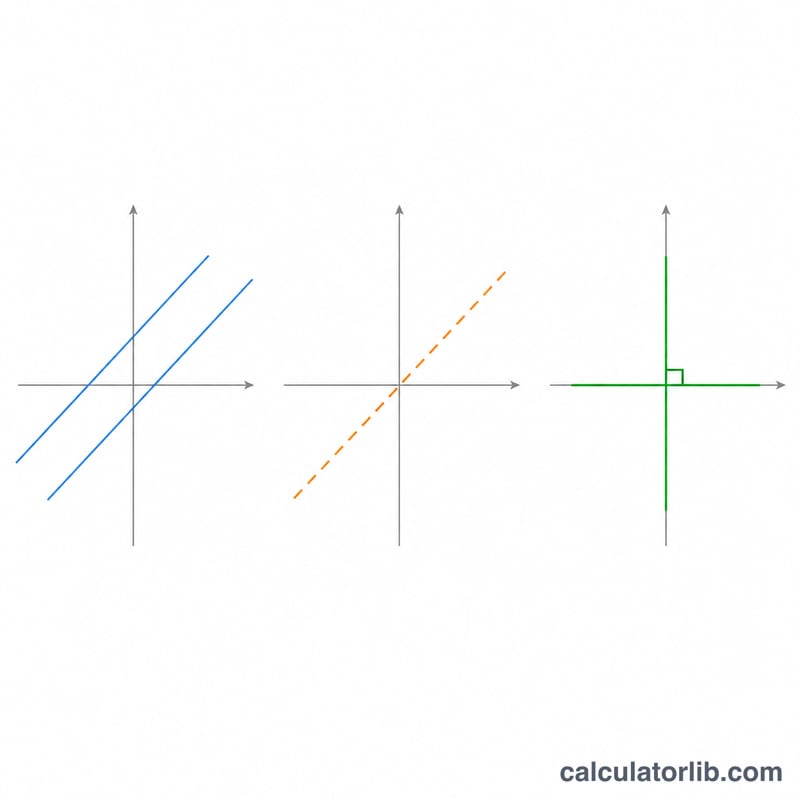
Worked example
Take \(a_1 = 2\), \(b_1 = 4\), \(a_2 = -2\), \(b_2 = 2\) in degrees. Then $$x_p = \frac{2 - 4}{2 - (-2)} = \frac{-2}{4} = -0.5,$$ and $$y_p = 2\cdot(-0.5) + 4 = 3.$$ The angle is $$\arctan\!\left(\frac{-2 - 2}{1 + (2)(-2)}\right) = \arctan\!\left(\frac{-4}{-3}\right) = \arctan(1.3333) = 0.9273 \text{ rad} = 53.13°.$$
FAQ
What if the slopes are equal? Equal slopes mean the lines are parallel and never meet, so there is no intersection point; if the intercepts are also equal the lines are identical.
Why is the angle always acute? Two crossing lines form two pairs of equal angles that sum to 180°. Reporting the acute value (0°–90°) gives a single, unambiguous answer.
How are perpendicular lines handled? When \(1 + a_1\cdot a_2\) equals zero the arctangent argument is undefined, so the calculator returns exactly 90° (\(\pi/2\)).