
What this calculator does
This tool tabulates the Bessel function of the first kind, written \(J_v(x)\), for a fixed order \(v\) while sweeping the argument \(x\). You choose a starting \(x\) value, an increment, and how many rows to generate, and the calculator returns a clean two-column table of \(x\) versus \(J_v(x)\). Bessel functions of the first kind appear throughout physics and engineering: vibrations of a circular drum, heat conduction in cylinders, electromagnetic waves in waveguides, and signal processing (FM modulation sidebands).
How to use it
Enter the Order \(v\) (any real number — 0, 1, 2, fractional like 0.5, or negative). Set the Initial value of \(x\), the Increment (the spacing between successive \(x\) values; may be negative for a descending sweep or zero to repeat one point), and the Number of repetitions (how many rows, from 1 up to 10000). Row \(i\) uses \(x = \text{startX} + i \times \text{stepX}\).
The formula explained
The function is defined by the power series $$J_v(x) = \sum_{k=0}^{\infty} \frac{(-1)^k}{k!\,\Gamma(k+v+1)} \left(\frac{x}{2}\right)^{v+2k},$$ where \(\Gamma\) is the gamma function. The calculator evaluates this series term by term using a stable recurrence: each term is obtained from the previous one by multiplying by \(-(x^2/4) / ((k+1)(k+v+1))\), which avoids factorial overflow. The gamma function is computed with the Lanczos approximation so that non-integer and negative orders work. For negative integer order it uses the identity \(J_{-n}(x) = (-1)^n J_n(x)\).
Worked example
With \(v = 0\), \(\text{startX} = 0\), \(\text{stepX} = 0.2\), \(\text{loopCount} = 6\) the table gives \(J_0(0) = 1\), \(J_0(0.2) \approx 0.990025\), \(J_0(0.4) \approx 0.960398\), \(J_0(0.6) \approx 0.912005\), \(J_0(0.8) \approx 0.846287\), and \(J_0(1.0) \approx 0.765198\) — matching the standard tabulated value \(J_0(1) = 0.7651976866\).
Reference Values of J_v(x)
The table below lists the Bessel function of the first kind \(J_v(x)\) for orders \(v=0,1,2\) at several standard arguments. Values are rounded to six decimal places and follow from the series \(J_{v}(x)=\sum_{k=0}^{\infty}\frac{(-1)^{k}}{k!\,\Gamma(v+k+1)}\left(\frac{x}{2}\right)^{2k+v}\).
| \(x\) | \(J_0(x)\) | \(J_1(x)\) | \(J_2(x)\) |
|---|---|---|---|
| 0 | 1.000000 | 0.000000 | 0.000000 |
| 0.5 | 0.938470 | 0.242268 | 0.030604 |
| 1 | 0.765198 | 0.440051 | 0.114903 |
| 2 | 0.223891 | 0.576725 | 0.352834 |
| 3 | −0.260052 | 0.339059 | 0.486091 |
| 5 | −0.177597 | −0.327579 | 0.046565 |
| 10 | −0.245936 | 0.043473 | 0.254630 |
As a worked check, evaluate \(J_0(1)\): the leading terms give \(1-\tfrac{(0.5)^2}{1}+\tfrac{(0.5)^4}{4}-\tfrac{(0.5)^6}{36}+\dots = 1-0.25+0.015625-0.000434+\dots\approx\) 0.765198.
Notable Zeros (Roots)
The positive zeros are the values of \(x\) where \(J_v(x)=0\); they set drum modes, waveguide cutoffs and similar boundary conditions.
| Root index \(s\) | \(s\)-th zero of \(J_0\) | \(s\)-th zero of \(J_1\) |
|---|---|---|
| 1 | 2.404826 | 3.831706 |
| 2 | 5.520078 | 7.015587 |
| 3 | 8.653728 | 10.173468 |
| 4 | 11.791534 | 13.323692 |
Note that \(x=0\) is a zero of \(J_v\) for every order \(v>0\), but it is not counted among the positive roots above.
Definitions & Glossary
- Order \(v\)
- The parameter (here the form field order) that selects which member of the Bessel family is computed. It may be any real number — integer orders arise in cylindrical problems, half-integer orders \(v=n+\tfrac12\) give the spherical Bessel functions.
- Argument \(x\)
- The independent variable at which \(J_v\) is evaluated. In this table it starts at startX and advances by stepX for loopCount rows.
- Gamma function \(\Gamma\)
- The continuous extension of the factorial, with \(\Gamma(n+1)=n!\) for non-negative integers. It appears in the denominator \(\Gamma(v+k+1)\) of the series so that non-integer orders are well defined.
- Bessel function of the first kind \(J_v(x)\)
- The solution of Bessel's differential equation \(x^2 y''+x y'+(x^2-v^2)y=0\) that remains finite at the origin (for \(v\ge 0\)). It is given by the power series in the formula above.
- Zeros / roots
- The values of \(x\) at which \(J_v(x)=0\). Each order has infinitely many positive zeros, increasingly evenly spaced and asymptotically separated by \(\pi\).
- Half-integer (spherical) order
- When \(v=n+\tfrac12\), \(J_v\) relates to the spherical Bessel functions \(j_n(x)=\sqrt{\tfrac{\pi}{2x}}\,J_{n+1/2}(x)\), which describe radial parts of wave equations in spherical coordinates.
- Recurrence-term ratio
- Successive terms of the series satisfy \(\frac{a_{k+1}}{a_k}=\frac{-(x/2)^2}{(k+1)(v+k+1)}\), which is used internally to generate each term from the previous one and to assess convergence.
Interpreting Your Table
A few facts help read the columns your sweep produces:
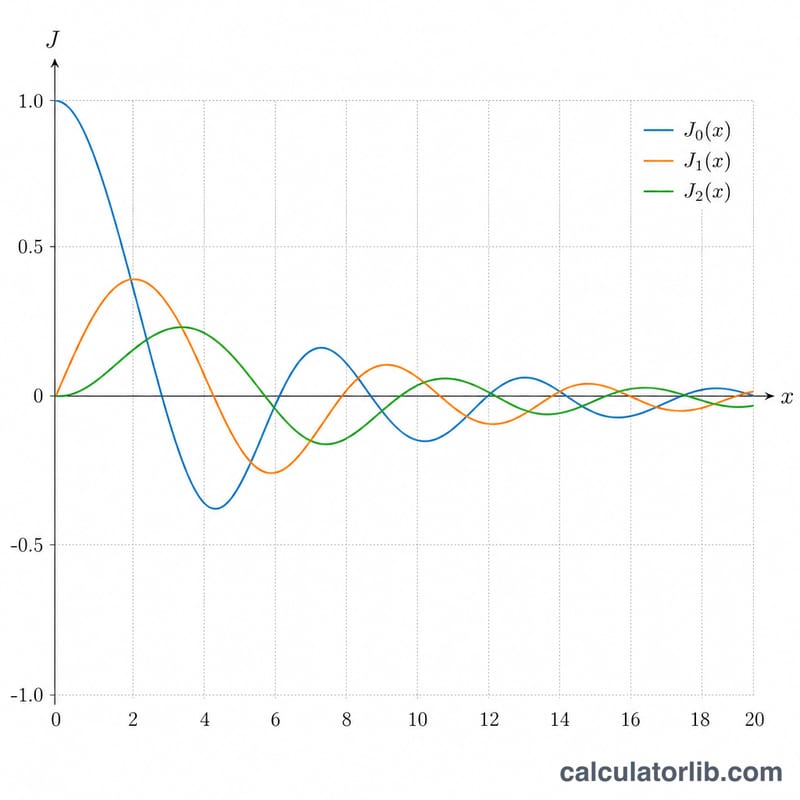
- Starting values. \(J_0(0)=1\), while \(J_v(0)=0\) for every order \(v>0\). So a table beginning at \(x=0\) starts at 1 only for the zeroth order.
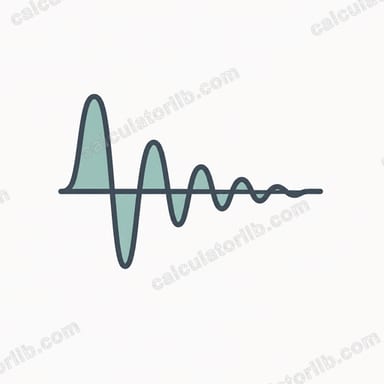
- Oscillation with decay. For large \(x\), \(J_v(x)\approx\sqrt{\tfrac{2}{\pi x}}\cos\!\left(x-\tfrac{v\pi}{2}-\tfrac{\pi}{4}\right)\). The function oscillates like a phase-shifted cosine while its amplitude decays as \(1/\sqrt{x}\). Successive maxima therefore shrink slowly as \(x\) grows.
- Sign changes mark zeros. Wherever a column changes sign between two rows, a root of \(J_v\) lies in that interval (e.g. \(J_0\) switches sign between \(x=2\) and \(x=3\), bracketing its first zero \(\approx 2.4048\)). For large arguments consecutive zeros are spaced by about \(\pi\).
- Physical nodes. Those zeros correspond to physical boundary conditions: the radial modes of a vibrating circular drumhead, cutoff frequencies of cylindrical waveguides, and field patterns in optical fibers are all indexed by zeros of \(J_v\).
- Magnitude. For fixed \(x\), higher orders \(v\) start near zero and rise more slowly; for small \(x\) the leading behavior is \(J_v(x)\sim \frac{1}{\Gamma(v+1)}\left(\frac{x}{2}\right)^{v}\), so larger \(v\) stays smaller until \(x\) becomes comparable to \(v\).
These observations follow from the established series and asymptotic forms above and apply to any order you enter.
FAQ
Can the order be a fraction or negative? Yes. The gamma-based series supports any real order, including half-integers (which give spherical Bessel forms) and negative values.
What happens at \(x = 0\)? \(J_0(0) = 1\) and \(J_v(0) = 0\) for \(v > 0\), because the leading \((x/2)^v\) factor vanishes.
How accurate is it for large \(x\)? The double-precision series is accurate for typical ranges (\(x\) up to roughly 20–30). For very large \(x\), catastrophic cancellation can reduce precision; in that regime the asymptotic form \(J_v(x) \approx \sqrt{2/(\pi x)} \cos(x - v\pi/2 - \pi/4)\) is preferable.