Connect via MCP →

Enter Calculation

Formula

Advertisement

Results

Softplus at x = 0 (reference)
0.693147
101 rows generated · x from -5 step 0.1
x Softplus f(x) First derivative f'(x)
-5 0.006715 0.006693
-4.9 0.007419 0.007392
-4.8 0.008196 0.008163
-4.7 0.009054 0.009013
-4.6 0.010002 0.009952
-4.5 0.011048 0.010987
-4.4 0.012203 0.012128
-4.3 0.013477 0.013387
-4.2 0.014884 0.014774
-4.1 0.016437 0.016302
-4 0.01815 0.017986
-3.9 0.02004 0.01984
-3.8 0.022124 0.021881
-3.7 0.024423 0.024127
-3.6 0.026957 0.026597
-3.5 0.02975 0.029312
-3.4 0.032828 0.032295
-3.3 0.036219 0.035571
-3.2 0.039953 0.039166
-3.1 0.044064 0.043107
-3 0.048587 0.047426
-2.9 0.053563 0.052154
-2.8 0.059033 0.057324
-2.7 0.065044 0.062973
-2.6 0.071645 0.069138
-2.5 0.07889 0.075858
-2.4 0.086836 0.083173
-2.3 0.095545 0.091123
-2.2 0.105083 0.09975
-2.1 0.11552 0.109097
-2 0.126928 0.119203
-1.9 0.139387 0.130108
-1.8 0.152978 0.141851
-1.7 0.167786 0.154465
-1.6 0.183901 0.167982
-1.5 0.201413 0.182426
-1.4 0.220417 0.197816
-1.3 0.241008 0.214165
-1.2 0.263282 0.231475
-1.1 0.287335 0.24974
-1 0.313262 0.268941
-0.9 0.341154 0.28905
-0.8 0.371101 0.310026
-0.7 0.403186 0.331812
-0.6 0.437488 0.354344
-0.5 0.474077 0.377541
-0.4 0.513015 0.401312
-0.3 0.554355 0.425557
-0.2 0.598139 0.450166
-0.1 0.644397 0.475021
0 0.693147 0.5
0.1 0.744397 0.524979
0.2 0.798139 0.549834
0.3 0.854355 0.574443
0.4 0.913015 0.598688
0.5 0.974077 0.622459
0.6 1.037488 0.645656
0.7 1.103186 0.668188
0.8 1.171101 0.689974
0.9 1.241154 0.71095
1 1.313262 0.731059
1.1 1.387335 0.75026
1.2 1.463282 0.768525
1.3 1.541008 0.785835
1.4 1.620417 0.802184
1.5 1.701413 0.817574
1.6 1.783901 0.832018
1.7 1.867786 0.845535
1.8 1.952978 0.858149
1.9 2.039387 0.869892
2 2.126928 0.880797
2.1 2.21552 0.890903
2.2 2.305083 0.90025
2.3 2.395545 0.908877
2.4 2.486836 0.916827
2.5 2.57889 0.924142
2.6 2.671645 0.930862
2.7 2.765044 0.937027
2.8 2.859033 0.942676
2.9 2.953563 0.947846
3 3.048587 0.952574
3.1 3.144064 0.956893
3.2 3.239953 0.960834
3.3 3.336219 0.964429
3.4 3.432828 0.967705
3.5 3.52975 0.970688
3.6 3.626957 0.973403
3.7 3.724423 0.975873
3.8 3.822124 0.978119
3.9 3.92004 0.98016
4 4.01815 0.982014
4.1 4.116437 0.983698
4.2 4.214884 0.985226
4.3 4.313477 0.986613
4.4 4.412203 0.987872
4.5 4.511048 0.989013
4.6 4.610002 0.990048
4.7 4.709054 0.990987
4.8 4.808196 0.991837
4.9 4.907419 0.992608
5 5.006715 0.993307

What is the Softplus function?

The Softplus function, \(f(x) = \ln(1 + e^{x})\), is a smooth, differentiable approximation of the ReLU (rectified linear unit) activation used in neural networks. Unlike ReLU, which has a sharp corner at the origin, Softplus is smooth everywhere and always strictly positive. This calculator builds a table of x, f(x) and its first derivative over a range you choose, and plots both curves so you can see the characteristic gentle S-to-ramp shape.
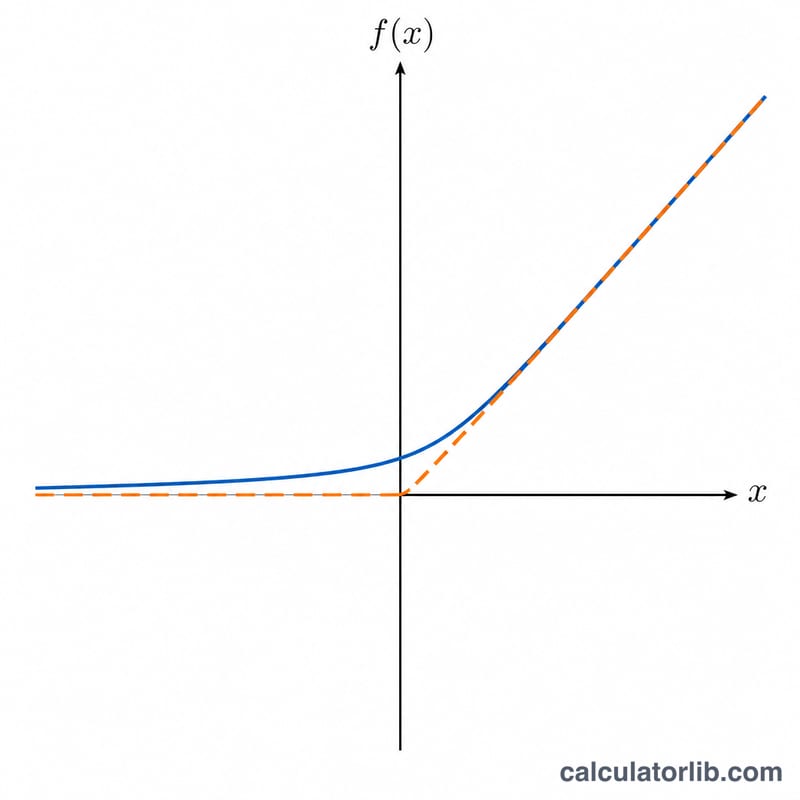
Softplus curve compared with ReLU on x-y axes
The Softplus curve is a smooth approximation of ReLU, always positive and gently bending near the origin.

How to use it

Enter three values: the Initial value of x (the first abscissa), the Increment (spacing between points), and the Number of repetitions (how many rows to generate). For example, an initial value of -5, increment 0.1 and 101 repetitions produce x from -5.0 to +5.0. The result is a scrollable table plus a graph of Softplus and its derivative.

The formula explained

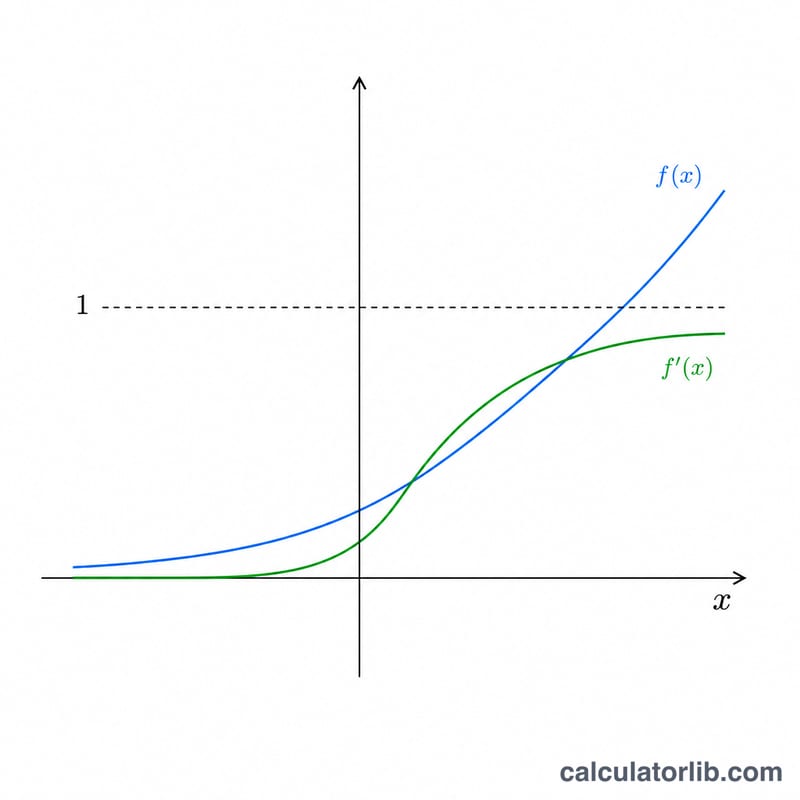
Softplus is $$f(x) = \ln\!\left(1 + e^{x}\right).$$ Its derivative is $$f^{\prime}(x) = \frac{e^{x}}{1 + e^{x}} = \frac{1}{1 + e^{-x}},$$ which is exactly the logistic sigmoid. As x grows large and positive, \(f(x)\) approaches \(x\) and \(f^{\prime}(x)\) approaches 1; as x goes large and negative, \(f(x)\) approaches 0 and \(f^{\prime}(x)\) approaches 0. To avoid overflow for large x, the tool uses the numerically stable form $$f(x) = \max(x, 0) + \ln\!\left(1 + e^{-|x|}\right).$$
Advertisement
Softplus and its sigmoid derivative plotted together
The derivative of Softplus is the sigmoid function, an S-shaped curve rising from 0 to 1.

Worked example

At x = 0: \(f(0) = \ln(2) = 0.693147\) and \(f^{\prime}(0) = 0.5\). At x = 1: $$f(1) = \ln(1 + 2.718282) = 1.313262$$ and $$f^{\prime}(1) = \frac{1}{1 + e^{-1}} = 0.731059.$$ At x = -1: \(f(-1) = 0.313262\) and \(f^{\prime}(-1) = 0.268941\). Notice the identity \(f(x) - f(-x) = x\), e.g. \(1.313262 - 0.313262 = 1\).

FAQ

Why use Softplus instead of ReLU? Softplus is smooth and has a non-zero gradient everywhere, which can help gradient-based optimization, though ReLU is cheaper to compute.

Is the output always positive? Yes. \(\ln(1 + e^{x}) > 0\) for every finite x because \(1 + e^{x} > 1\).

What does the derivative represent? It is the slope of the Softplus curve and equals the logistic sigmoid, ranging monotonically from 0 to 1 with value 0.5 at x = 0.


Last updated: