
What Is the Piston Force Calculator?
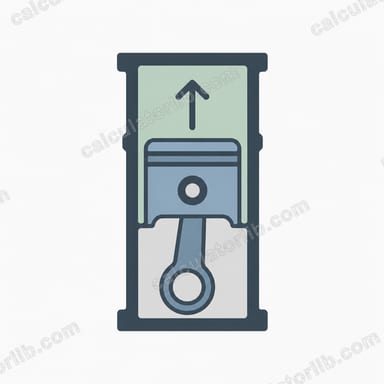
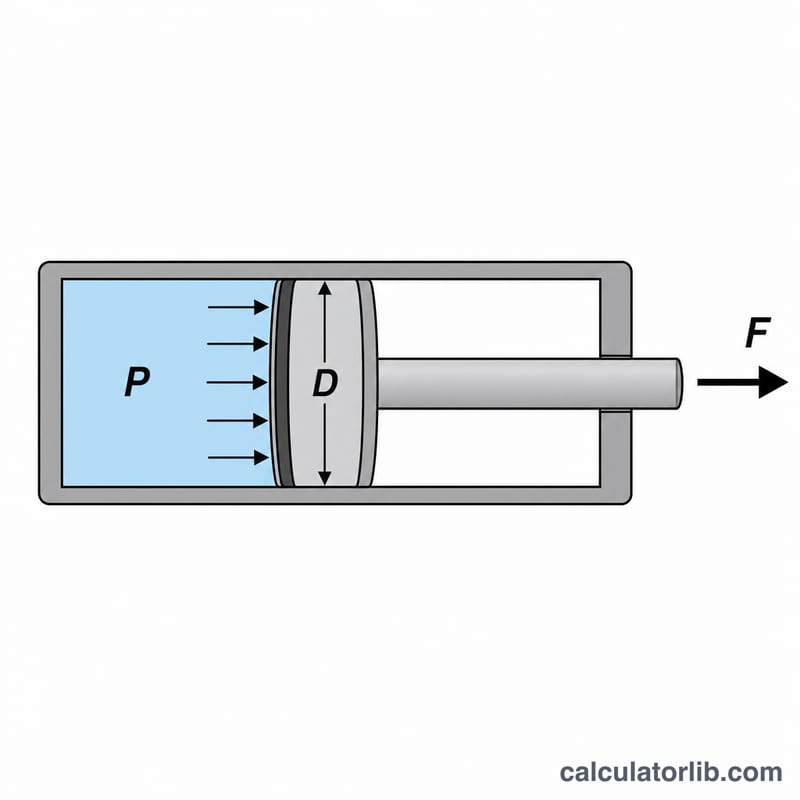
This calculator determines the linear force produced by a hydraulic or pneumatic piston (cylinder) given the fluid pressure acting on it and the bore diameter of the cylinder. It is a universal engineering tool based on pure physics, so it applies anywhere — just keep your units consistent.
How to Use It
Enter the operating pressure (P) and the bore diameter (D), then choose a unit system. In SI, supply pressure in pascals (Pa) and diameter in meters (m) to get force in newtons (N). In Imperial, supply pressure in psi and diameter in inches to get force in pound-force (lbf). The tool also reports the piston face area it computed.
The Formula Explained
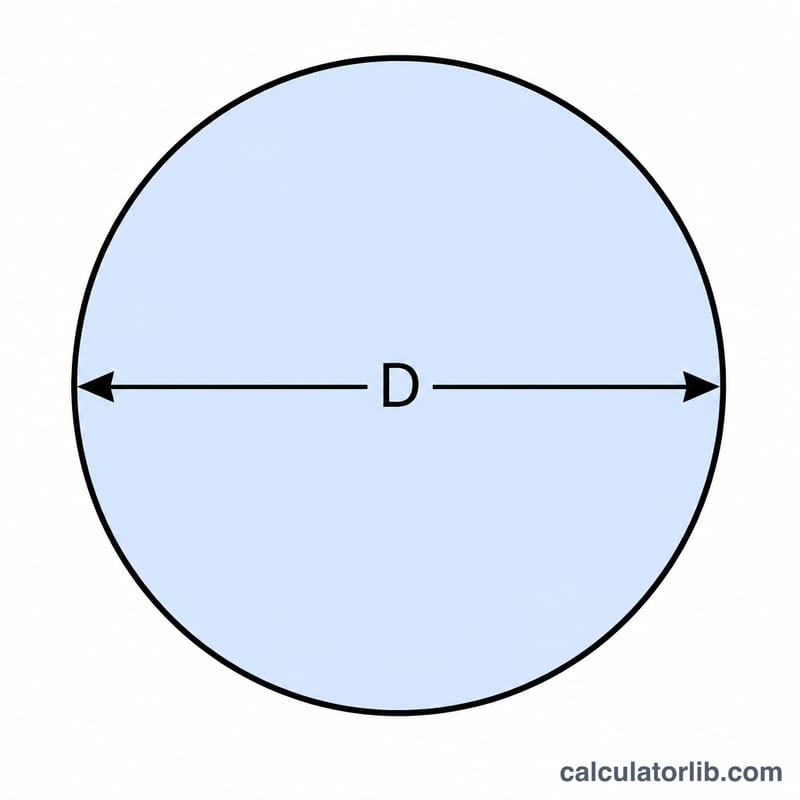
A piston is a circle of diameter D, so its face area is \(A = \frac{\pi}{4}\cdot D^{2}\). Pressure is force per unit area, therefore the total force pushing the piston is the pressure multiplied by that area:
$$F = \text{Pressure (P)} \times \frac{\pi}{4}\,\text{Bore Diameter (D)}^{2}$$
Doubling the diameter quadruples the force, because area scales with the square of diameter — a key reason large-bore cylinders deliver so much thrust.
Worked Example
A hydraulic cylinder with a 0.1 m bore operates at 500,000 Pa (5 bar). The area is $$\frac{\pi}{4}(0.1)^{2} = 0.0078540 \text{ m}^{2}.$$ The force is $$500{,}000 \times 0.0078540 \approx 3{,}927 \text{ N}.$$
FAQ
Does this account for the piston rod? No — it gives the full push (extend) force on the cap side. On the rod side, subtract the rod's cross-sectional area from A.
What about friction and back-pressure? This is the theoretical force. Real output is reduced by seal friction and any pressure on the opposite side.
Can I mix units? No. Use consistent units within a system (Pa & m, or psi & in) or your result will be wrong.