
What Is Propeller Slip?
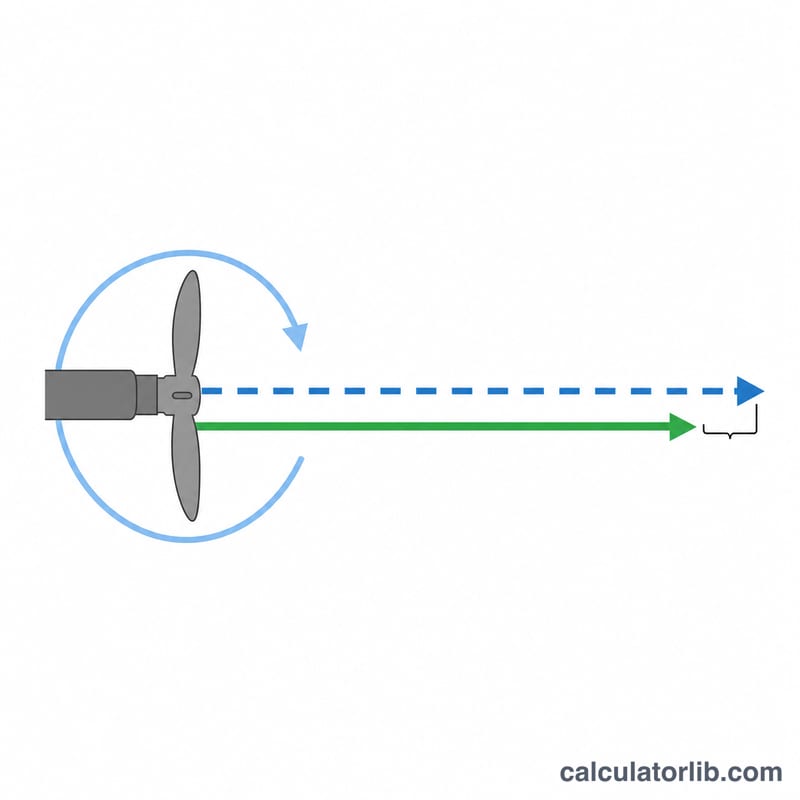
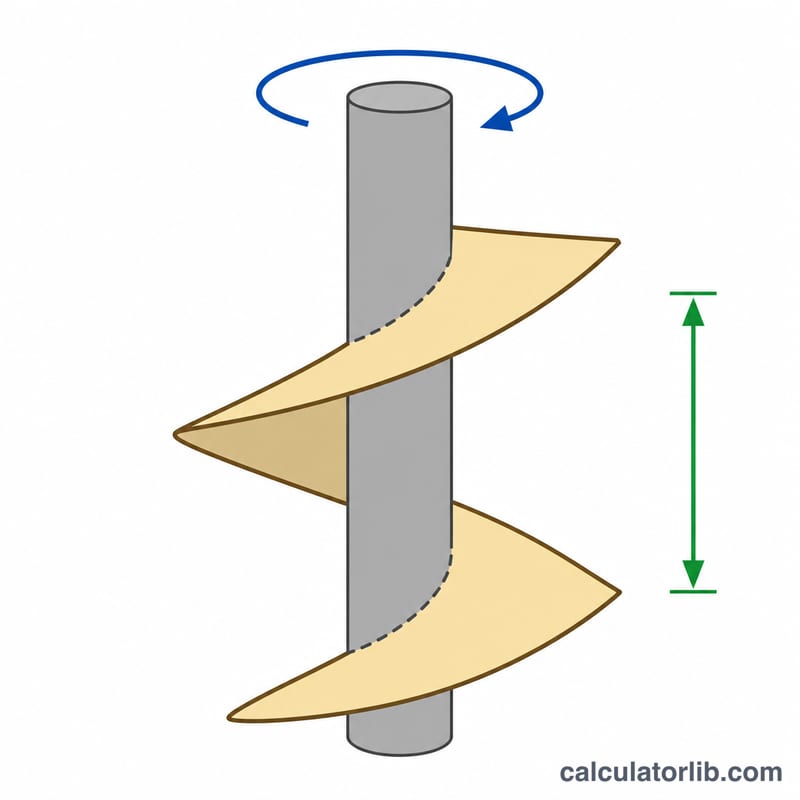
Propeller slip is the difference between the distance a boat propeller should move the boat in one revolution (based on its pitch) and the distance it actually moves it. Because water is a fluid, a prop never achieves 100% of its theoretical output — some "slip" always occurs. Slip is normal: most well-matched planing boats run between 10% and 25% slip, while displacement hulls and heavily loaded boats can run higher.
How to Use This Calculator
Enter your engine RPM (at the moment you measured speed), the propeller pitch in inches, your gear (reduction) ratio, and the actual boat speed in knots. The calculator divides engine RPM by the gear ratio to get propeller shaft RPM, computes the theoretical speed the prop would deliver, and compares it to your real speed to produce a slip percentage.
The Formula Explained
Theoretical speed (knots) = \( \text{Pitch} \times \text{PropRPM} \times 60 \div 12 \div 6076.12 \). Here PropRPM is engine RPM divided by the gear ratio, \(\times 60\) converts per-minute to per-hour, \(\div 12\) converts inches to feet, and \(\div 6076.12\) converts feet to nautical miles. \( \text{Slip\%} = (\text{Theoretical} - \text{Actual}) \div \text{Theoretical} \times 100 \).
$$\begin{gathered} \text{Slip \%} = \frac{V_t - \text{Speed (kn)}}{V_t} \times 100 \\[1.5em] \text{where}\quad V_t = \frac{\text{Pitch (in)} \times \dfrac{\text{RPM}}{\text{Ratio}} \times 60}{12 \times 6076.12} \end{gathered}$$
Worked Example
An engine turning 3000 RPM through a 2:1 gearbox spins the prop at 1500 RPM. With a 19-inch pitch prop: theoretical speed = \( 19 \times 1500 \times 60 \div 12 \div 6076.12 \approx 23.45 \) knots. If the boat actually does 22 knots, slip:
$$\text{slip} = \frac{23.45 - 22}{23.45} \times 100 \approx 6.2\%$$
FAQ
Is a low slip number always better? Not necessarily. Very low slip can mean the prop is overloading the engine; very high slip can mean the prop is too small or the boat is overloaded. Aim for the range recommended for your hull type.
What if I get a negative slip? Negative slip usually means your inputs are off — most often the gear ratio or pitch is wrong, or the speed reading is too high.
Knots or MPH? This tool uses nautical miles (knots). Enter actual speed in knots for an accurate result.