
What Is the Gear Ratio RPM Calculator?
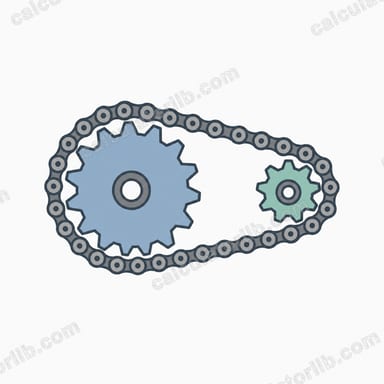
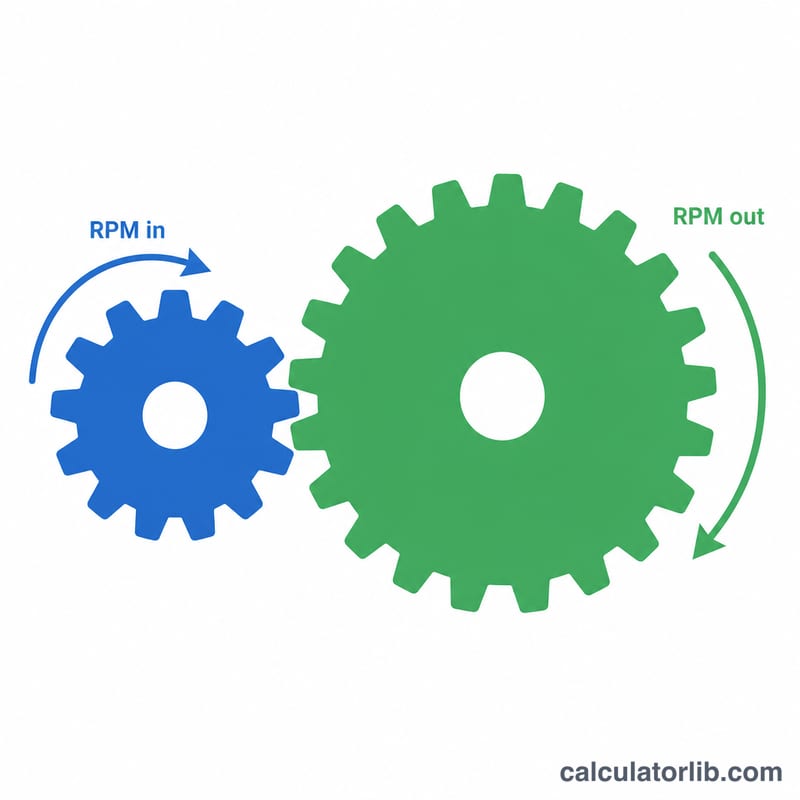
This tool computes the output rotational speed (RPM) of a driven shaft based on the input speed and the gear ratio between two meshing gears. A gear ratio greater than 1 (a reduction) slows the output and increases torque; a ratio less than 1 (an overdrive) speeds the output up. It applies universally to any geared system — gearboxes, transmissions, pulleys, and chain drives.
How to Use It
Enter the input speed in RPM (for example, the engine or motor speed) and the gear ratio expressed as the driven-to-drive ratio. A ratio written as 3.5:1 simply means you enter 3.5. The calculator returns the output speed in RPM.
The Formula Explained
The relationship is straightforward: $$\text{RPM}_{out} = \frac{\text{RPM}_{in}}{\text{Gear Ratio}}$$ Because the gear ratio is the factor by which speed is multiplied or reduced, dividing input speed by it gives the resulting output speed. If you know two values you can rearrange the equation to solve for the third.
Worked Example
Suppose a motor spins at 3,000 RPM and drives a gearbox with a 3.5:1 reduction ratio. The output speed is $$3{,}000 \div 3.5 = 857.14 \text{ RPM}$$ The output shaft turns slower than the motor, trading speed for torque.
FAQ
What does a 2:1 gear ratio mean? It means the input must turn twice for every one turn of the output, halving the output speed.
Can the ratio be less than 1? Yes — a ratio below 1 is an overdrive that makes the output spin faster than the input.
Does torque change too? Yes. Torque scales inversely with speed, so a reduction that halves speed roughly doubles torque (ignoring losses).