

What Is a Gear Ratio?
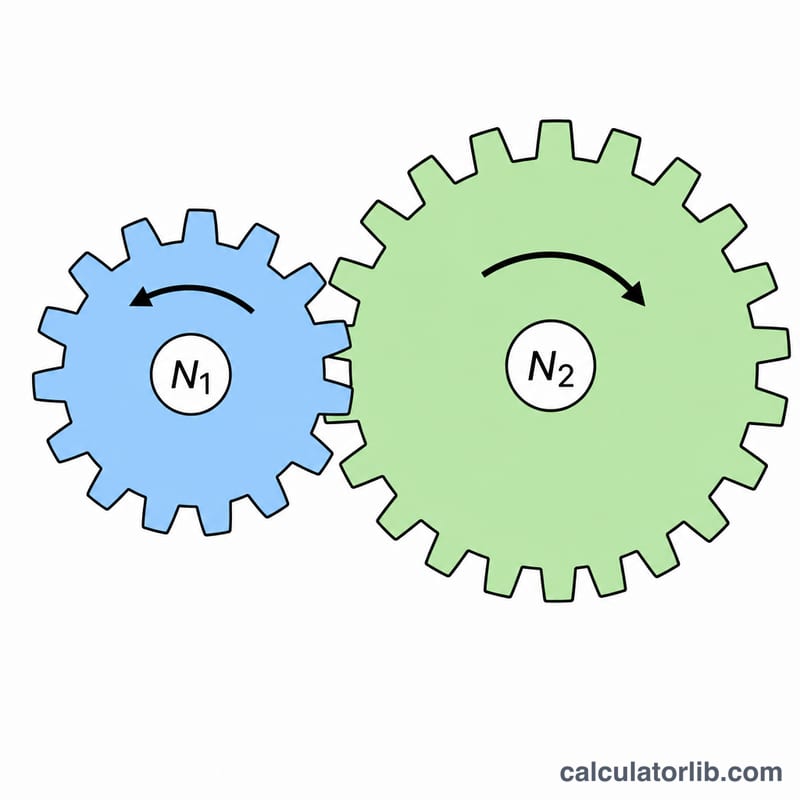
The gear ratio describes how two meshing gears transfer rotation and torque. It is the ratio of the number of teeth on the driven (output) gear to the number of teeth on the driver (input) gear. A ratio greater than 1 means a speed reduction with torque gain; a ratio less than 1 means an overdrive that increases speed but reduces torque.
How to Use This Calculator
Enter the tooth counts of the driver gear (connected to the power source) and the driven gear (connected to the load), then enter the input shaft speed in RPM. The calculator returns the gear ratio, the resulting output speed, and the torque multiplication factor, which equals the ratio (ignoring friction losses).
The Formula Explained
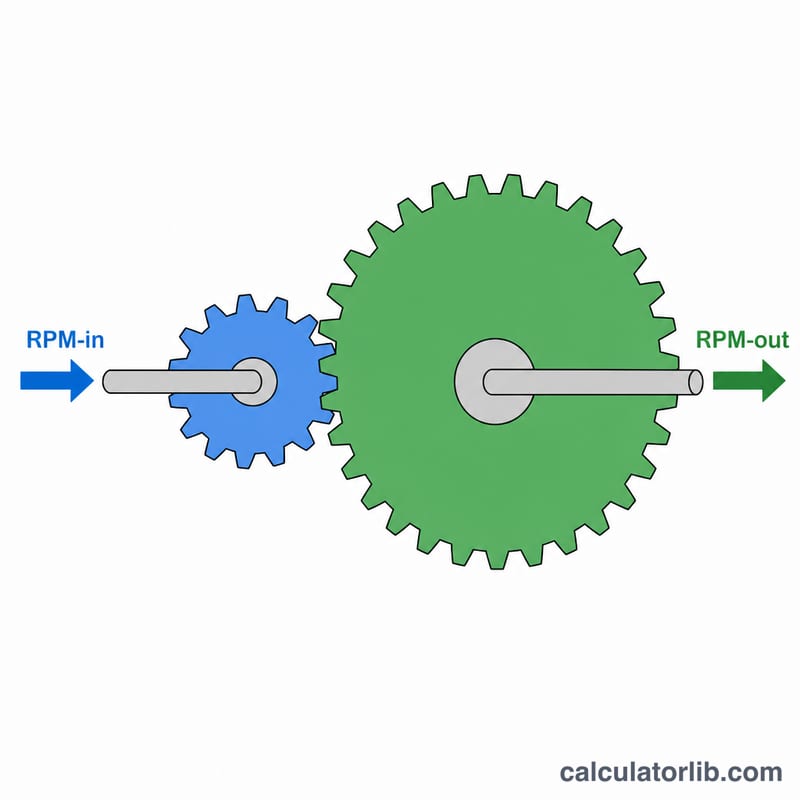
The core equation is $$\text{Ratio} = \frac{\text{Driven Teeth}}{\text{Driver Teeth}}$$. Output speed follows from conservation of the number of teeth passing the mesh per unit time: $$\text{Output RPM} = \frac{\text{Input RPM}}{\text{Ratio}}$$. Because power is conserved (ideally), torque is multiplied by the same ratio that speed is divided by, so a 3:1 reduction triples torque while cutting speed to one-third.
Worked Example
Suppose a 12-tooth driver gear meshes with a 36-tooth driven gear and the input shaft turns at 1500 RPM. The ratio is \(36 \div 12 = 3\). Output speed is \(1500 \div 3 = 500\) RPM, and torque is multiplied by 3. This is a typical 3:1 reduction gear.
FAQ
Which gear is the "driver"? The driver is the input gear attached to the motor or engine; the driven gear is the output connected to the wheel, tool, or load.
Does this account for friction? No. It gives ideal values. Real systems lose a few percent of torque to friction and meshing inefficiency.
What does a ratio less than 1 mean? It is an overdrive — the output spins faster than the input but delivers less torque.