
What This Calculator Does
The Gear Ratio Speed Calculator estimates how fast a vehicle travels at a given engine speed (RPM) for a chosen transmission gear and final drive (differential) ratio. It is a universal mechanical tool useful for car enthusiasts, motorsport tuners, and anyone studying drivetrain behavior. Results are shown in km/h, mph, and m/s.
How to Use It
Enter the engine RPM, the tire (rolling) diameter in meters, the transmission gear ratio for the gear you are interested in, and the final drive ratio. The calculator computes wheel revolutions per minute and multiplies by tire circumference to obtain speed.
The Formula Explained
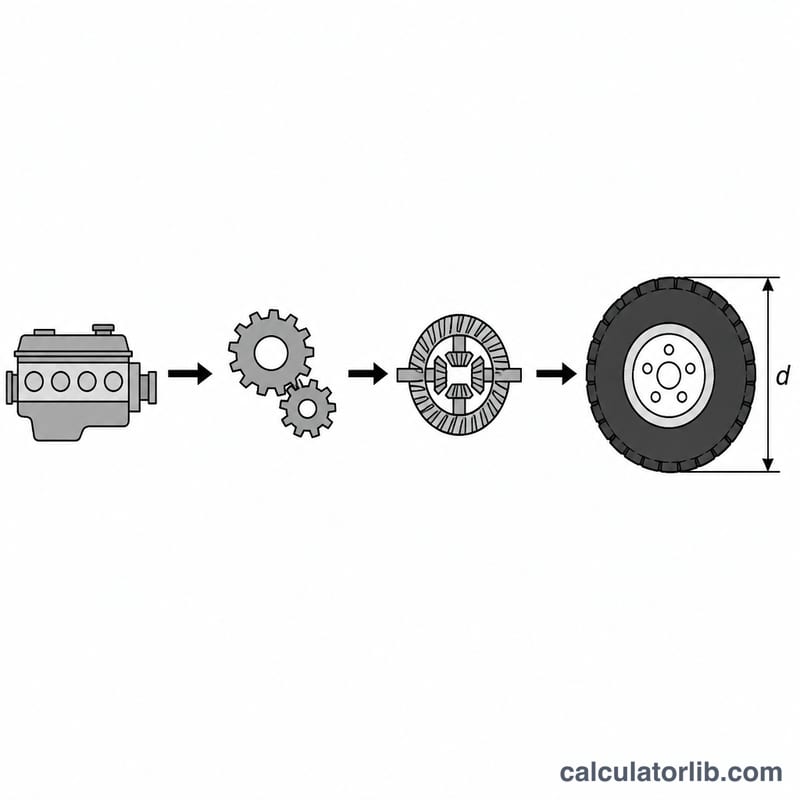
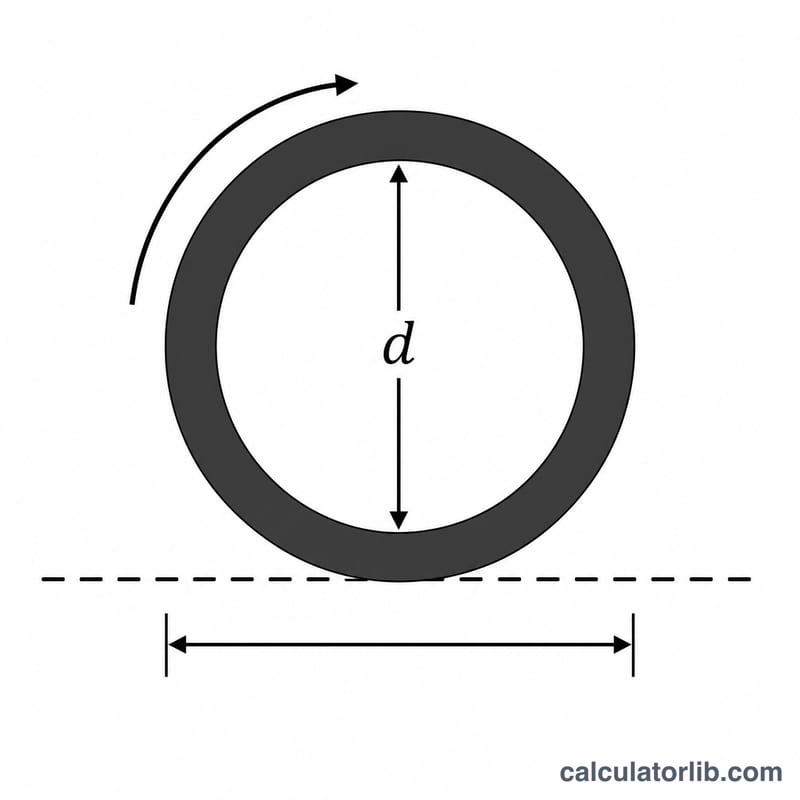
The overall reduction is the product of the gear ratio and the final drive ratio. Wheel RPM = engine RPM ÷ (gear × final). Each wheel revolution moves the car forward by one tire circumference (π × diameter). So distance per minute = wheel RPM × π × d, and speed in km/h = that value × 60 ÷ 1000.
$$\text{Speed (km/h)} = \frac{\text{RPM} \times \pi \times \text{Tire Diameter (m)}}{\text{Gear Ratio} \times \text{Final Drive}} \times \frac{60}{1000}$$
Worked Example
For 4000 RPM, a 0.6 m tire, a 1.0 gear ratio, and a 3.9 final drive: wheel RPM = \(4000 \div 3.9 \approx 1025.6\). Distance per minute = \(1025.6 \times \pi \times 0.6 \approx 1933\) m. Speed = \(1933 \times 60 \div 1000 \approx 115.99\) km/h (about 72 mph).
$$\text{Speed} = \frac{4000 \times \pi \times 0.6}{1.0 \times 3.9} \times \frac{60}{1000} \approx 115.99 \text{ km/h}$$
FAQ
Where do I find tire diameter? A tire size like 205/55R16 gives diameter \(\approx 0.632\) m. Use a tire size calculator or measure the rolling diameter directly.
Is this exact? It assumes no tire slip and ideal rolling diameter, so real-world speed is usually slightly lower.
What about the final drive? It is the differential/axle ratio, multiplied with the transmission gear to give total reduction.