
What this calculator does
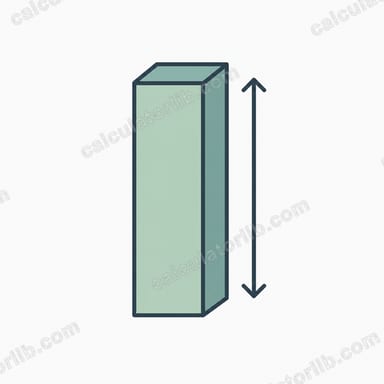
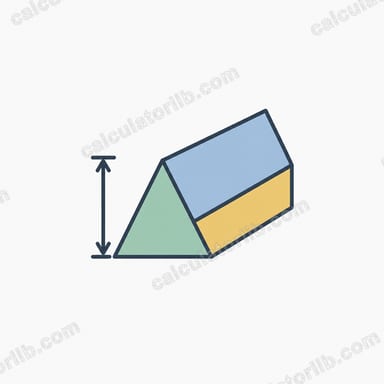
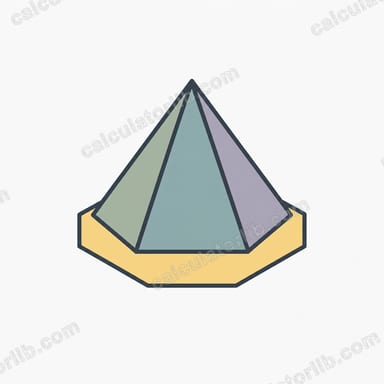
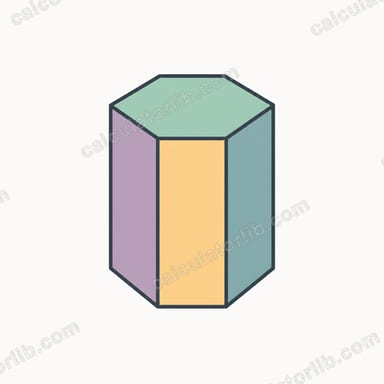
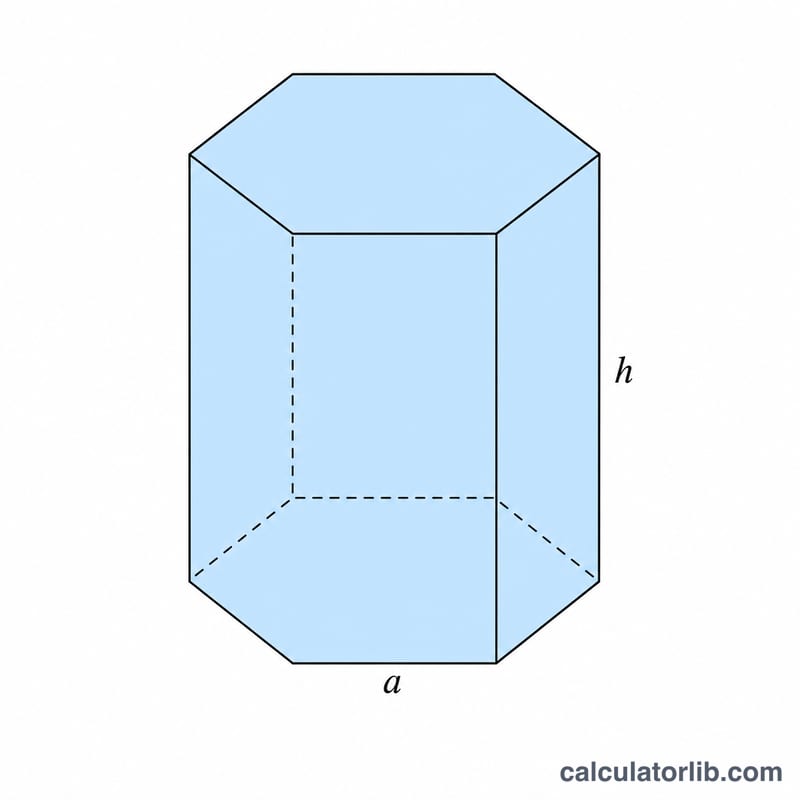
This tool finds the height of a regular hexagonal prism when you know the side length of its regular-hexagon base and the prism's total volume. A regular hexagonal prism is a solid whose two parallel bases are regular hexagons (all six sides equal, all interior angles 120 degrees) joined by rectangular faces of uniform height perpendicular to the base.
How to use it
Enter the side length a of the hexagon and the volume V. All values use generic, consistent units: if a is in centimetres then V must be in cubic centimetres, and the returned height will be in centimetres. The side length must be greater than zero, and the volume should be positive for a physically meaningful prism.
The formula explained
The area of a regular hexagon with side a is \(A = \dfrac{3\sqrt{3}}{2} \times a^{2}\). The volume of any prism is its base area times its height, so \(V = A \times h\). Rearranging gives the height directly:
$$h = \frac{V}{A} = \frac{2V}{3\sqrt{3} \times a^{2}}$$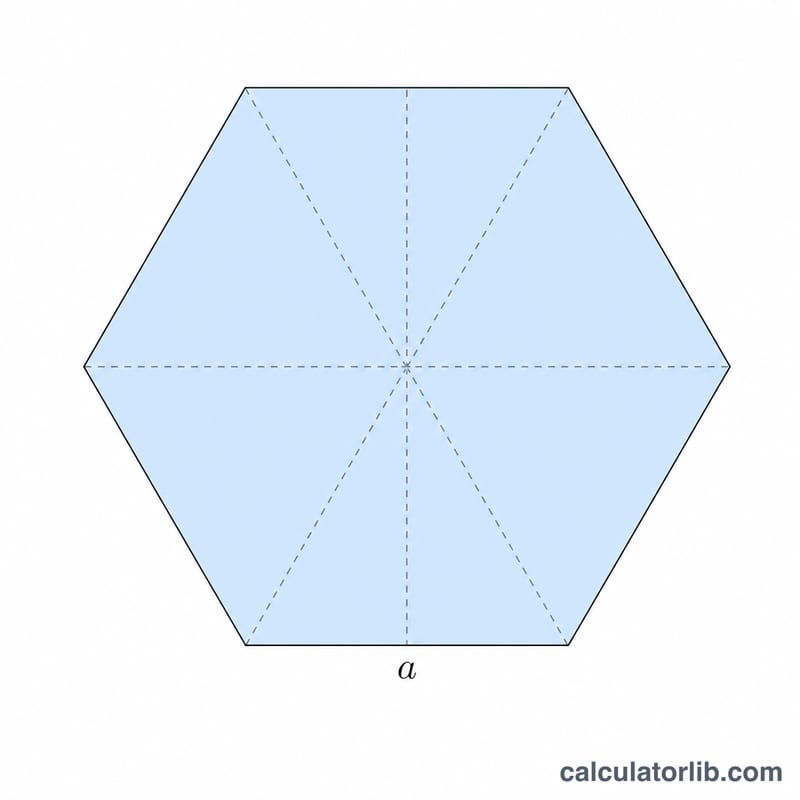
Worked example
Take a = 1 and V = 6√3 ≈ 10.392304845. The base area is $$A = \frac{3\sqrt{3}}{2} \times 1^{2} \approx 2.598076211.$$ Dividing, $$h = \frac{10.392304845}{2.598076211} = 4.$$ As a second case, a = 2 and V = 100 gives \(A = 6\sqrt{3} \approx 10.392304845\) and h ≈ 9.6225044865.
FAQ
What units does the result use? The same length unit as your side input. There is no built-in conversion, so make sure the volume is expressed in that unit cubed.
Why must the side be greater than zero? A side of zero makes the base area zero, and dividing the volume by zero is undefined.
Does this work for an irregular hexagon? No. The base-area formula assumes a regular hexagon with all sides equal and all angles 120 degrees.