
What the Cone Height Calculator Does
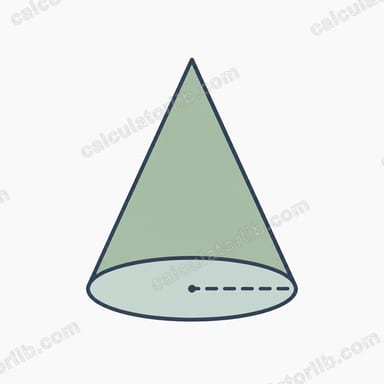
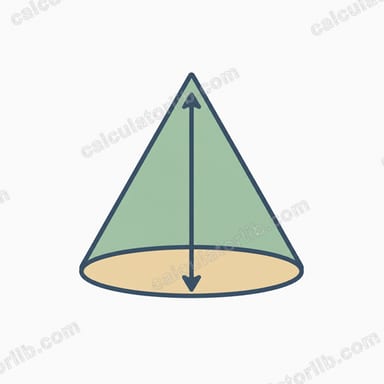
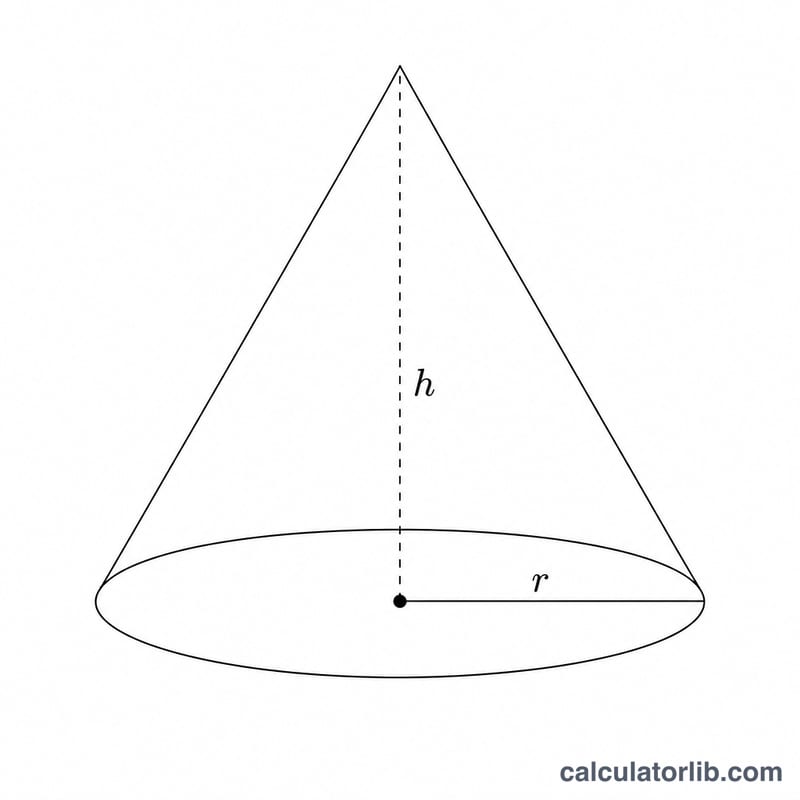
This calculator works backwards from the standard cone volume formula. Instead of finding volume from dimensions, it takes the volume you already know along with the base radius and solves for the unknown height. It is handy whenever you have a known capacity (for example a container, funnel or 3D model) and need to figure out how tall the cone must be to hold it.
As a bonus, once the height is found the tool also reports the base area, slant height, lateral (side) surface area and total surface area — giving you a complete picture of the cone from just two inputs.
Inputs You Provide
- Volume – the total capacity of the cone (in cubic units such as cm³, m³ or in³).
- Radius – the radius of the circular base (in the matching linear unit, e.g. cm if volume is cm³).
Keep your units consistent: if volume is in cm³, the radius should be in cm so the resulting height comes out in cm.
The Formula Explained
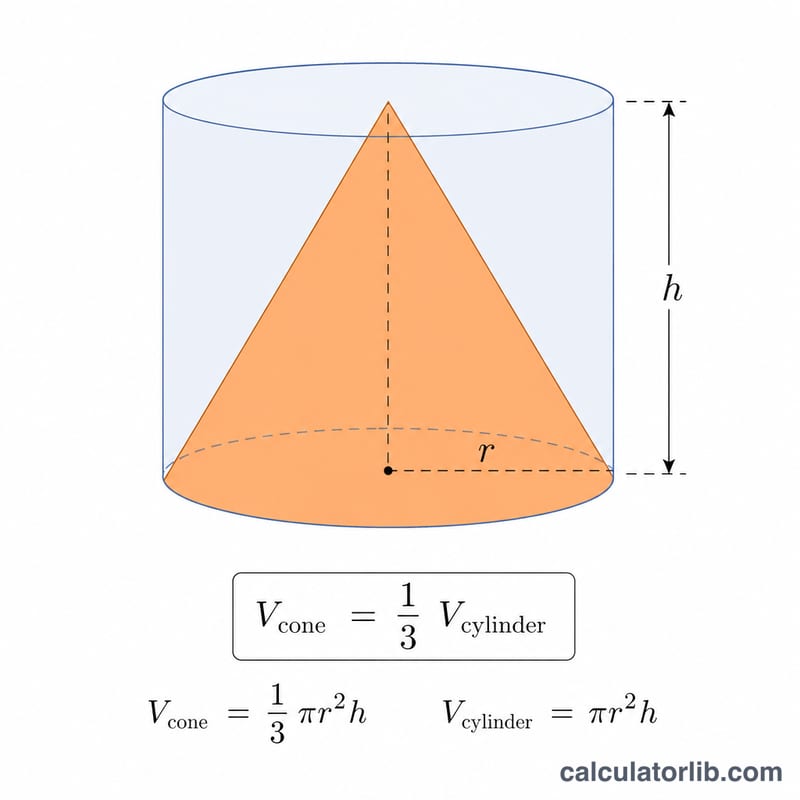
A cone's volume is V = ⅓ π r² h. Rearranging that equation to isolate height gives the formula this calculator uses:
h = 3V / (π r²)
The extra results come from related geometry:
- Base area = π r²
- Slant height = √(r² + h²)
- Lateral area = π r × slant height
- Total surface area = lateral area + base area
Worked Example
Suppose a cone has a volume of 100 cm³ and a base radius of 3 cm.
- Height: h = (3 × 100) / (π × 3²) = 300 / 28.274 ≈ 10.61 cm
- Base area = π × 9 ≈ 28.27 cm²
- Slant height = √(3² + 10.61²) ≈ 11.03 cm
- Lateral area = π × 3 × 11.03 ≈ 103.96 cm²
- Total surface area ≈ 103.96 + 28.27 = 132.23 cm²
Frequently Asked Questions
Why does the radius get squared in the formula? Because the cone's base is a circle, its area scales with r². Doubling the radius quarters the required height for the same volume, so radius has a strong effect on the result.
What happens if I enter a radius of zero? The formula divides by π r², so a radius of 0 is undefined — a cone with no base can't have a measurable height. Always use a positive radius.
Can I use any units? Yes, as long as they match. Volume must be in cubic units of the same length unit as the radius, and the height will come back in that length unit.