
What the Pyramid Length Calculator Does
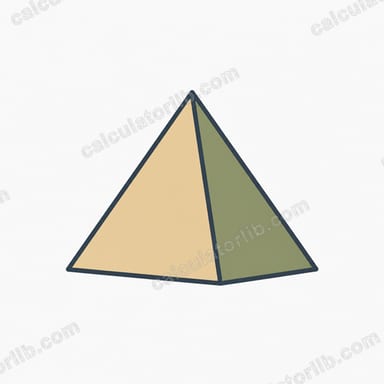
This calculator finds the base length of a rectangular-based pyramid when you already know its volume, its height, and the width of its base. Instead of measuring the base directly, you rearrange the standard pyramid volume formula to solve for the unknown length. It is handy in geometry homework, design work, packaging, and any situation where you know how much space a pyramid encloses but need one of its base dimensions.
The Inputs You Provide
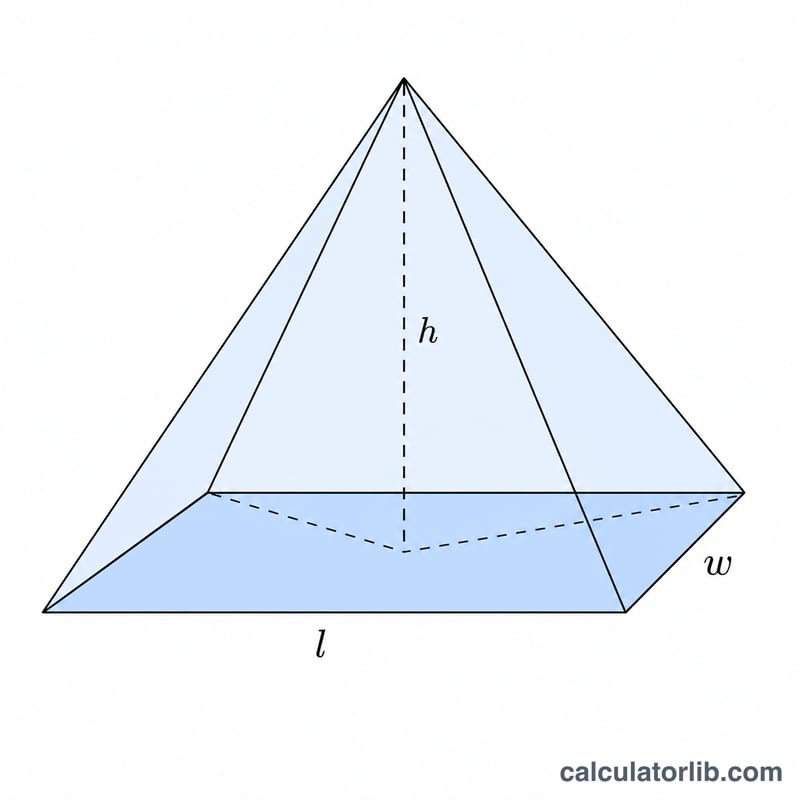
- Volume (V) — the total space inside the pyramid, in cubic units (cm³, m³, etc.).
- Height (h) — the perpendicular distance from the base to the apex.
- Width (w) — one side of the rectangular base.
Keep your units consistent. If volume is in cubic centimetres and height and width are in centimetres, the resulting length comes out in centimetres.
The Formula Explained
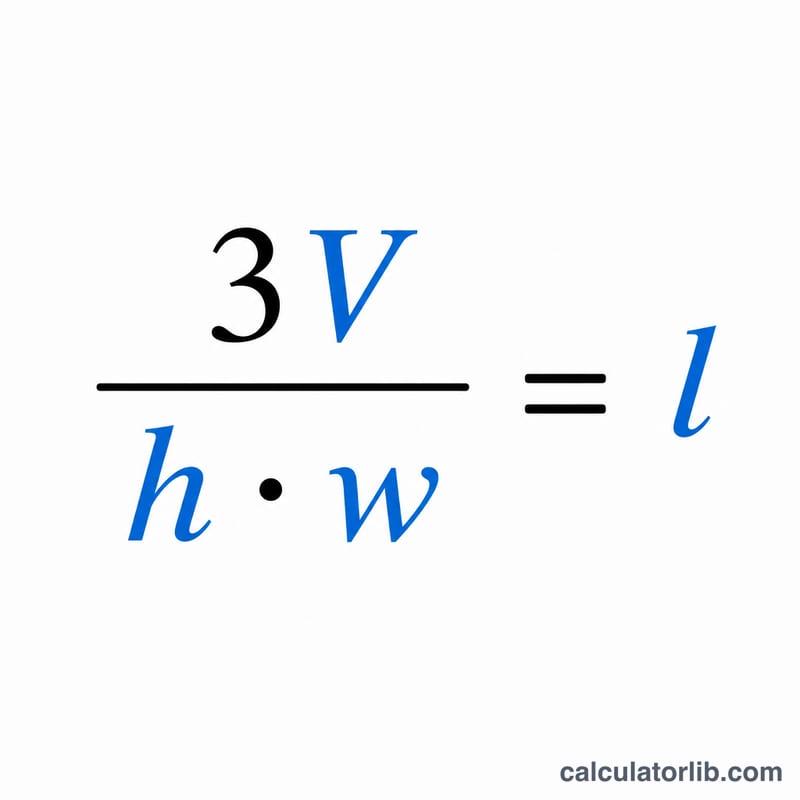
The volume of a pyramid is V = (1/3) × length × width × height. Solving that equation for length gives the formula this tool uses:
l = 3V / (h × w)
The factor of 3 cancels the one-third in the original volume equation. Dividing the volume by the height times the width isolates the remaining base dimension — the length.
Worked Example
Suppose a pyramid has a volume of 200 cm³, a height of 10 cm, and a base width of 6 cm. Plug the numbers in:
- Numerator: 3 × 200 = 600
- Denominator: 10 × 6 = 60
- Length: 600 ÷ 60 = 10 cm
So the pyramid's base length is 10 cm. You can verify it: (1/3) × 10 × 6 × 10 = 200 cm³, matching the volume you started with.
Frequently Asked Questions
Does this work for square-based pyramids? Yes. A square base simply means the length equals the width. If your result does not match the width you entered, your base is rectangular, not square.
What happens if I enter zero for height or width? The formula divides by height × width, so a zero in either field would mean dividing by zero, which has no valid result. Always use positive, non-zero measurements.
Can I use this for a cone or other shape? No. The one-third factor and the rectangular base assumption are specific to rectangular pyramids. A cone uses (1/3)πr²h and needs a different rearrangement.