
What this calculator does
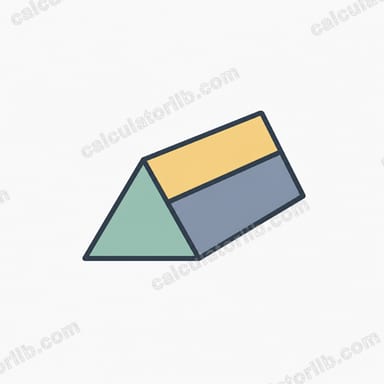
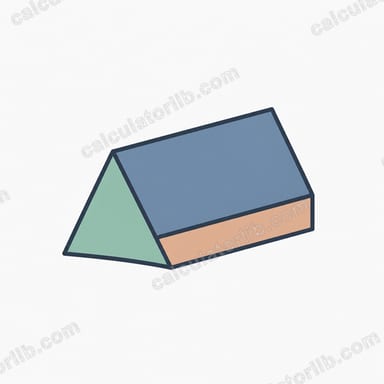
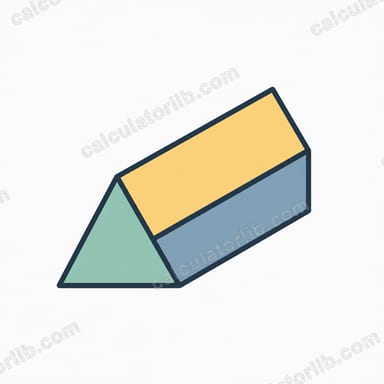
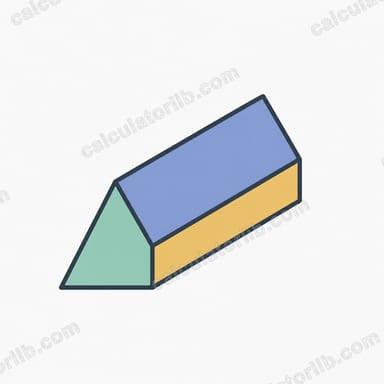
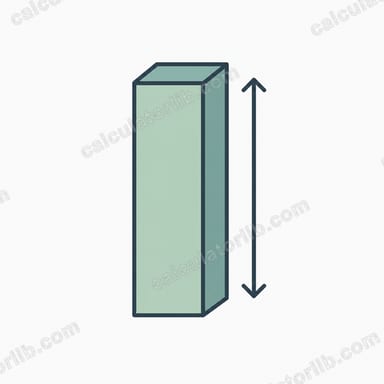
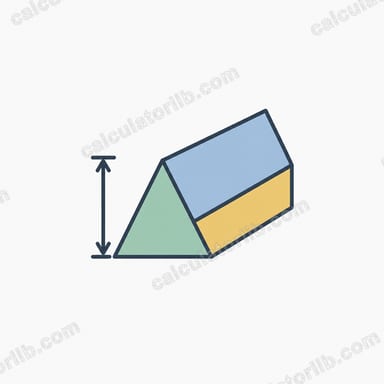
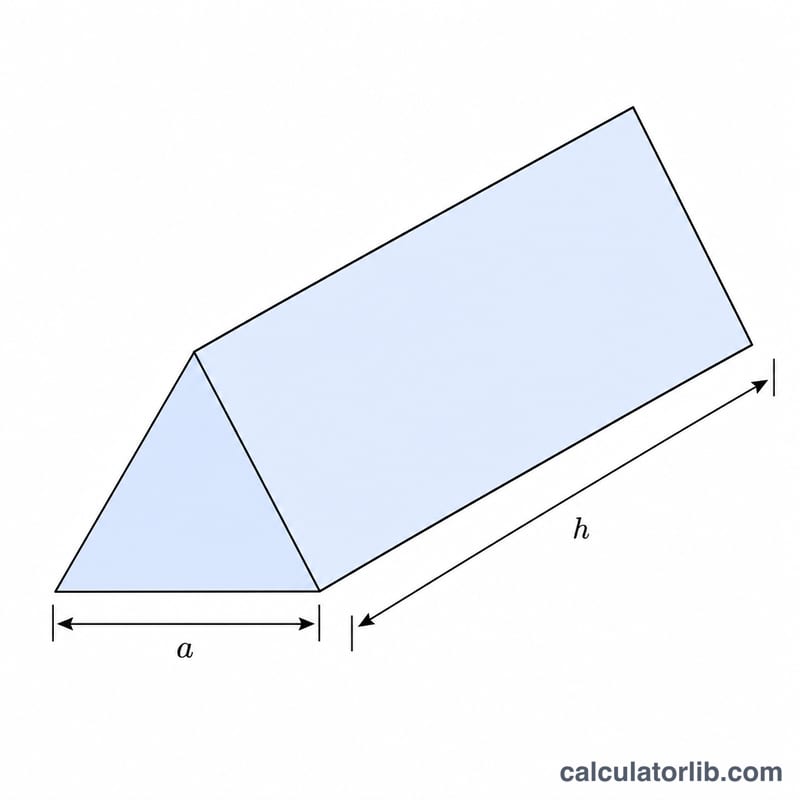
An equilateral triangular prism is a right prism whose two parallel end faces are equilateral triangles of side a, joined by three identical rectangular side faces. This tool finds the prism's height h when you already know its volume V and the side length a of the triangular base. All quantities are plain numbers in one consistent unit system: if V is in cubic units and a is in linear units, then h comes out in the same linear units.
How to use it
Enter the volume V and the side a of the equilateral triangle, then read the height h. The side must be greater than zero; a side of zero has no triangular cross-section and the height is undefined. A volume of zero gives a degenerate prism with height zero.
The formula explained
The area of an equilateral triangle with side a is \(A = \frac{\sqrt{3}}{4} \times a^{2}\). A prism's volume is base area times height, so \(V = \frac{\sqrt{3}}{4} \times a^{2} \times h\). Rearranging for the unknown height gives \(h = \frac{V}{\frac{\sqrt{3}}{4} \times a^{2}}\), which simplifies to $$h = \frac{4V}{\sqrt{3} \times a^{2}}.$$ We use \(\sqrt{3} \approx 1.7320508075688772\).
Worked example
Suppose \(V = 10\) and \(a = 2\). Then \(a^{2} = 4\), and the denominator is \(\sqrt{3} \times 4 = 1.7320508 \times 4 = 6.9282032\). Dividing, $$h = \frac{4 \times 10}{6.9282032} = \frac{40}{6.9282032} = 5.7735027.$$ So the prism is about 5.77 units tall.
FAQ
Do I need to choose units? No. Keep volume and side in matching units (for example cm³ with cm), and the height comes out in the same length unit.
What if I enter a = 0? The cross-section vanishes and division by zero would occur, so the height is reported as 0 / undefined. Use a positive side length.
Does this work for any triangular prism? No. This calculator assumes the base is a perfect equilateral triangle. For scalene or isosceles bases use the general formula \(h = \frac{V}{\text{base area}}\).