
What is the Linear Inequality Solver?
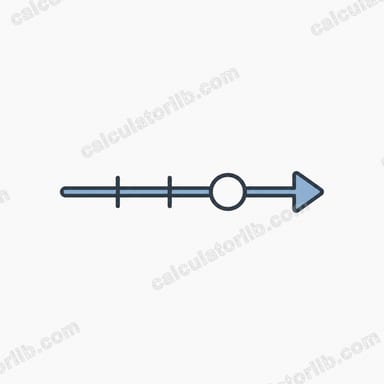
This calculator solves a one-variable, first-degree (linear) inequality of the form \(ax + b > 0\), \(ax + b \ge 0\), \(ax + b < 0\), or \(ax + b \le 0\). It returns the root of the associated equation \(ax + b = 0\), the full solution range for x, and a number-line graph that marks the endpoint with an open or closed circle.
How to use it
Pick the inequality sign from the dropdown, then enter the coefficient a (which must not be 0) and the constant b. Press calculate to see the solution range, the root, and a shaded number line. Both a and b may be negative or non-integer.
The formula explained
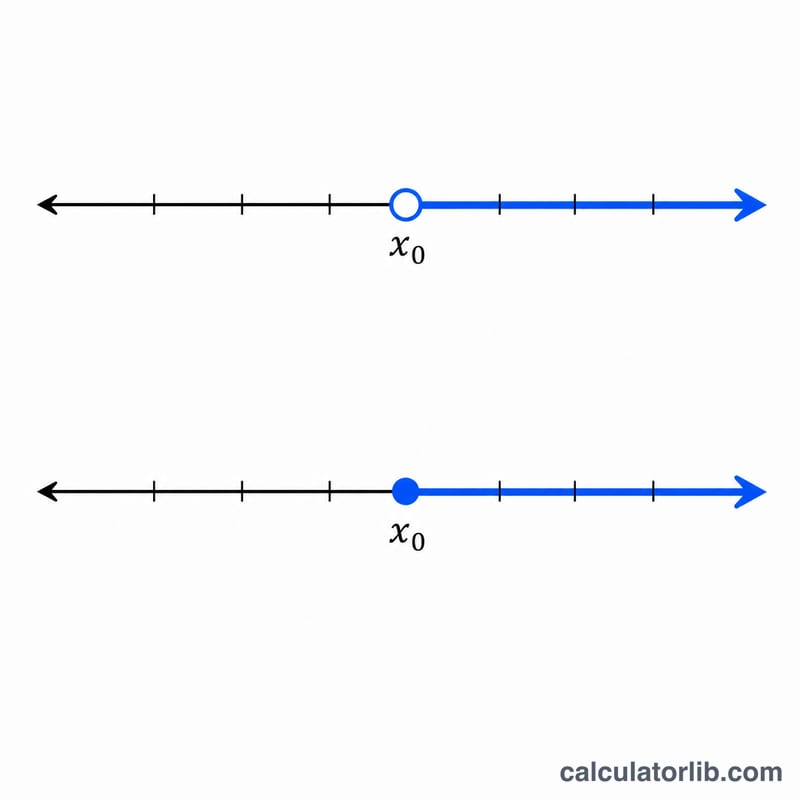
The root is $$x_0 = \dfrac{-b}{a}$$. The direction of the solution depends on both the chosen sign and the sign of a, because dividing an inequality by a negative number flips its direction. If \(a > 0\) the inequality keeps its original direction; if \(a < 0\) the direction reverses. The strictness (open circle for \(>\) or \(<\), closed circle for \(\ge\) or \(\le\)) is preserved from the input and is never affected by the sign of a.
Worked example
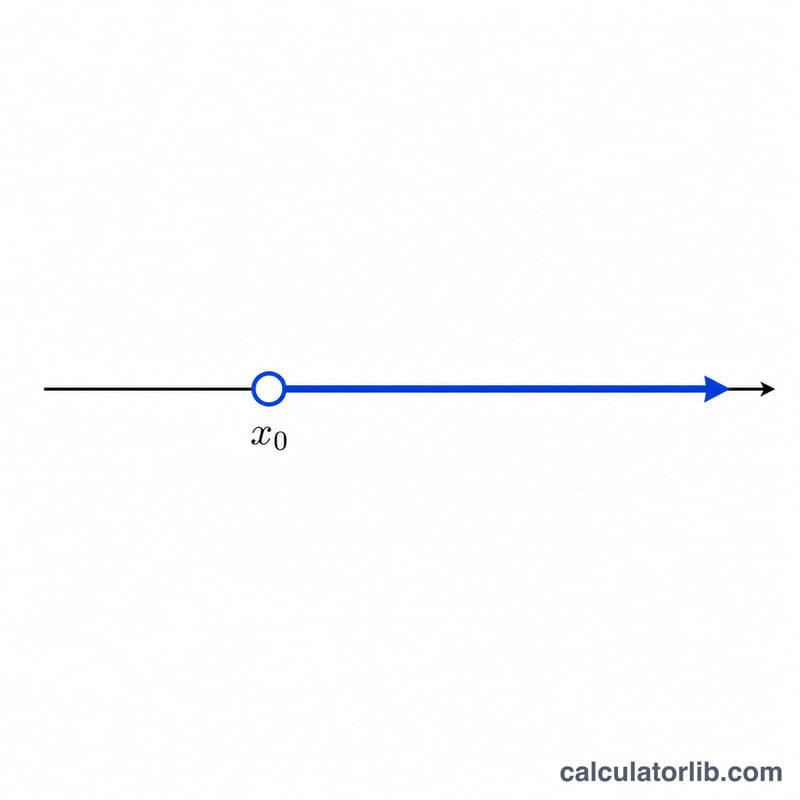
For \(2x - 2 > 0\): $$x_0 = \frac{-(-2)}{2} = 1.$$ Since \(a > 0\) and the sign is "greater than", the solution is \(x > 1\) with an open circle at 1 and the ray shaded toward positive infinity.
For \(-3x + 6 \le 0\): $$x_0 = \frac{-(6)}{-3} = 2.$$ The "\(\le\)" family is the "less" direction, but \(a < 0\) flips it, giving \(x \ge 2\) with a closed circle at 2.
FAQ
Why can't a be 0? If \(a = 0\) the expression is just the constant b, with no x to solve for, so it is either always true or always false. The tool rejects \(a = 0\).
Is the endpoint included? Only for \(\ge\) and \(\le\) (closed circle). For \(>\) and \(<\) the endpoint is excluded (open circle).
Can the root be a fraction? Yes. \(x_0 = -b/a\) can be any real number; it is shown to about 14 significant digits with trailing zeros trimmed.