
What is the Data Transfer Rate Converter?
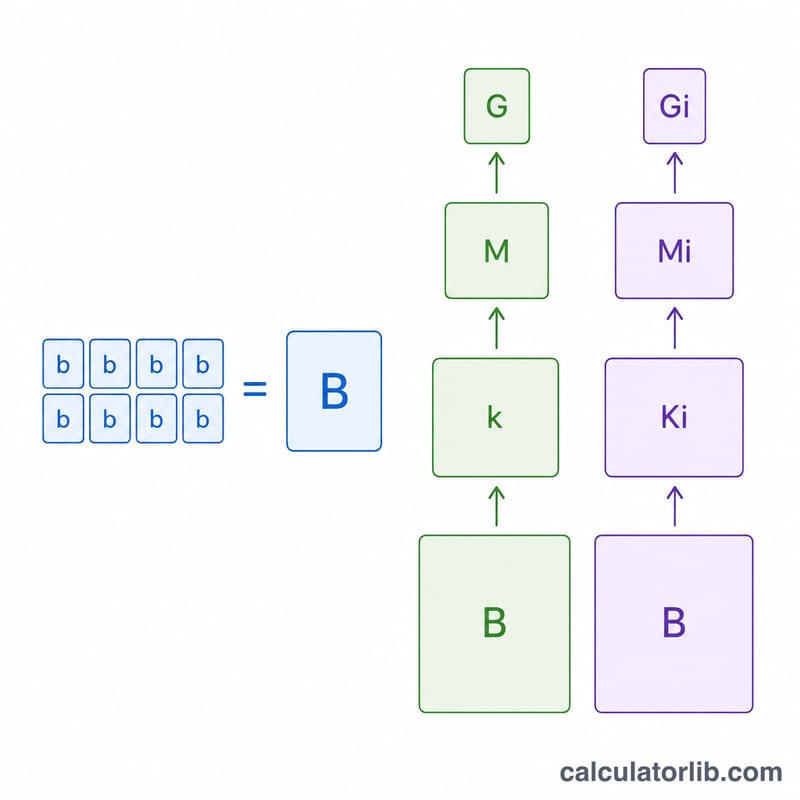
This tool converts a network or storage transfer speed entered in one unit into every other common data-rate unit at the same time. It covers plain bits and bytes per second, the decimal SI units (kilobit, megabit, gigabit, terabit and their byte equivalents based on powers of 1000), and the binary IEC 80000-13 units (kibibit, mebibit, gibibit, tebibit and their byte equivalents based on powers of 1024). It is universal and not tied to any country or standard body version beyond those listed.
How to use it
Enter a numeric Speed, choose the Unit it is expressed in, and submit. The result table lists the equivalent value in all 18 units, grouped by Base, SI (1000 based), and IEC 80000-13 (1024 based). Remember the key distinctions: lowercase b means bit, uppercase B means byte, and 1 byte = 8 bits. SI uses 1000 multiples while IEC uses 1024 multiples.
The formula explained
Each unit is stored as a factor relative to the base unit, bits per second. First the input is normalized to bits per second by multiplying by its source factor, then each target value is found by dividing by that target unit's factor. Because every factor is an exact integer, no rounding error is introduced before display formatting.
$$\text{bits/s} = \text{Speed} \times \text{Unit Factor}$$$$\begin{gathered} B = \text{Speed} \times \text{Unit Factor} \\[1.5em] \text{where}\quad \left\{ \begin{aligned} B &= \text{value in bits per second} \\ \text{Result} &= \dfrac{B}{\text{Target Unit Factor}} \end{aligned} \right. \end{gathered}$$
Worked example
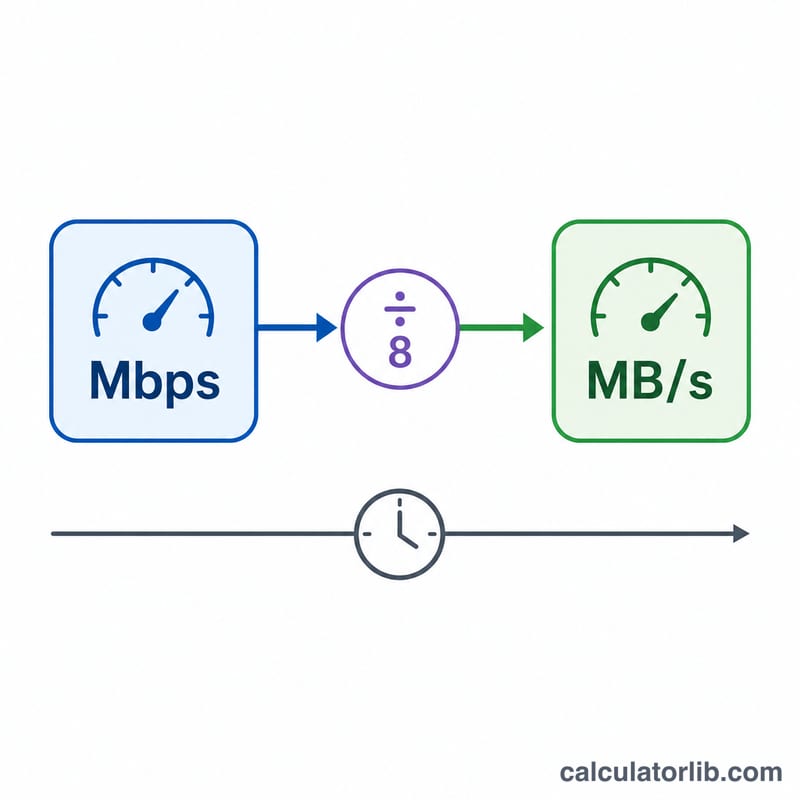
Suppose Speed = 1 and Unit = Megabit per second (factor 1,000,000). The value in bits per second is \(1 \times 1{,}000{,}000 = 1{,}000{,}000\) b/s. Dividing: Byte per second = \(1{,}000{,}000 / 8 = 125{,}000\); Kilobyte per second = \(1{,}000{,}000 / 8000 = 125\); Megabyte per second = \(1{,}000{,}000 / 8{,}000{,}000 = 0.125\); Kibibit per second = \(1{,}000{,}000 / 1024 = 976.5625\). So a 1 Mb/s link transfers 125 kB/s.
FAQ
Why is 1 Mbps not 1 MB/s? Because a byte is 8 bits, 1 megabit per second equals only 0.125 megabytes per second, so an 8 Mb/s connection downloads at about 1 MB/s.
What is the difference between MB and MiB? MB (megabyte) is decimal: 1,000,000 bytes. MiB (mebibyte) is binary: 1,048,576 bytes. The converter shows both so you can compare advertised SI speeds with binary software readouts.
Can I enter zero or a negative value? Zero converts to zero everywhere. Negative numbers are passed through mathematically even though a transfer rate is normally non-negative.