What is this calculator?
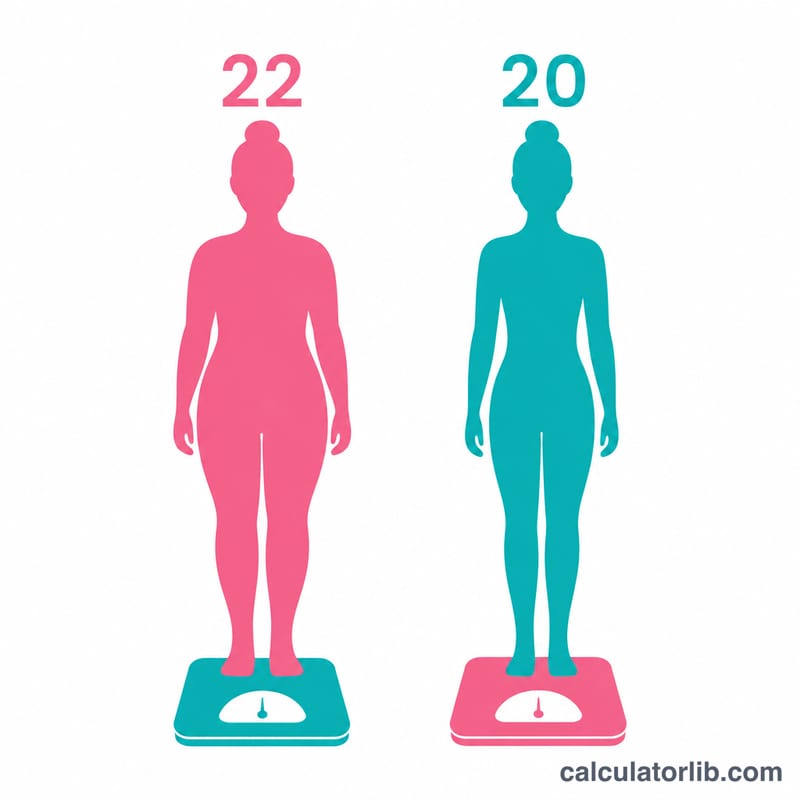
This tool converts a target Body Mass Index (BMI) into a target body weight for your height. Two common targets are used: the ideal weight (at BMI 22, often considered the healthiest point) and the beauty weight (at BMI 20, a slimmer appearance popularized on Japanese health sites). Both targets are user-editable, so you can model any BMI you like. The BMI math is universal and applies anywhere.
How to use it
Enter your height in centimeters. The calculator returns your ideal and beauty weights in kilograms, plus a reference table listing both target weights for every 5 cm from 140 cm to 200 cm. The default BMI targets are 22 (ideal) and 20 (beauty), but you can change them.
The formula explained
BMI is defined as weight in kilograms divided by height in meters squared. To find a weight for a chosen BMI, invert the formula: \(\text{weight} = \text{BMI} \times (\text{height}_m)^2\). Because the input is in centimeters, divide by 100 first, then square. A frequent mistake is squaring centimeters directly — always convert to meters.
$$\text{Weight} = \text{BMI} \times \left(\frac{\text{Height (cm)}}{100}\right)^2$$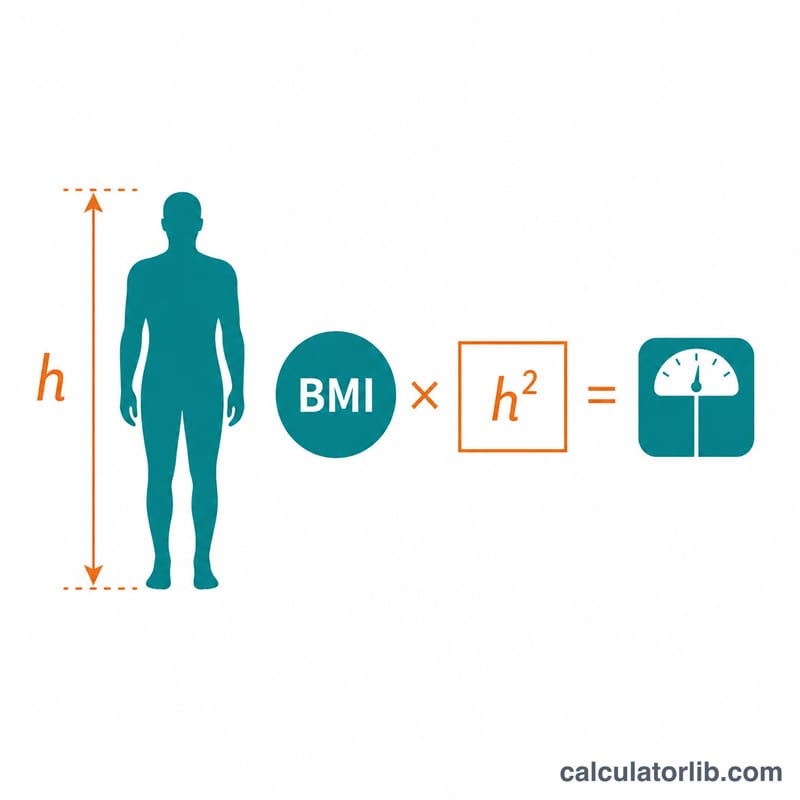
Worked example
For a height of 170 cm: \(\text{height}_m = 1.70\), and \(1.70^2 = 2.89\). Ideal weight:
$$W_{\text{ideal}} = 22 \times 2.89 = 63.58 \text{ kg} \approx 63.6 \text{ kg}$$Beauty weight:
$$W_{\text{beauty}} = 20 \times 2.89 = 57.80 \text{ kg} \approx 57.8 \text{ kg}$$BMI Categories and Normal Range
Body Mass Index (BMI) is calculated as weight in kilograms divided by height in metres squared: \(\text{BMI} = \frac{ {\text{weight (kg)}}}{ {\text{height (m)}}^2}\). This calculator reverses that formula to find the weight that corresponds to a chosen BMI at your height.
WHO adult classification
The World Health Organization (WHO) classifies adult BMI as follows:
| Category | BMI (kg/m²) |
|---|---|
| Underweight | Below 18.5 |
| Normal range | 18.5 to 24.9 |
| Overweight | 25 to 29.9 |
| Obese | 30 and above |
Japan (JASSO) criteria
The Japan Society for the Study of Obesity (JASSO) uses different cut-offs for Japan. Under its criteria, a BMI of 25 or above is classed as obese, and 18.5 to under 25 is considered normal. The WHO's "overweight" and "obese" distinction at 30 is therefore not used in the same way in Japan. Check which standard applies to your country or health system.
Where BMI 20 and 22 fall
Both BMI 20 (beauty weight) and BMI 22 (ideal weight) lie within the WHO normal range of 18.5 to 24.9, and also within the JASSO normal range. These categories are population-level screening tools. They describe groups of people, not a verdict on any one individual's health.
Interpreting Your Ideal and Beauty Weight
Both results are BMI-derived reference points, not personal targets. They show what weight would give a particular BMI at your height; they do not say what you should weigh.
- Ideal weight (BMI 22): In Japan, BMI 22 is used as the "standard weight". It is linked to the lowest disease incidence in Japanese epidemiological data. It is a statistical reference for populations, not a guarantee of health for an individual.
- Beauty weight (BMI 20): This is a cosmetic reference rather than a medical one. It sits close to the lower end of the normal range (18.5), so it leaves a smaller margin above the underweight threshold than BMI 22 does.
Limitations of BMI
BMI uses only height and weight. It does not account for muscle mass, age, sex, or body frame. Two people of the same height and weight can have very different body composition, and the same BMI can mean different things for athletes, older adults, or people with different builds.
The reference table is useful for seeing how the two weights change across heights from 140 to 200 cm. For questions about your own weight or health, consult a healthcare professional. This is general information, not medical advice.
FAQ
Is BMI 22 really "ideal"? BMI 22 sits near the center of the normal range (18.5 to under 25) and is widely cited as the point of lowest health risk, but individual factors matter.
What does the beauty weight mean? It is simply the weight at a lower BMI (20), giving a slimmer look. It is a cosmetic reference, not a medical recommendation.
Can I use other BMI values? Yes. Both targets are editable, so you can compute weight for any positive BMI.