
What This Calculator Does
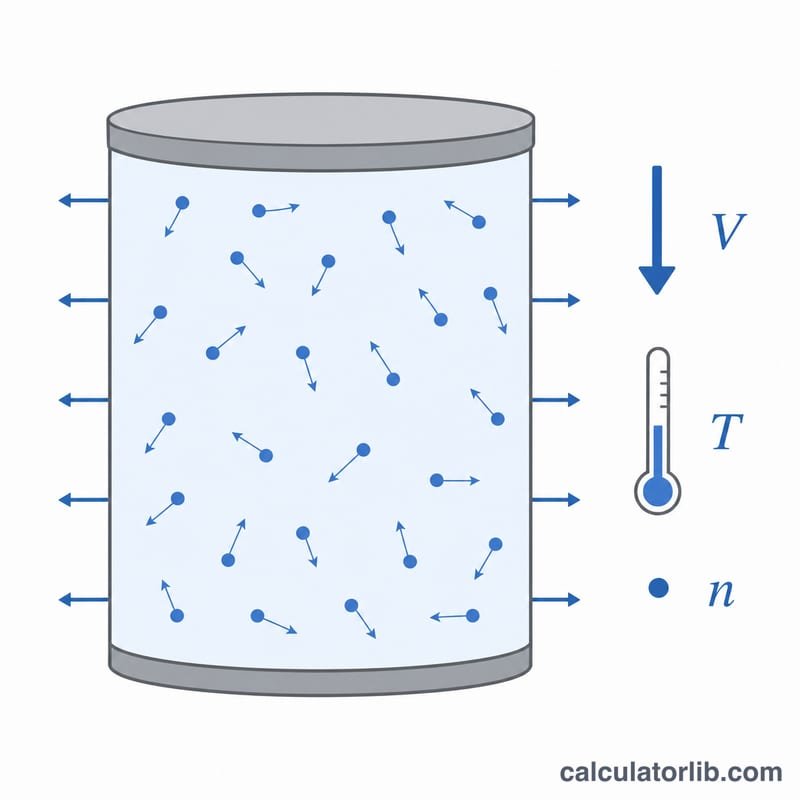
The Ideal Gas Pressure Calculator solves the ideal gas law for pressure. Given the amount of gas (in moles), the absolute temperature (in kelvin), and the container volume (in liters), it returns the pressure exerted by the gas in both atmospheres and pascals. It is a universal physics and chemistry tool with no country-specific assumptions.
How to Use It
Enter three values: the number of moles of gas (n), the temperature in kelvin (T), and the volume in liters (V). Click calculate and the tool applies \(P = nRT/V\). Remember that temperature must be absolute (kelvin), so convert from Celsius by adding 273.15.
The Formula Explained
The ideal gas law is \(PV = nRT\). Rearranging for pressure gives $$P = \frac{nRT}{V}.$$ Here \(R\) is the universal gas constant, equal to 0.082057 L\(\cdot\)atm/(mol\(\cdot\)K) when pressure is in atmospheres and volume in liters. The result is then converted to pascals by multiplying by 101,325 (the number of pascals in one atmosphere).
Worked Example
Suppose you have 2 moles of an ideal gas at 300 K confined in a 10 L container. Then $$P = \frac{2 \times 0.082057 \times 300}{10} = \frac{49.2342}{10} = 4.92342 \text{ atm},$$ which is about 498,856 Pa. That is roughly 4.9 times normal atmospheric pressure.
FAQ
Why must temperature be in kelvin? The gas law assumes pressure and volume are proportional to absolute temperature. Using Celsius would give wrong or even negative results.
What units does the result use? The primary result is in atmospheres (atm); a secondary row converts it to pascals (Pa). 1 atm = 101,325 Pa.
Is real gas behavior accounted for? No. This uses the ideal gas model, which is accurate for many gases at moderate temperatures and low to moderate pressures but deviates near condensation or very high pressure.