
What Is the Pendulum Frequency Calculator?
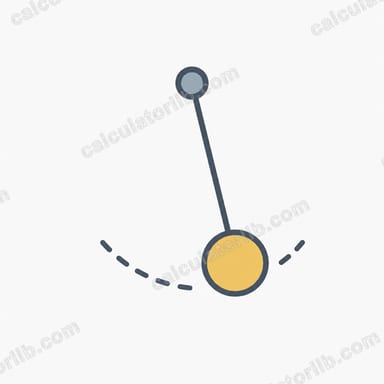
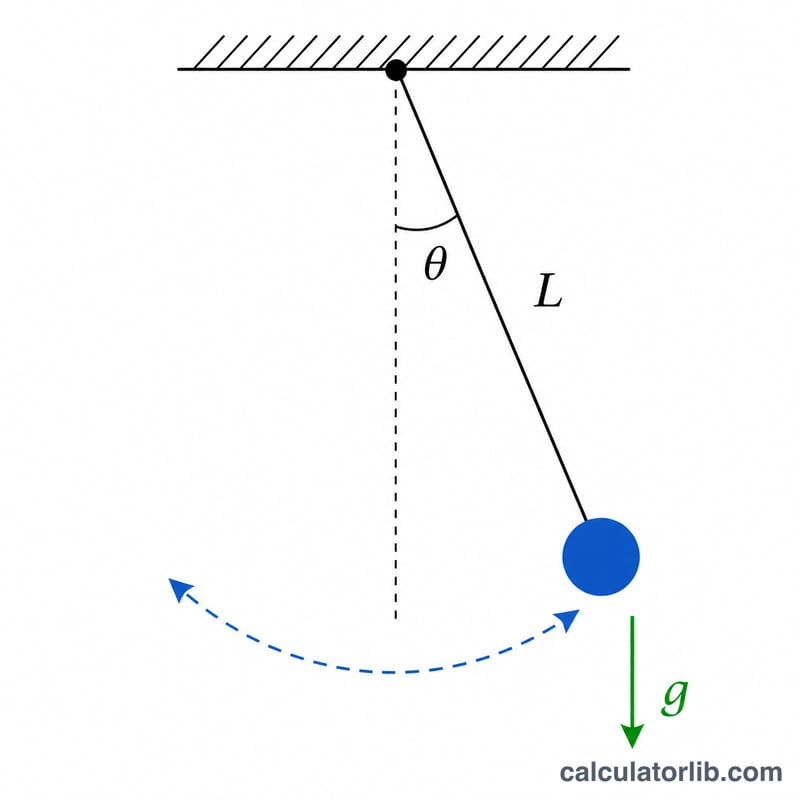
This tool computes the natural oscillation frequency of a simple pendulum — a point mass on a massless string swinging under gravity. It uses the small-angle approximation, which is accurate for swing angles up to about 15°. Enter the pendulum length and the local gravitational acceleration to get the frequency in hertz, along with the period and angular frequency.
How to Use It
Enter the pendulum length L in metres and the gravitational acceleration g in metres per second squared (Earth's surface is about 9.81 m/s²). The calculator returns:
- Frequency f — cycles per second (Hz)
- Period T — seconds per cycle (1/f)
- Angular frequency ω — radians per second (2πf)
The Formula Explained
The frequency of a simple pendulum is:
$$f = \frac{1}{2\pi}\sqrt{\frac{\text{Gravity }g}{\text{Length }L}}$$
Notice the frequency depends only on length and gravity — not on the mass of the bob or (for small angles) the swing amplitude. A longer pendulum swings more slowly, giving a lower frequency, while stronger gravity speeds it up.
Worked Example
For a 1-metre pendulum on Earth (g = 9.81 m/s²):
$$f = \frac{1}{2\pi}\sqrt{\frac{9.81}{1}} = 0.15915 \times 3.1321 \approx 0.4985\ \text{Hz}$$ The period is \(T = 1 / 0.4985 \approx 2.006\) seconds — close to the famous "seconds pendulum" that takes about one second per half-swing.
FAQ
Does mass affect the frequency? No. For an ideal simple pendulum the mass cancels out; only length and gravity matter.
Why must the angle be small? The formula linearises the restoring force. For large swings the true period grows slightly, so this estimate is best for angles below ~15°.
What gravity value should I use? Use 9.81 m/s² for typical Earth-surface problems, or the local value if you need higher precision (gravity varies slightly with latitude and altitude).