
What Is Natural Frequency?
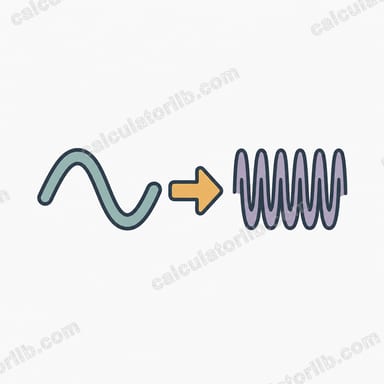
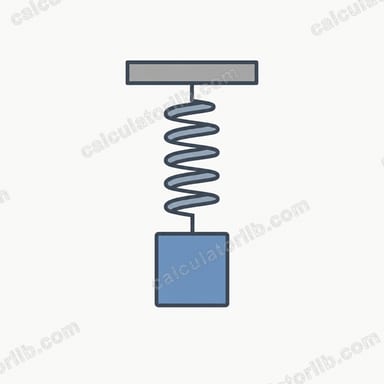
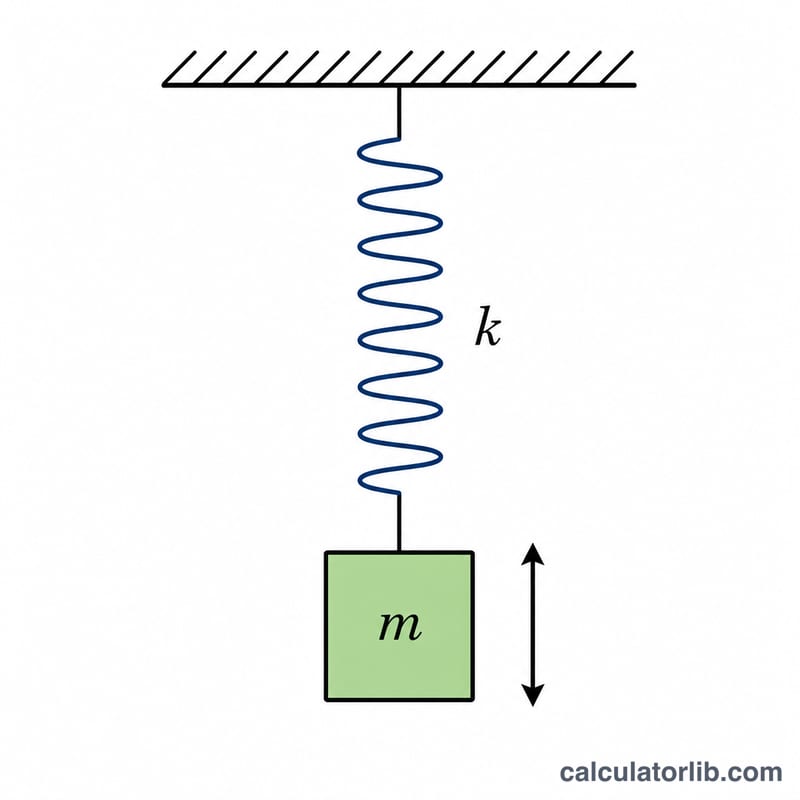
The natural frequency is the rate at which a system oscillates when displaced from equilibrium and released, with no external driving force or damping. For a simple spring-mass system, it depends only on the spring stiffness k and the attached mass m. Understanding natural frequency is essential in mechanical and structural engineering because driving a system near this frequency causes resonance, which can amplify vibrations and lead to failure.
How to Use This Calculator
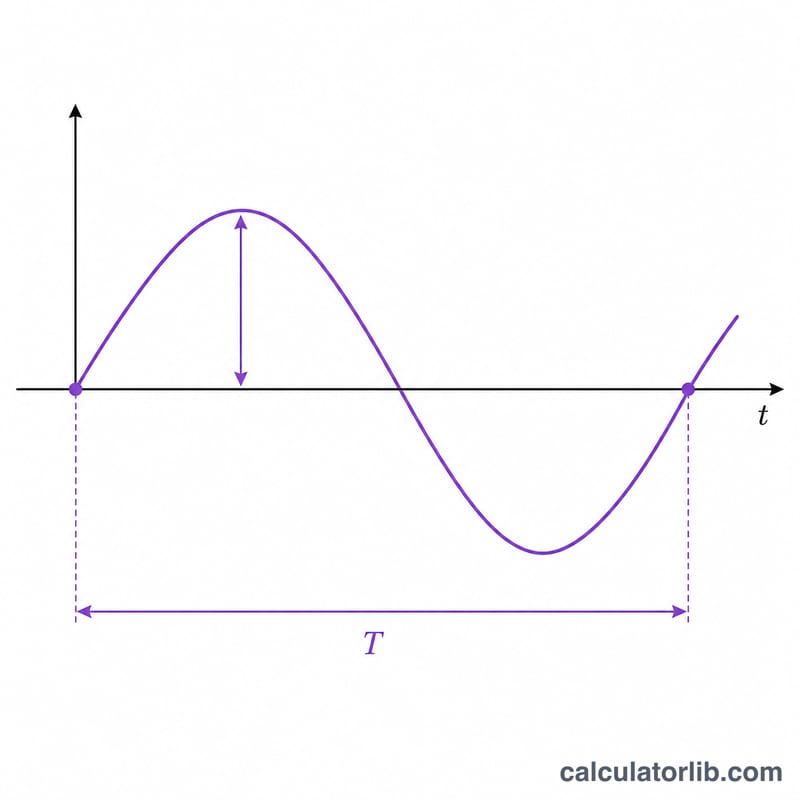
Enter the spring stiffness k in newtons per metre (N/m) and the mass m in kilograms (kg). The calculator returns the natural frequency in hertz (Hz), the angular frequency \(\omega\) in radians per second, and the oscillation period \(T\) in seconds. Stiffer springs and lighter masses produce higher natural frequencies.
The Formula Explained
The undamped natural frequency is given by:
$$f = \frac{1}{2\pi}\sqrt{\dfrac{\text{Stiffness }k}{\text{Mass }m}}$$Here \(\sqrt{k/m}\) is the angular natural frequency \(\omega\) in rad/s, and dividing by \(2\pi\) converts it to ordinary frequency in cycles per second (Hz). The period is simply \(T = 1 / f\).
Worked Example
Suppose a spring with stiffness \(k = 1000\) N/m holds a mass \(m = 2\) kg. Then $$\omega = \sqrt{1000 / 2} = \sqrt{500} \approx 22.3607 \text{ rad/s}.$$ The natural frequency is $$f = \frac{22.3607}{2\pi} \approx 3.5588 \text{ Hz},$$ and the period is $$T = \frac{1}{3.5588} \approx 0.281 \text{ s}.$$
FAQ
Does damping change the natural frequency? Light damping lowers the oscillation frequency slightly (the damped natural frequency), but this calculator gives the undamped value, which is the standard reference.
What units should I use? Use SI units: \(k\) in N/m and \(m\) in kg to get frequency directly in Hz.
Why is resonance dangerous? When an external force oscillates at the natural frequency, energy accumulates each cycle, causing large amplitude vibrations that can damage structures and machinery.